2YJG | pdb_00002yjg

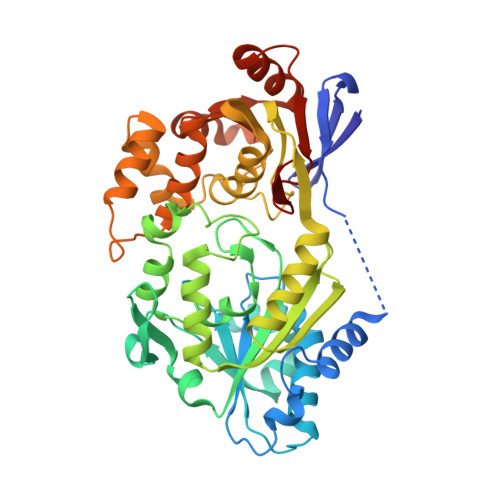
Structure of the lactate racemase apoprotein from Thermoanaerobacterium thermosaccharolyticum


Experimental Data Snapshot

  • Method: X-RAY DIFFRACTION
  • Resolution: 1.80 Å
  • R-Value Free: 
    0.229 (Depositor), 0.232 (DCC) 
  • R-Value Work: 
    0.182 (Depositor), 0.186 (DCC) 
  • R-Value Observed: 
    0.184 (Depositor) 

Starting Model: experimental
View more details

wwPDB Validation 3D Report Full Report

Validation slider image for 2YJG

This is version 1.3 of the entry. See complete history

Literature

Lactate Racemase is a Nickel-Dependent Enzyme Activated by a Widespread Maturation System.

Desguin, B.Goffin, P.Viaene, E.Kleerebezem, M.Martin-Diaconescu, V.Maroney, M.J.Declercq, J.Soumillion, P.Hols, P.

(2014) Nat Commun 5: 3615

  • DOI: https://doi.org/10.1038/ncomms4615
  • Primary Citation Related Structures: 
    2YJG

  • PubMed Abstract: 

    Racemases catalyse the inversion of stereochemistry in biological molecules, giving the organism the ability to use both isomers. Among them, lactate racemase remains unexplored due to its intrinsic instability and lack of molecular characterization. Here we determine the genetic basis of lactate racemization in Lactobacillus plantarum. We show that, unexpectedly, the racemase is a nickel-dependent enzyme with a novel α/β fold. In addition, we decipher the process leading to an active enzyme, which involves the activation of the apo-enzyme by a single nickel-containing maturation protein that requires preactivation by two other accessory proteins. Genomic investigations reveal the wide distribution of the lactate racemase system among prokaryotes, showing the high significance of both lactate enantiomers in carbon metabolism. The even broader distribution of the nickel-based maturation system suggests a function beyond activation of the lactate racemase and possibly linked with other undiscovered nickel-dependent enzymes.


  • Organizational Affiliation
    • Institute of Life Sciences, Université catholique de Louvain, Place Croix du Sud 5, 1348 Louvain-La-Neuve, Belgium.

Macromolecule Content 

  • Total Structure Weight: 96.85 kDa 
  • Atom Count: 7,076 
  • Modeled Residue Count: 835 
  • Deposited Residue Count: 872 
  • Unique protein chains: 1

Macromolecules

Find similar proteins by:|  3D Structure
Entity ID: 1
MoleculeChains  Sequence LengthOrganismDetailsImage
LACTATE RACEMASE APOPROTEIN
A, B
436Thermoanaerobacterium thermosaccharolyticum DSM 571Mutation(s): 0 
EC: 5.1.2.1
UniProt
Find proteins for D9TQ02 (Thermoanaerobacterium thermosaccharolyticum (strain ATCC 7956 / DSM 571 / NCIMB 9385 / NCA 3814 / NCTC 13789 / WDCM 00135 / 2032))
Explore D9TQ02 
Go to UniProtKB:  D9TQ02
Entity Groups
Sequence Clusters30% Identity50% Identity70% Identity90% Identity95% Identity100% Identity
UniProt GroupD9TQ02
Sequence Annotations
Expand
Reference Sequence

Small Molecules

Ligands 3 Unique
IDChains Name / Formula / InChI Key2D Diagram3D Interactions
SO4

Query on SO4


Download:Ideal Coordinates CCD File
D [auth A],
E [auth A],
G [auth B],
H [auth B],
I [auth B]
SULFATE ION
O4 S
QAOWNCQODCNURD-UHFFFAOYSA-L
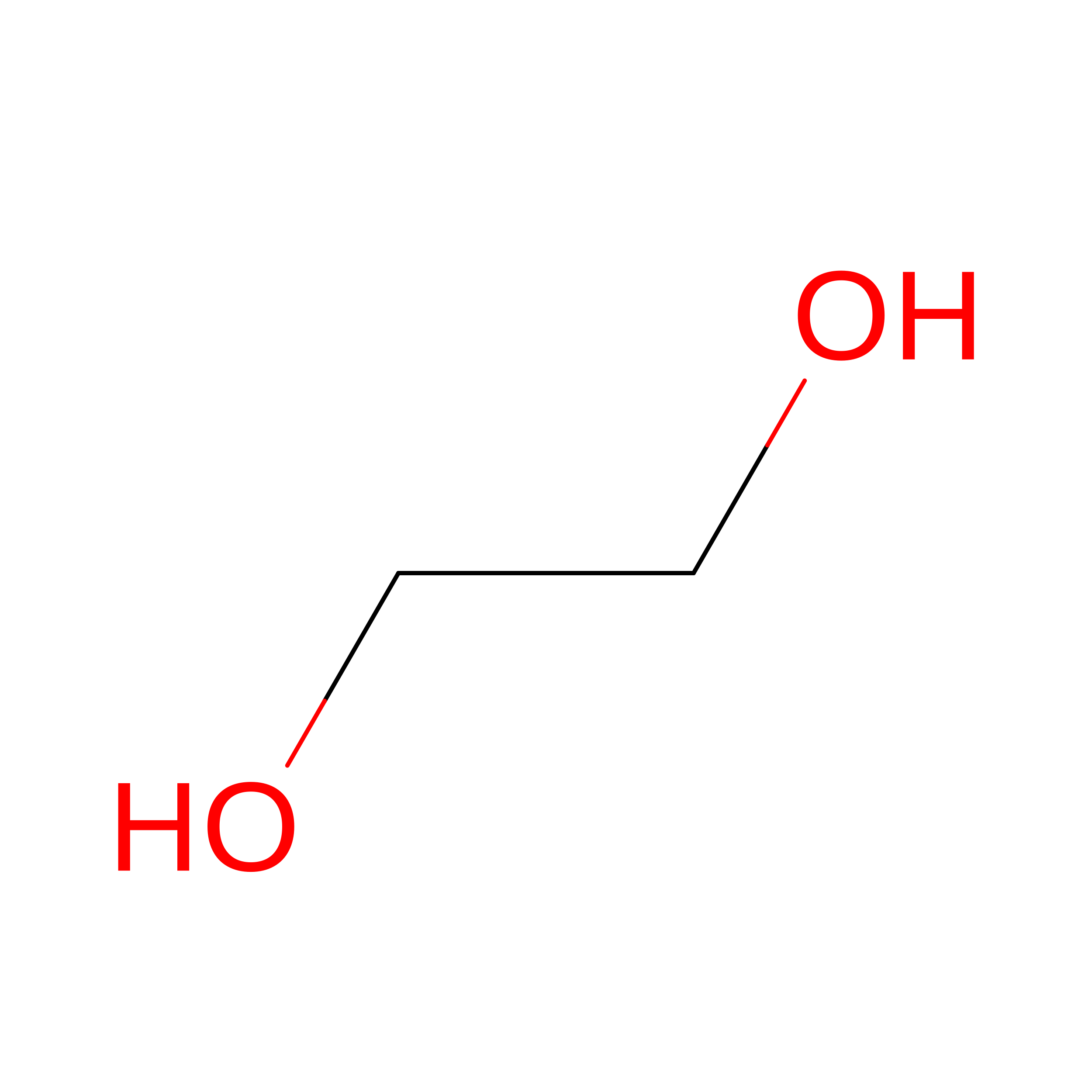
EDO

Query on EDO


Download:Ideal Coordinates CCD File
F [auth A]1,2-ETHANEDIOL
C2 H6 O2
LYCAIKOWRPUZTN-UHFFFAOYSA-N
MG

Query on MG


Download:Ideal Coordinates CCD File
C [auth A]MAGNESIUM ION
Mg
JLVVSXFLKOJNIY-UHFFFAOYSA-N

Experimental Data & Validation

Experimental Data

  • Method: X-RAY DIFFRACTION
  • Resolution: 1.80 Å
  • R-Value Free:  0.229 (Depositor), 0.232 (DCC) 
  • R-Value Work:  0.182 (Depositor), 0.186 (DCC) 
  • R-Value Observed: 0.184 (Depositor) 
Space Group: P 21 21 2
Unit Cell:
Length ( Å )Angle ( ˚ )
a = 78.41α = 90
b = 223.25β = 90
c = 46.14γ = 90
Software Package:
Software NamePurpose
REFMACrefinement
XDSdata reduction
XSCALEdata scaling
Auto-Rickshawphasing

Structure Validation

View Full Validation Report


Entry History 

Deposition Data

Revision History  (Full details and data files)

  • Version 1.0: 2012-05-30
    Type: Initial release
  • Version 1.1: 2014-07-30
    Changes: Database references
  • Version 1.2: 2019-05-08
    Changes: Data collection, Experimental preparation, Other
  • Version 1.3: 2024-05-01
    Changes: Data collection, Database references, Derived calculations, Other, Refinement description