2YE0 | pdb_00002ye0

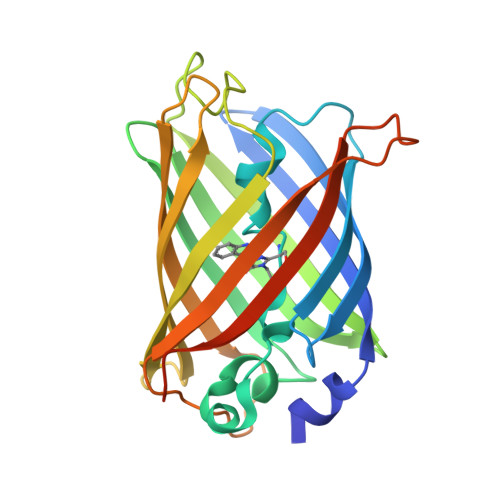
X-ray structure of the cyan fluorescent protein mTurquoise (K206A mutant)


Experimental Data Snapshot

  • Method: X-RAY DIFFRACTION
  • Resolution: 1.47 Å
  • R-Value Free: 
    0.185 (Depositor), 0.186 (DCC) 
  • R-Value Work: 
    0.141 (Depositor), 0.147 (DCC) 
  • R-Value Observed: 
    0.144 (Depositor) 

Starting Model: experimental
View more details

wwPDB Validation 3D Report Full Report

Validation slider image for 2YE0

This is version 1.6 of the entry. See complete history

Literature

Structure-Guided Evolution of Cyan Fluorescent Proteins Towards a Quantum Yield of 93%

Goedhart, J.von Stetten, D.Noirclerc-Savoye, M.Lelimousin, M.Joosen, L.Hink, M.A.van Weeren, L.Gadella, T.W.J.Royant, A.

(2012) Nat Commun 3: 751

  • DOI: https://doi.org/10.1038/ncomms1738
  • Primary Citation Related Structures: 
    2YDZ, 2YE0, 3ZTF

  • PubMed Abstract: 

    Cyan variants of green fluorescent protein are widely used as donors in Förster resonance energy transfer experiments. The popular, but modestly bright, Enhanced Cyan Fluorescent Protein (ECFP) was sequentially improved into the brighter variants Super Cyan Fluorescent Protein 3A (SCFP3A) and mTurquoise, the latter exhibiting a high-fluorescence quantum yield and a long mono-exponential fluorescence lifetime. Here we combine X-ray crystallography and excited-state calculations to rationalize these stepwise improvements. The enhancement originates from stabilization of the seventh β-strand and the strengthening of the sole chromophore-stabilizing hydrogen bond. The structural analysis highlighted one suboptimal internal residue, which was subjected to saturation mutagenesis combined with fluorescence lifetime-based screening. This resulted in mTurquoise2, a brighter variant with faster maturation, high photostability, longer mono-exponential lifetime and the highest quantum yield measured for a monomeric fluorescent protein. Together, these properties make mTurquoise2 the preferable cyan variant of green fluorescent protein for long-term imaging and as donor for Förster resonance energy transfer to a yellow fluorescent protein.


  • Organizational Affiliation
    • Swammerdam Institute for Life Sciences, Section of Molecular Cytology, van Leeuwenhoek Centre for Advanced Microscopy, University of Amsterdam, 1098 XH Amsterdam, The Netherlands.

Macromolecule Content 

  • Total Structure Weight: 27.67 kDa 
  • Atom Count: 1,994 
  • Modeled Residue Count: 226 
  • Deposited Residue Count: 243 
  • Unique protein chains: 1

Macromolecules

Find similar proteins by:|  3D Structure
Entity ID: 1
MoleculeChains  Sequence LengthOrganismDetailsImage
GREEN FLUORESCENT PROTEIN243Aequorea victoriaMutation(s): 9 
UniProt
Find proteins for P42212 (Aequorea victoria)
Explore P42212 
Go to UniProtKB:  P42212
Entity Groups
Sequence Clusters30% Identity50% Identity70% Identity90% Identity95% Identity100% Identity
UniProt GroupP42212
Sequence Annotations
Expand
Reference Sequence

Small Molecules

Modified Residues  1 Unique
IDChains TypeFormula2D DiagramParent
SWG
Query on SWG
A
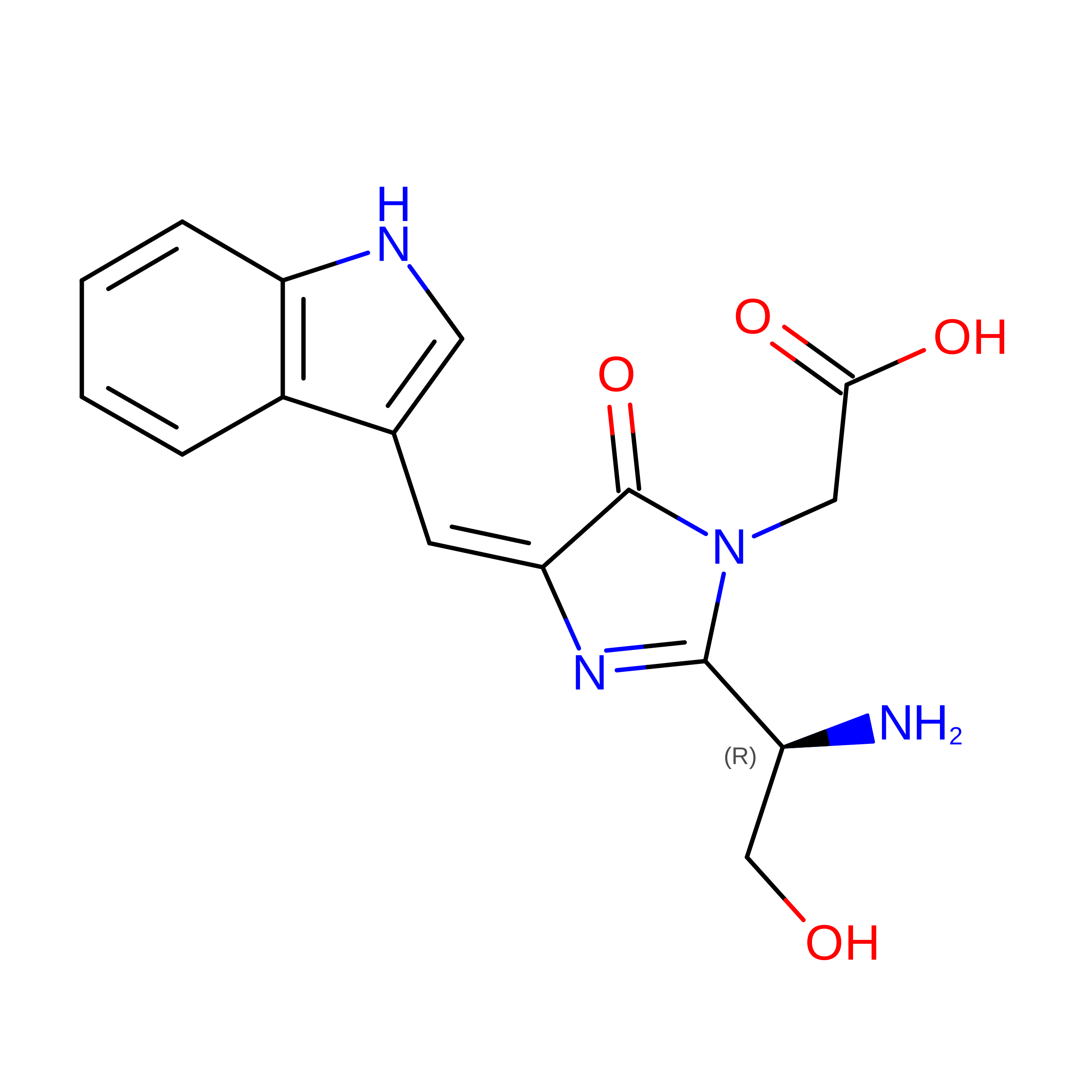
L-PEPTIDE LINKINGC16 H16 N4 O4SER, TRP, GLY

Experimental Data & Validation

Experimental Data

  • Method: X-RAY DIFFRACTION
  • Resolution: 1.47 Å
  • R-Value Free:  0.185 (Depositor), 0.186 (DCC) 
  • R-Value Work:  0.141 (Depositor), 0.147 (DCC) 
  • R-Value Observed: 0.144 (Depositor) 
Space Group: P 21 21 21
Unit Cell:
Length ( Å )Angle ( ˚ )
a = 50.984α = 90
b = 62.32β = 90
c = 70.366γ = 90
Software Package:
Software NamePurpose
REFMACrefinement
XDSdata reduction
SCALAdata scaling
REFMACphasing

Structure Validation

View Full Validation Report


Entry History 

Deposition Data

Revision History  (Full details and data files)

  • Version 1.0: 2012-03-21
    Type: Initial release
  • Version 1.1: 2012-04-04
    Changes: Other
  • Version 1.2: 2017-09-06
    Changes: Data collection
  • Version 1.3: 2017-12-20
    Changes: Database references
  • Version 1.4: 2019-10-23
    Changes: Data collection, Database references, Derived calculations, Other
  • Version 1.5: 2023-12-20
    Changes: Data collection, Database references, Derived calculations, Refinement description
  • Version 1.6: 2024-11-20
    Changes: Structure summary