2XP2 | pdb_00002xp2

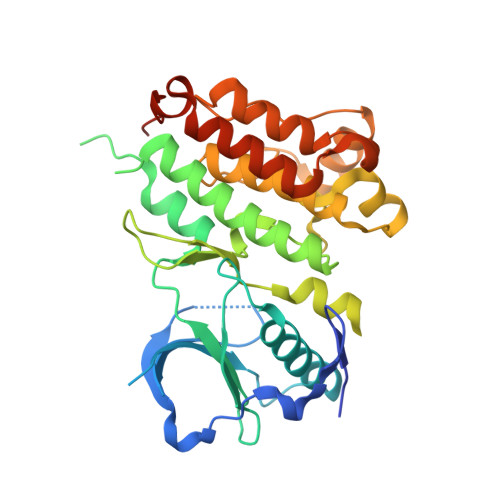
Structure of the Human Anaplastic Lymphoma Kinase in Complex with Crizotinib (PF-02341066)


Experimental Data Snapshot

  • Method: X-RAY DIFFRACTION
  • Resolution: 1.90 Å
  • R-Value Free: 
    0.252 (Depositor), 0.247 (DCC) 
  • R-Value Work: 
    0.207 (Depositor), 0.204 (DCC) 
  • R-Value Observed: 
    0.207 (Depositor) 

Starting Model: experimental
View more details

wwPDB Validation 3D Report Full Report

Validation slider image for 2XP2

Ligand Structure Quality Assessment 


This is version 1.4 of the entry. See complete history

Literature

Structure Based Drug Design of Crizotinib (Pf-02341066), a Potent and Selective Dual Inhibitor of Mesenchymal-Epithelial Transition Factor (C-met) Kinase and Anaplastic Lymphoma Kinase (Alk).

Cui, J.J.Tran-Dube, M.Shen, H.Nambu, M.Kung, P.P.Pairish, M.Jia, L.Meng, J.Funk, L.Botrous, I.Mctigue, M.Grodsky, N.Ryan, K.Padrique, E.Alton, G.Timofeevski, S.Yamazaki, S.Li, Q.Zou, H.Christensen, J.Mroczkowski, B.Bender, S.Kania, R.S.Edwards, M.P.

(2011) J Med Chem 54: 6342

  • DOI: https://doi.org/10.1021/jm2007613
  • Primary Citation Related Structures: 
    2WGJ, 2WKM, 2XP2

  • PubMed Abstract: 

    Because of the critical roles of aberrant signaling in cancer, both c-MET and ALK receptor tyrosine kinases are attractive oncology targets for therapeutic intervention. The cocrystal structure of 3 (PHA-665752), bound to c-MET kinase domain, revealed a novel ATP site environment, which served as the target to guide parallel, multiattribute drug design. A novel 2-amino-5-aryl-3-benzyloxypyridine series was created to more effectively make the key interactions achieved with 3. In the novel series, the 2-aminopyridine core allowed a 3-benzyloxy group to reach into the same pocket as the 2,6-dichlorophenyl group of 3 via a more direct vector and thus with a better ligand efficiency (LE). Further optimization of the lead series generated the clinical candidate crizotinib (PF-02341066), which demonstrated potent in vitro and in vivo c-MET kinase and ALK inhibition, effective tumor growth inhibition, and good pharmaceutical properties.


  • Organizational Affiliation
    • La Jolla Laboratories, Pfizer Worldwide Research and Development, San Diego, California 92121, USA. jean.cui@pfizer.com

Macromolecule Content 

  • Total Structure Weight: 37.36 kDa 
  • Atom Count: 2,459 
  • Modeled Residue Count: 289 
  • Deposited Residue Count: 327 
  • Unique protein chains: 1

Macromolecules

Find similar proteins by:|  3D Structure
Entity ID: 1
MoleculeChains  Sequence LengthOrganismDetailsImage
TYROSINE-PROTEIN KINASE RECEPTOR327Homo sapiensMutation(s): 0 
EC: 2.7.10.1
UniProt & NIH Common Fund Data Resources
Find proteins for Q9UM73 (Homo sapiens)
Explore Q9UM73 
Go to UniProtKB:  Q9UM73
PHAROS:  Q9UM73
GTEx:  ENSG00000171094 
Entity Groups
Sequence Clusters30% Identity50% Identity70% Identity90% Identity95% Identity100% Identity
UniProt GroupQ9UM73
Sequence Annotations
Expand
Reference Sequence

Small Molecules

Ligands 1 Unique
IDChains Name / Formula / InChI Key2D Diagram3D Interactions
VGH

Query on VGH


Download:Ideal Coordinates CCD File
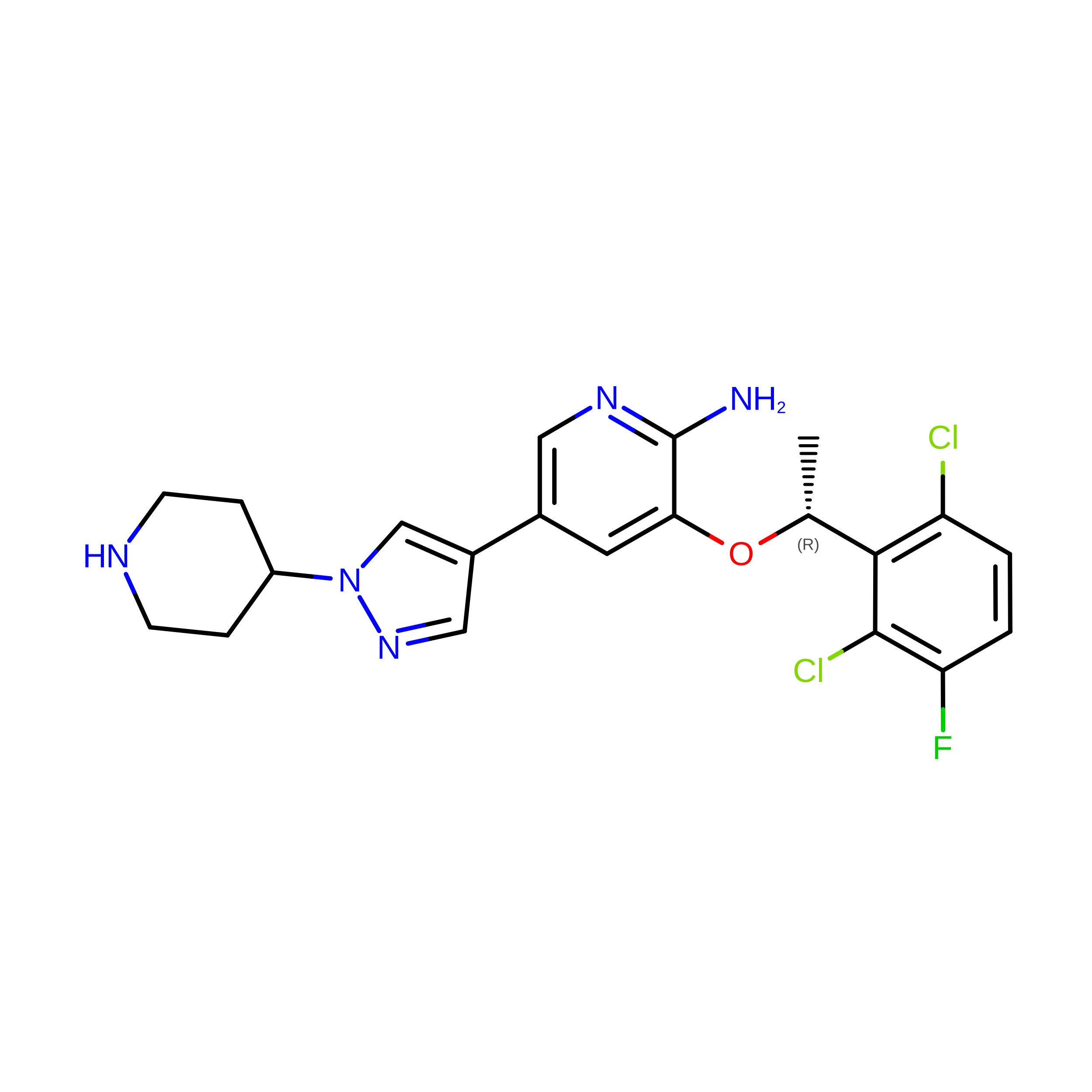
B [auth A]3-[(1R)-1-(2,6-dichloro-3-fluorophenyl)ethoxy]-5-(1-piperidin-4-yl-1H-pyrazol-4-yl)pyridin-2-amine
C21 H22 Cl2 F N5 O
KTEIFNKAUNYNJU-GFCCVEGCSA-N

Experimental Data & Validation

Experimental Data

  • Method: X-RAY DIFFRACTION
  • Resolution: 1.90 Å
  • R-Value Free:  0.252 (Depositor), 0.247 (DCC) 
  • R-Value Work:  0.207 (Depositor), 0.204 (DCC) 
  • R-Value Observed: 0.207 (Depositor) 
Space Group: P 21 21 21
Unit Cell:
Length ( Å )Angle ( ˚ )
a = 51.633α = 90
b = 57.086β = 90
c = 104.709γ = 90
Software Package:
Software NamePurpose
CNSrefinement
XDSdata reduction
SCALAdata scaling
CNSphasing

Structure Validation

View Full Validation Report


Ligand Structure Quality Assessment 


Entry History 

Deposition Data

Revision History  (Full details and data files)

  • Version 1.0: 2010-09-15
    Type: Initial release
  • Version 1.1: 2011-09-28
    Changes: Database references, Structure summary, Version format compliance
  • Version 1.2: 2019-05-08
    Changes: Data collection, Experimental preparation, Other
  • Version 1.3: 2019-05-15
    Changes: Data collection, Experimental preparation
  • Version 1.4: 2023-12-20
    Changes: Data collection, Database references, Derived calculations, Other, Refinement description