2WFP | pdb_00002wfp

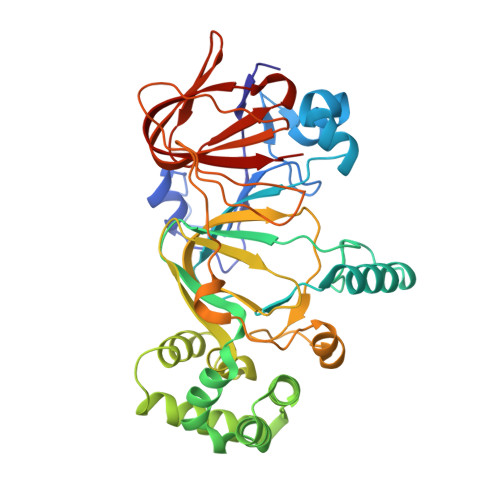
Crystal structure of mannose 6-phosphate isomerase (apo form) from Salmonella typhimurium


Experimental Data Snapshot

  • Method: X-RAY DIFFRACTION
  • Resolution: 1.67 Å
  • R-Value Free: 
    0.216 (Depositor), 0.213 (DCC) 
  • R-Value Work: 
    0.189 (Depositor), 0.187 (DCC) 
  • R-Value Observed: 
    0.190 (Depositor) 

wwPDB Validation 3D Report Full Report

Validation slider image for 2WFP

This is version 1.2 of the entry. See complete history

Literature

Crystal Structures of Mannose 6-Phosphate Isomerase from Salmonella Typhimurium Bound to Metal Atoms and Substrate: Implications for Catalytic Mechanism

Sagurthi, S.R.Gowda, G.Savithri, H.S.Murthy, M.R.N.

(2009) Acta Crystallogr D Biol Crystallogr 65: 724

  • DOI: https://doi.org/10.1107/S0907444909013328
  • Primary Citation Related Structures: 
    2WFP

  • PubMed Abstract: 

    Mannose-6-phosphate isomerase (MPI) catalyzes the interconversion of mannose 6-phosphate and fructose 6-phosphate. X-ray crystal structures of MPI from Salmonella typhimurium in the apo form (with no metal bound) and in the holo form (with bound Zn2+) and two other structures with yttrium bound at an inhibitory site and complexed with Zn2+ and fructose 6-phosphate (F6P) were determined in order to gain insights into the structure and the isomerization mechanism. Isomerization involves acid/base catalysis with proton transfer between the C1 and C2 atoms of the substrate. His99, Lys132, His131 and Asp270 are close to the substrate and are likely to be the residues involved in proton transfer. The interactions observed at the active site suggest that the ring-opening step is probably catalyzed by His99 and Asp270. An active-site loop consisting of residues 130-133 undergoes conformational changes upon substrate binding. Zn2+ binding induces structural order in the loop consisting of residues 50-54. The metal atom appears to play a role in substrate binding and is probably also important for maintaining the architecture of the active site. Isomerization probably follows the previously suggested cis-enediol mechanism.


  • Organizational Affiliation
    • Molecular Biophysics Unit, Indian Institute of Science, Bangalore 560 012, India.

Macromolecule Content 

  • Total Structure Weight: 43.91 kDa 
  • Atom Count: 3,460 
  • Modeled Residue Count: 389 
  • Deposited Residue Count: 394 
  • Unique protein chains: 1

Macromolecules

Find similar proteins by:|  3D Structure
Entity ID: 1
MoleculeChains  Sequence LengthOrganismDetailsImage
MANNOSE-6-PHOSPHATE ISOMERASE394Salmonella enterica subsp. enterica serovar Typhimurium str. LT2Mutation(s): 0 
EC: 5.3.1.8
UniProt
Find proteins for P25081 (Salmonella typhimurium (strain LT2 / SGSC1412 / ATCC 700720))
Explore P25081 
Go to UniProtKB:  P25081
Entity Groups
Sequence Clusters30% Identity50% Identity70% Identity90% Identity95% Identity100% Identity
UniProt GroupP25081
Sequence Annotations
Expand
Reference Sequence

Small Molecules

Ligands 1 Unique
IDChains Name / Formula / InChI Key2D Diagram3D Interactions
EDO

Query on EDO


Download:Ideal Coordinates CCD File
B [auth A]
C [auth A]
D [auth A]
E [auth A]
F [auth A]
B [auth A],
C [auth A],
D [auth A],
E [auth A],
F [auth A],
G [auth A],
H [auth A],
I [auth A],
J [auth A],
K [auth A],
L [auth A],
M [auth A],
N [auth A],
O [auth A],
P [auth A],
Q [auth A]
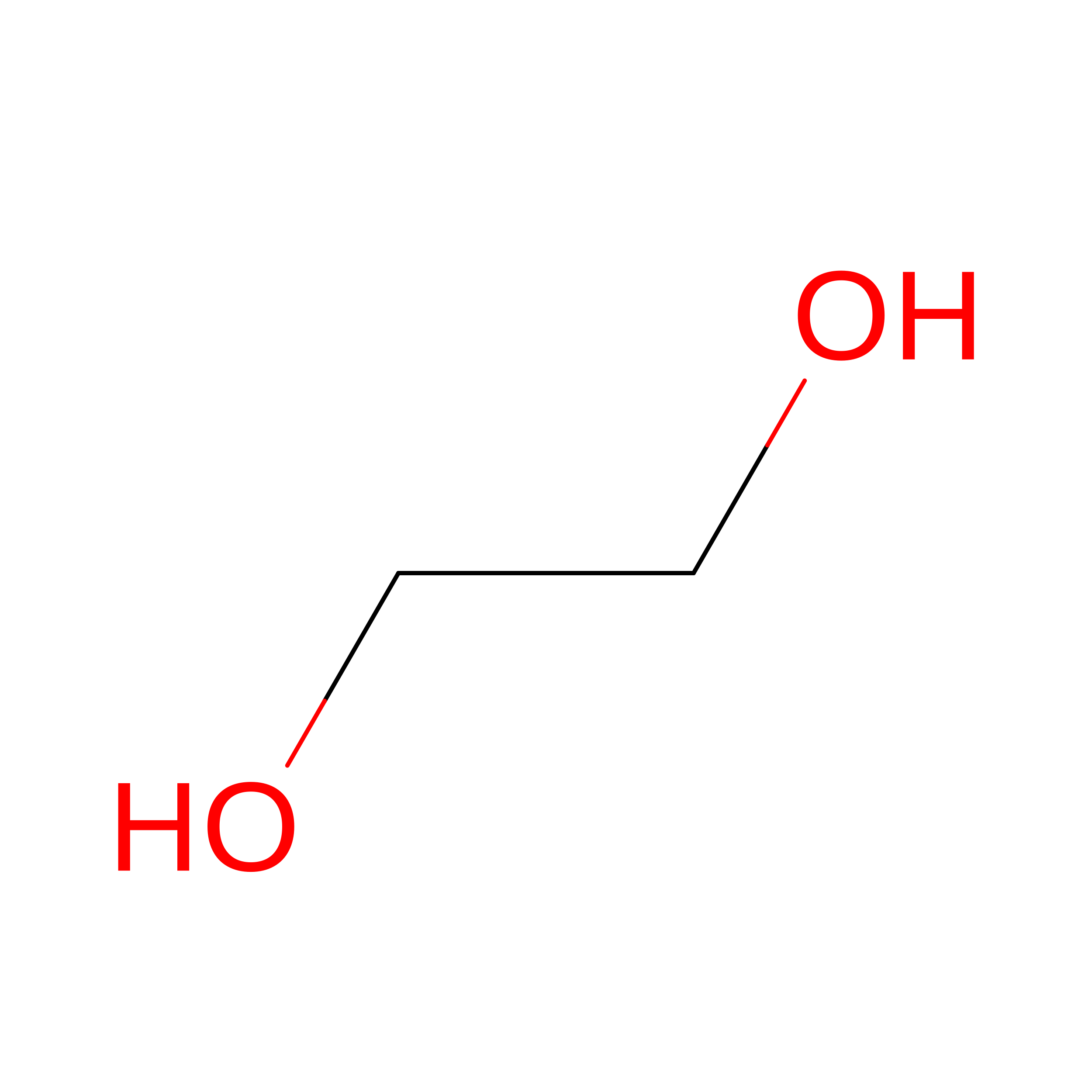
1,2-ETHANEDIOL
C2 H6 O2
LYCAIKOWRPUZTN-UHFFFAOYSA-N

Experimental Data & Validation

Experimental Data

  • Method: X-RAY DIFFRACTION
  • Resolution: 1.67 Å
  • R-Value Free:  0.216 (Depositor), 0.213 (DCC) 
  • R-Value Work:  0.189 (Depositor), 0.187 (DCC) 
  • R-Value Observed: 0.190 (Depositor) 
Space Group: P 21 21 21
Unit Cell:
Length ( Å )Angle ( ˚ )
a = 35.904α = 90
b = 92.47β = 90
c = 111.87γ = 90
Software Package:
Software NamePurpose
REFMACrefinement
DENZOdata reduction
SCALEPACKdata scaling

Structure Validation

View Full Validation Report


Entry History 

Deposition Data

Revision History  (Full details and data files)

  • Version 1.0: 2009-07-14
    Type: Initial release
  • Version 1.1: 2011-07-13
    Changes: Advisory, Version format compliance
  • Version 1.2: 2024-05-08
    Changes: Data collection, Database references, Derived calculations, Other