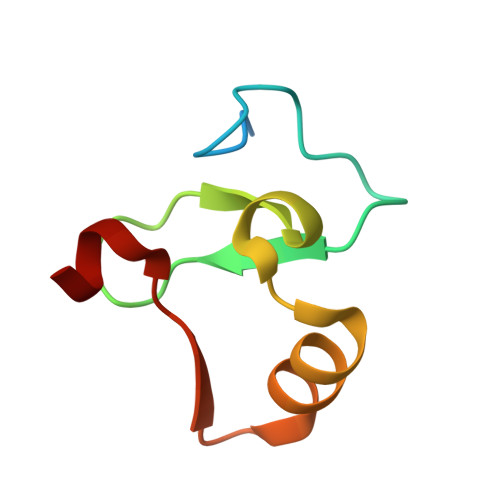
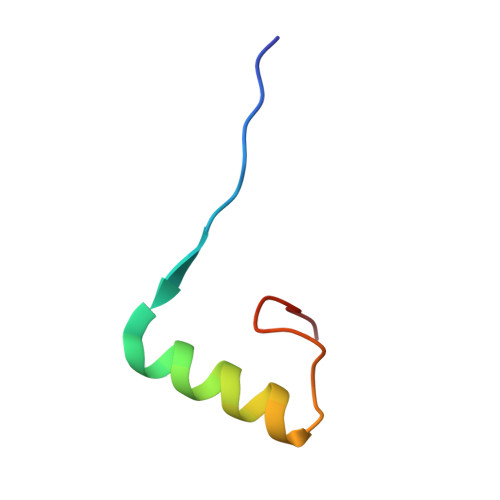
2VPB | pdb_00002vpb

Decoding of methylated histone H3 tail by the Pygo-BCL9 Wnt signaling complex


Experimental Data Snapshot

  • Method: X-RAY DIFFRACTION
  • Resolution: 1.59 Å
  • R-Value Free: 
    0.225 (Depositor), 0.223 (DCC) 
  • R-Value Work: 
    0.192 (Depositor), 0.192 (DCC) 
  • R-Value Observed: 
    0.194 (Depositor) 

Starting Model: experimental
View more details

wwPDB Validation 3D Report Full Report

Validation slider image for 2VPB

This is version 1.5 of the entry. See complete history

Literature

Decoding of Methylated Histone H3 Tail by the Pygo- Bcl9 Wnt Signaling Complex.

Fiedler, M.Sanchez-Barrena, M.J.Nekrasov, M.Mieszczanek, J.Rybin, V.Muller, J.Evans, P.Bienz, M.

(2008) Mol Cell 30: 507

  • DOI: https://doi.org/10.1016/j.molcel.2008.03.011
  • Primary Citation Related Structures: 
    2VP7, 2VPB, 2VPD, 2VPE, 2VPG

  • PubMed Abstract: 

    Pygo and BCL9/Legless transduce the Wnt signal by promoting the transcriptional activity of beta-catenin/Armadillo in normal and malignant cells. We show that human and Drosophila Pygo PHD fingers associate with their cognate HD1 domains from BCL9/Legless to bind specifically to the histone H3 tail methylated at lysine 4 (H3K4me). The crystal structures of ternary complexes between PHD, HD1, and two different H3K4me peptides reveal a unique mode of histone tail recognition: efficient histone binding requires HD1 association, and the PHD-HD1 complex binds preferentially to H3K4me2 while displaying insensitivity to methylation of H3R2. Therefore, this is a prime example of histone tail binding by a PHD finger (of Pygo) being modulated by a cofactor (BCL9/Legless). Rescue experiments in Drosophila indicate that Wnt signaling outputs depend on histone decoding. The specificity of this process provided by the Pygo-BCL9/Legless complex suggests that this complex facilitates an early step in the transition from gene silence to Wnt-induced transcription.


  • Organizational Affiliation
    • MRC Laboratory of Molecular Biology, Hills Road, Cambridge CB2 0QH, UK.

Macromolecule Content 

  • Total Structure Weight: 10.92 kDa 
  • Atom Count: 812 
  • Modeled Residue Count: 92 
  • Deposited Residue Count: 100 
  • Unique protein chains: 2

Macromolecules

Find similar proteins by:|  3D Structure
Entity ID: 1
MoleculeChains  Sequence LengthOrganismDetailsImage
PYGOPUS HOMOLOG 165Homo sapiensMutation(s): 0 
UniProt & NIH Common Fund Data Resources
Find proteins for Q9Y3Y4 (Homo sapiens)
Explore Q9Y3Y4 
Go to UniProtKB:  Q9Y3Y4
PHAROS:  Q9Y3Y4
GTEx:  ENSG00000171016 
Entity Groups
Sequence Clusters30% Identity50% Identity70% Identity90% Identity95% Identity100% Identity
UniProt GroupQ9Y3Y4
Sequence Annotations
Expand
Reference Sequence
Find similar proteins by:|  3D Structure
Entity ID: 2
MoleculeChains  Sequence LengthOrganismDetailsImage
B-CELL CLL/LYMPHOMA 9 PROTEIN35Homo sapiensMutation(s): 0 
UniProt & NIH Common Fund Data Resources
Find proteins for O00512 (Homo sapiens)
Explore O00512 
Go to UniProtKB:  O00512
PHAROS:  O00512
GTEx:  ENSG00000116128 
Entity Groups
Sequence Clusters30% Identity50% Identity70% Identity90% Identity95% Identity100% Identity
UniProt GroupO00512
Sequence Annotations
Expand
Reference Sequence

Experimental Data & Validation

Experimental Data

  • Method: X-RAY DIFFRACTION
  • Resolution: 1.59 Å
  • R-Value Free:  0.225 (Depositor), 0.223 (DCC) 
  • R-Value Work:  0.192 (Depositor), 0.192 (DCC) 
  • R-Value Observed: 0.194 (Depositor) 
Space Group: I 2 2 2
Unit Cell:
Length ( Å )Angle ( ˚ )
a = 32.1α = 90
b = 79.47β = 90
c = 91.83γ = 90
Software Package:
Software NamePurpose
REFMACrefinement
MOSFLMdata reduction
SCALAdata scaling
PHASERphasing

Structure Validation

View Full Validation Report


Entry History 

Deposition Data

Revision History  (Full details and data files)

  • Version 1.0: 2008-06-17
    Type: Initial release
  • Version 1.1: 2011-05-08
    Changes: Version format compliance
  • Version 1.2: 2011-07-13
    Changes: Version format compliance
  • Version 1.3: 2019-05-08
    Changes: Data collection, Experimental preparation, Other
  • Version 1.4: 2019-05-29
    Changes: Data collection, Experimental preparation
  • Version 1.5: 2023-12-13
    Changes: Data collection, Database references, Derived calculations, Other, Refinement description