2VEF | pdb_00002vef

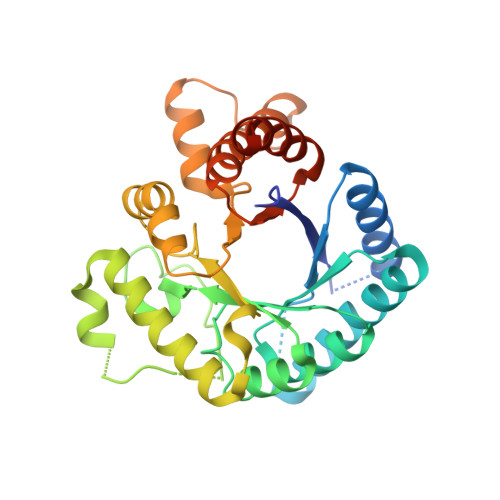
Dihydropteroate synthase from Streptococcus pneumoniae


Experimental Data Snapshot

  • Method: X-RAY DIFFRACTION
  • Resolution: 1.80 Å
  • R-Value Free: 
    0.240 (Depositor), 0.244 (DCC) 
  • R-Value Work: 
    0.194 (Depositor), 0.198 (DCC) 
  • R-Value Observed: 
    0.197 (Depositor) 

wwPDB Validation 3D Report Full Report

Validation slider image for 2VEF

This is version 1.2 of the entry. See complete history

Literature

Dihydropteroate Synthase from Streptococcus Pneumoniae: Structure, Ligand Recognition and Mechanism of Sulfonamide Resistance.

Levy, C.Minnis, D.Derrick, J.P.

(2008) Biochem J 412: 379

  • DOI: https://doi.org/10.1042/BJ20071598
  • Primary Citation Related Structures: 
    2VEF, 2VEG

  • PubMed Abstract: 

    DHPS (dihydropteroate synthase) catalyses an essential step in the biosynthesis of folic acid and is the target for the sulfonamide group of antimicrobial drugs. In the present paper we report two crystal structures of DHPS from the respiratory pathogen Streptococcus pneumoniae: the apoenzyme at 1.8 A (1 A=0.1 nm) resolution and a complex with DHPP (6-hydroxymethyl-7,8-dihydropterin monophosphate) at 2.4 A resolution. The enzyme forms a alpha/beta barrel structure, with a highly conserved binding pocket for recognition of the pterin substrate, DHPPP (6-hydroxymethyl-7,8-dihydropterin pyrophosphate). There is a fixed order of substrate binding: DHPPP binds first, followed by the second substrate, pABA (p-aminobenzoic acid). Binding of PP(i) also allows the enzyme to recognize pABA or sulfonamide drugs, which act as pABA analogues. Using equilibrium and pre-steady state kinetic fluorescence measurements, we show that the on-rate for DHPPP binding to the enzyme is relatively low (2.6x10(5) M(-1) x s(-1)) and propose that binding of this substrate induces a large scale movement of the second loop in the enzyme structure to participate in the formation of the pABA-binding site. Two mutations which confer resistance to sulfonamide drugs do not affect DHPPP binding, but have a substantial effect on pABA and sulfonamide recognition. The results show that binding of DHPPP and pABA are separate distinguishable events in the reaction cycle, and that mutations which confer resistance to sulfonamide drugs act exclusively on the second step in the binding process.


  • Organizational Affiliation
    • Manchester Interdisciplinary Biocentre, University of Manchester, 131 Princess Street, Manchester M1 7DN, UK.

Macromolecule Content 

  • Total Structure Weight: 69.01 kDa 
  • Atom Count: 4,794 
  • Modeled Residue Count: 554 
  • Deposited Residue Count: 628 
  • Unique protein chains: 1

Macromolecules

Find similar proteins by:|  3D Structure
Entity ID: 1
MoleculeChains  Sequence LengthOrganismDetailsImage
DIHYDROPTEROATE SYNTHASE
A, B
314Streptococcus pneumoniaeMutation(s): 0 
EC: 2.5.1.15
UniProt
Find proteins for P59655 (Streptococcus pneumoniae (strain ATCC BAA-255 / R6))
Explore P59655 
Go to UniProtKB:  P59655
Entity Groups
Sequence Clusters30% Identity50% Identity70% Identity90% Identity95% Identity100% Identity
UniProt GroupP59655
Sequence Annotations
Expand
Reference Sequence

Small Molecules

Ligands 1 Unique
IDChains Name / Formula / InChI Key2D Diagram3D Interactions
PO4

Query on PO4


Download:Ideal Coordinates CCD File
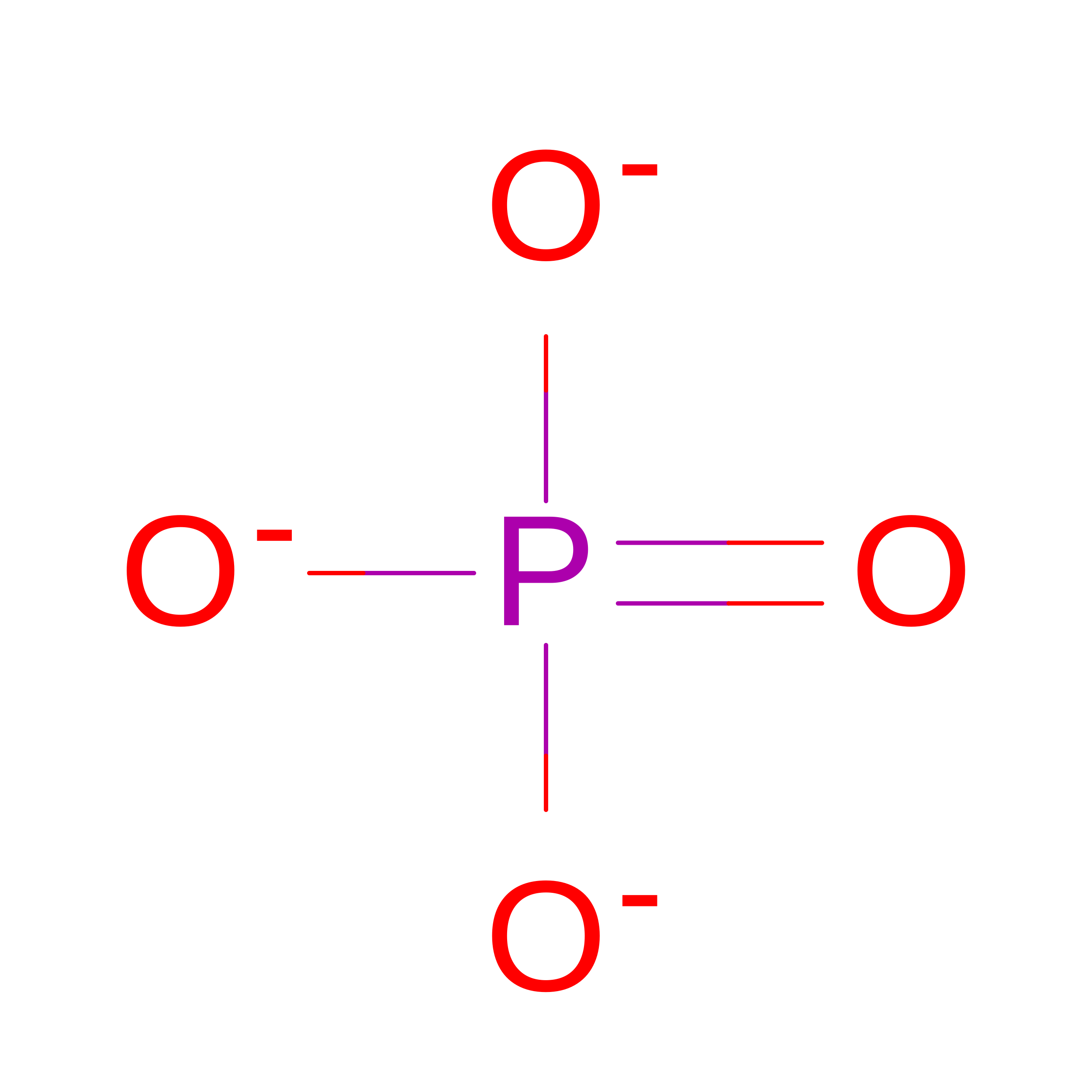
C [auth A]PHOSPHATE ION
O4 P
NBIIXXVUZAFLBC-UHFFFAOYSA-K

Experimental Data & Validation

Experimental Data

  • Method: X-RAY DIFFRACTION
  • Resolution: 1.80 Å
  • R-Value Free:  0.240 (Depositor), 0.244 (DCC) 
  • R-Value Work:  0.194 (Depositor), 0.198 (DCC) 
  • R-Value Observed: 0.197 (Depositor) 
Space Group: P 21 21 21
Unit Cell:
Length ( Å )Angle ( ˚ )
a = 45.613α = 90
b = 90.382β = 90
c = 138.656γ = 90
Software Package:
Software NamePurpose
REFMACrefinement
CrystalCleardata reduction
CrystalCleardata scaling
SOLVEphasing

Structure Validation

View Full Validation Report


Entry History 

Deposition Data

Revision History  (Full details and data files)

  • Version 1.0: 2008-03-25
    Type: Initial release
  • Version 1.1: 2011-07-13
    Changes: Refinement description, Version format compliance
  • Version 1.2: 2024-05-08
    Changes: Data collection, Database references, Other