2TNF | pdb_00002tnf

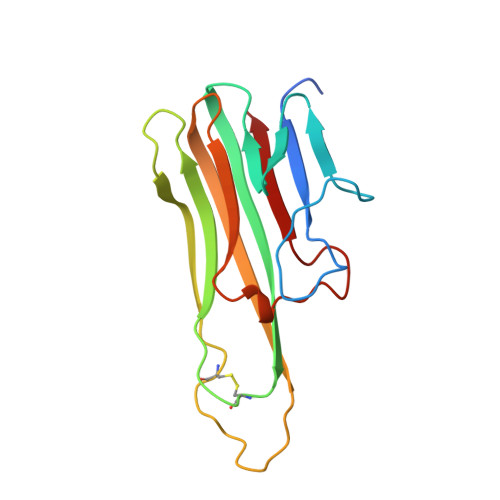
1.4 A RESOLUTION STRUCTURE OF MOUSE TUMOR NECROSIS FACTOR, TOWARDS MODULATION OF ITS SELECTIVITY AND TRIMERISATION


Experimental Data Snapshot

  • Method: X-RAY DIFFRACTION
  • Resolution: 1.40 Å
  • R-Value Free: 
    0.235 (Depositor) 
  • R-Value Work: 
    0.201 (Depositor), 0.197 (DCC) 
  • R-Value Observed: 
    0.201 (Depositor) 

Starting Model: experimental
View more details

wwPDB Validation 3D Report Full Report

Validation slider image for 2TNF

This is version 1.5 of the entry. See complete history

Literature

The structure of mouse tumour-necrosis factor at 1.4 A resolution: towards modulation of its selectivity and trimerization.

Baeyens, K.J.De Bondt, H.L.Raeymaekers, A.Fiers, W.De Ranter, C.J.

(1999) Acta Crystallogr D Biol Crystallogr 55: 772-778

  • DOI: https://doi.org/10.1107/s0907444998018435
  • Primary Citation Related Structures: 
    2TNF

  • PubMed Abstract: 

    The 1.4 A resolution structure of recombinant mouse tumour-necrosis factor alpha (mTNF) at 100 K has been determined. The crystals are triclinic, space group P1, with unit-cell parameters a = 48.06, b = 48.18, c = 51.01 A, alpha = 114.8, beta = 103.6, gamma = 91.1 degrees. The structure was refined to a final crystallographic R value of 19.7% (Rfree = 23.3%), including 3477 protein atoms, one 2-propanol molecule, one Tris molecule and 240 water molecules. Throughout the crystal lattice, the trimers are differently packed compared with human TNF, which was crystallized in the tetragonal space group P41212 and refined to 2.6 A resolution. The structures of mTNF and human TNF are very similar, diverging mainly in regions that are either flexible and/or involved in crystal packing. Some loops in mTNF which contain residues important for receptor binding are better resolved than in human TNF, such as the surface-exposed loops 30-34 and 144-147, which are also important for receptor specificity. Compared with human TNFs, the channel formed by the three monomers in mTNF is narrower. One 2-propanol molecule trapped in the trimeric channel could be a lead compound for the design of TNF inhibitors.


  • Organizational Affiliation
    • Laboratorium voor Analytische Chemie en Medicinale Fysicochemie, E. Van Evenstraat 4, B-3000 Leuven, Belgium.

Macromolecule Content 

  • Total Structure Weight: 52 kDa 
  • Atom Count: 3,729 
  • Modeled Residue Count: 444 
  • Deposited Residue Count: 468 
  • Unique protein chains: 1

Macromolecules

Find similar proteins by:|  3D Structure
Entity ID: 1
MoleculeChains  Sequence LengthOrganismDetailsImage
PROTEIN (TUMOR NECROSIS FACTOR ALPHA)
A, B, C
156Mus musculusMutation(s): 0 
UniProt
Find proteins for P06804 (Mus musculus)
Explore P06804 
Go to UniProtKB:  P06804
Entity Groups
Sequence Clusters30% Identity50% Identity70% Identity90% Identity95% Identity100% Identity
UniProt GroupP06804
Sequence Annotations
Expand
Reference Sequence

Small Molecules

Ligands 2 Unique
IDChains Name / Formula / InChI Key2D Diagram3D Interactions
TRS

Query on TRS


Download:Ideal Coordinates CCD File
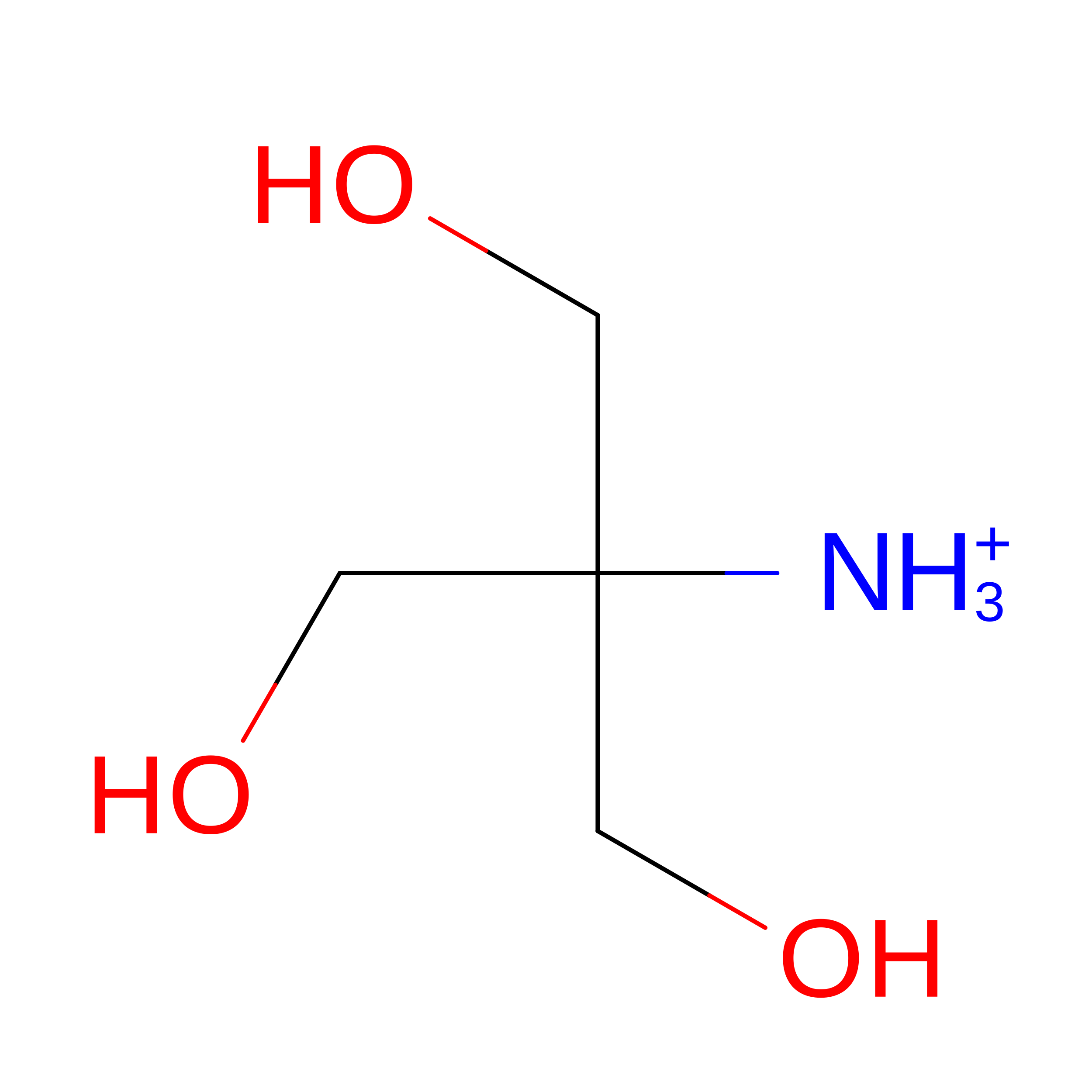
D [auth A]2-AMINO-2-HYDROXYMETHYL-PROPANE-1,3-DIOL
C4 H12 N O3
LENZDBCJOHFCAS-UHFFFAOYSA-O
IPA

Query on IPA


Download:Ideal Coordinates CCD File
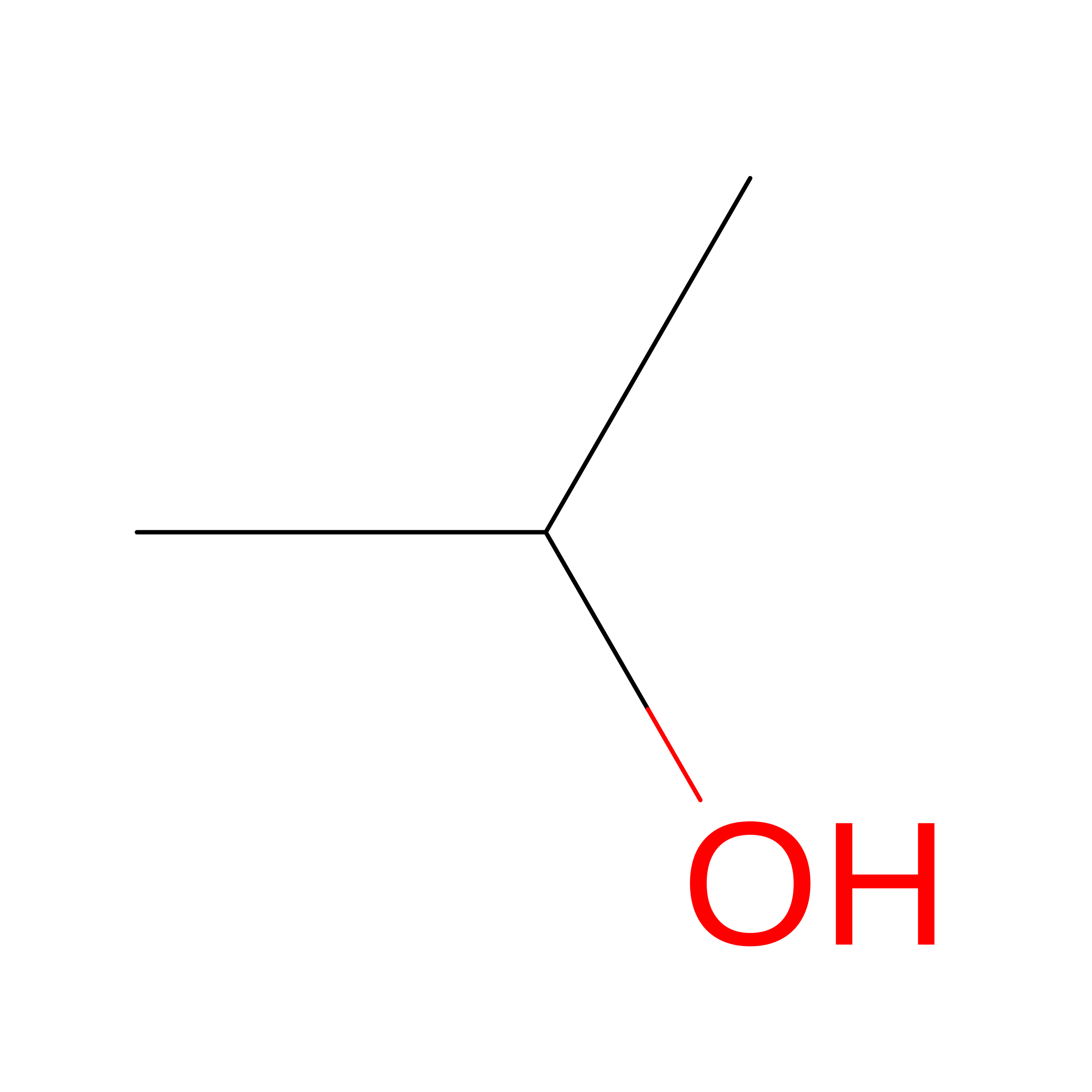
E [auth B]ISOPROPYL ALCOHOL
C3 H8 O
KFZMGEQAYNKOFK-UHFFFAOYSA-N

Experimental Data & Validation

Experimental Data

  • Method: X-RAY DIFFRACTION
  • Resolution: 1.40 Å
  • R-Value Free:  0.235 (Depositor) 
  • R-Value Work:  0.201 (Depositor), 0.197 (DCC) 
  • R-Value Observed: 0.201 (Depositor) 
Space Group: P 1
Unit Cell:
Length ( Å )Angle ( ˚ )
a = 48.214α = 114.81
b = 48.3β = 103.65
c = 51.095γ = 91.05
Software Package:
Software NamePurpose
DENZOdata reduction
SCALEPACKdata scaling
X-PLORmodel building
X-PLORrefinement
X-PLORphasing

Structure Validation

View Full Validation Report


Entry History 

Deposition Data

Revision History  (Full details and data files)

  • Version 1.0: 1999-10-12
    Type: Initial release
  • Version 1.1: 2008-04-27
    Changes: Version format compliance
  • Version 1.2: 2011-07-13
    Changes: Version format compliance
  • Version 1.3: 2017-10-11
    Changes: Structure summary
  • Version 1.4: 2023-08-30
    Changes: Data collection, Database references, Derived calculations, Refinement description
  • Version 1.5: 2024-10-30
    Changes: Structure summary