2RS5 | pdb_00002rs5

STRUCTURAL ANALYSIS OF ANTIVIRAL AGENTS THAT INTERACT WITH THE CAPSID OF HUMAN RHINOVIRUSES


Experimental Data Snapshot

  • Method: X-RAY DIFFRACTION
  • Resolution: 3.00 Å

wwPDB Validation 3D Report Full Report

Validation slider image for 2RS5

Ligand Structure Quality Assessment 


This is version 2.1 of the entry. See complete history

Literature

Structural analysis of antiviral agents that interact with the capsid of human rhinoviruses.

Badger, J.Minor, I.Oliveira, M.A.Smith, T.J.Rossmann, M.G.

(1989) Proteins 6: 1-19

  • DOI: https://doi.org/10.1002/prot.340060102
  • Primary Citation Related Structures: 
    1R08, 2R04, 2R06, 2R07, 2RM2, 2RR1, 2RS1, 2RS3, 2RS5

  • PubMed Abstract: 

    X-Ray diffraction data have been obtained for nine related antiviral agents ("WIN compounds") while bound to human rhinovirus 14 (HRV14). These compounds can inhibit both viral attachment to host cells and uncoating. To calculate interpretable electron density maps it was necessary to account for (1) the low (approximately 60%) occupancies of these compounds in the crystal, (2) the large (up to 7.9 A) conformational changes induced at the attachment site, and (3) the incomplete diffraction data. Application of a density difference map technique, which exploits the 20-fold noncrystallographic redundancy in HRV14, resulted in clear images of the HRV14:WIN complexes. A real-space refinement procedure was used to fit atomic models to these maps. The binding site of WIN compounds in HRV14 is a hydrophobic pocket composed mainly from residues that form the beta-barrel of VP1. Among rhinoviruses, the residues associated with the binding pocket are far more conserved than external residues and are mostly contained within regular secondary structural elements. Molecular dynamics simulations of three HRV14:WIN complexes suggest that portions of the WIN compounds and viral protein near the entrance of the binding pocket are more flexible than portions deeper within the beta-barrel.


  • Organizational Affiliation
    • Department of Biological Sciences, Purdue University, West Lafayette, Indiana 47907.

Macromolecule Content 

  • Total Structure Weight: 94.81 kDa 
  • Atom Count: 6,294 
  • Modeled Residue Count: 804 
  • Deposited Residue Count: 855 
  • Unique protein chains: 4

Macromolecules

Find similar proteins by:|  3D Structure
Entity ID: 1
MoleculeChains  Sequence LengthOrganismDetailsImage
HUMAN RHINOVIRUS 14 COAT PROTEIN (SUBUNIT VP1)A [auth 1]289rhinovirus B14Mutation(s): 0 
UniProt
Find proteins for P03303 (Human rhinovirus 14)
Explore P03303 
Go to UniProtKB:  P03303
Entity Groups
Sequence Clusters30% Identity50% Identity70% Identity90% Identity95% Identity100% Identity
UniProt GroupP03303
Sequence Annotations
Expand
Reference Sequence
Find similar proteins by:|  3D Structure
Entity ID: 2
MoleculeChains  Sequence LengthOrganismDetailsImage
HUMAN RHINOVIRUS 14 COAT PROTEIN (SUBUNIT VP2)B [auth 2]262rhinovirus B14Mutation(s): 0 
UniProt
Find proteins for P03303 (Human rhinovirus 14)
Explore P03303 
Go to UniProtKB:  P03303
Entity Groups
Sequence Clusters30% Identity50% Identity70% Identity90% Identity95% Identity100% Identity
UniProt GroupP03303
Sequence Annotations
Expand
Reference Sequence
Find similar proteins by:|  3D Structure
Entity ID: 3
MoleculeChains  Sequence LengthOrganismDetailsImage
HUMAN RHINOVIRUS 14 COAT PROTEIN (SUBUNIT VP3)C [auth 3]236rhinovirus B14Mutation(s): 0 
UniProt
Find proteins for P03303 (Human rhinovirus 14)
Explore P03303 
Go to UniProtKB:  P03303
Entity Groups
Sequence Clusters30% Identity50% Identity70% Identity90% Identity95% Identity100% Identity
UniProt GroupP03303
Sequence Annotations
Expand
Reference Sequence
Find similar proteins by:|  3D Structure
Entity ID: 4
MoleculeChains  Sequence LengthOrganismDetailsImage
HUMAN RHINOVIRUS 14 COAT PROTEIN (SUBUNIT VP4)D [auth 4]68rhinovirus B14Mutation(s): 0 
UniProt
Find proteins for P03303 (Human rhinovirus 14)
Explore P03303 
Go to UniProtKB:  P03303
Entity Groups
Sequence Clusters30% Identity50% Identity70% Identity90% Identity95% Identity100% Identity
UniProt GroupP03303
Sequence Annotations
Expand
Reference Sequence

Small Molecules

Ligands 1 Unique
IDChains Name / Formula / InChI Key2D Diagram3D Interactions
W56

Query on W56


Download:Ideal Coordinates CCD File
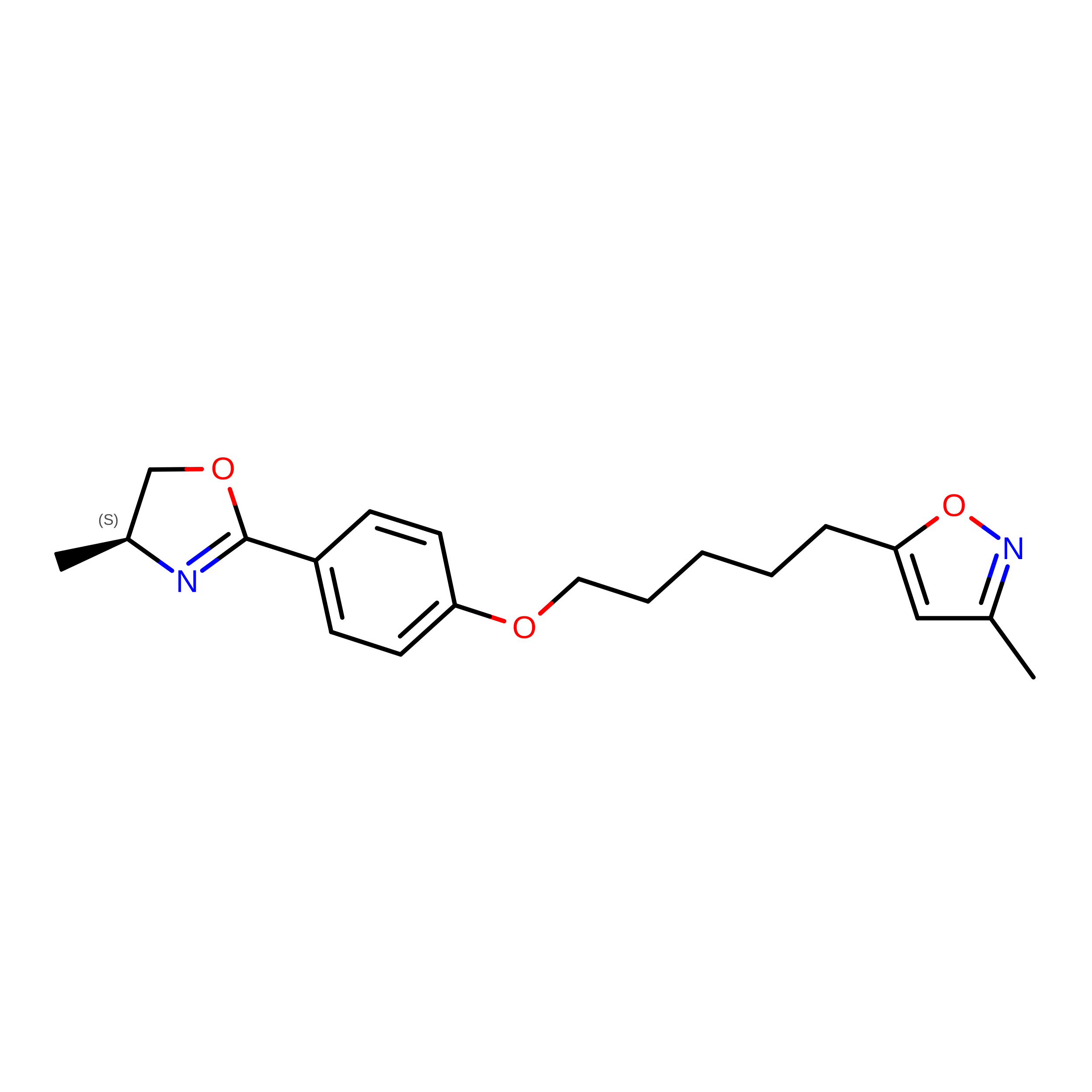
E [auth 1]5-(5-(4-(5-HYDRO-4-METHYL-2-OXAZOLYL)PHENOXY)PENTYL)-3-METHYL ISOXAZOLE
C19 H24 N2 O3
UXIYKMARWUSIKU-HNNXBMFYSA-N

Experimental Data & Validation

Experimental Data

  • Method: X-RAY DIFFRACTION
  • Resolution: 3.00 Å
Space Group: P 21 3
Unit Cell:
Length ( Å )Angle ( ˚ )
a = 445.1α = 90
b = 445.1β = 90
c = 445.1γ = 90
Software Package:
Software NamePurpose
REAL-SPACErefinement

Structure Validation

View Full Validation Report


Ligand Structure Quality Assessment 


Entry History 

Deposition Data

Revision History  (Full details and data files)

  • Version 1.0: 1990-01-15
    Type: Initial release
  • Version 1.1: 2008-03-25
    Changes: Version format compliance
  • Version 1.2: 2011-07-13
    Changes: Version format compliance
  • Version 2.0: 2023-01-18
    Type: Remediation
    Changes: Advisory, Atomic model, Data collection, Database references, Derived calculations, Other, Refinement description
  • Version 2.1: 2024-05-22
    Changes: Data collection