Download Mendeley
A novel peptide mediates aggregation and migration of hemocytes from an insect
Nakatogawa, S., Oda, Y., Kamiya, M., Kamijima, T., Aizawa, T., Clark, K.D., Demura, M., Kawano, K., Strand, M.R., Hayakawa, Y.(2009) Curr Biol 19: 779-785
- PubMed: 19375321 Search on PubMed
- DOI: https://doi.org/10.1016/j.cub.2009.03.050
- Primary Citation Related Structures:
2RPS - PubMed Abstract:
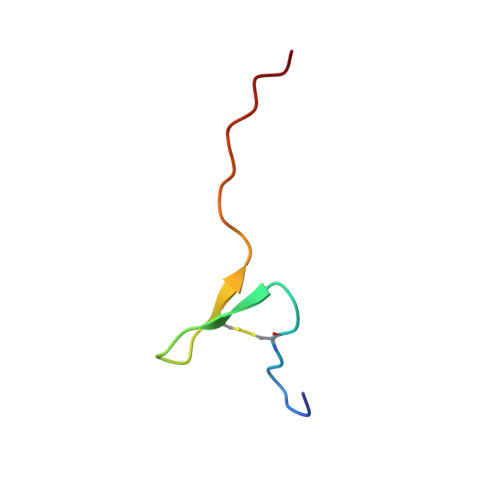
Insect blood cells (hemocytes) comprise an essential arm of the immune system [1-7]. Several factors mediating recognition and phagocytosis of foreign intruders by hemocytes have been identified, but the mechanisms regulating hemocyte movement remain fragmentary. Embryonic hemocytes from Drosophila migrate along stereotypical routes in response to chemotactic signals from PVF ligands, members of the platelet-derived growth factor family [8-12]. Embryonic and larval hemocytes also accumulate at external wounds [11-13], but PVFs are not required for this response, suggesting involvement by other, unknown factors. Here we report the identification of hemocyte chemotactic peptide (HCP) from the moth Pseudaletia separata and present evidence that it stimulates aggregation and directed movement of phagocytic hemocytes. Spatiotemporal studies revealed that HCP is expressed in both epidermal cells and hemocytes, whereas structure-function studies identified post-translational modifications important for activity. HCP also shares similarities with another group of cytokines from moths called ENF peptides [14-17]. Taken together, our results identify HCP as a chemotactic cytokine that enhances clotting at wound sites in larvae.
- Graduate School of Science, Hokkaido University, Sapporo, 060-0189, Japan.
Organizational Affiliation: