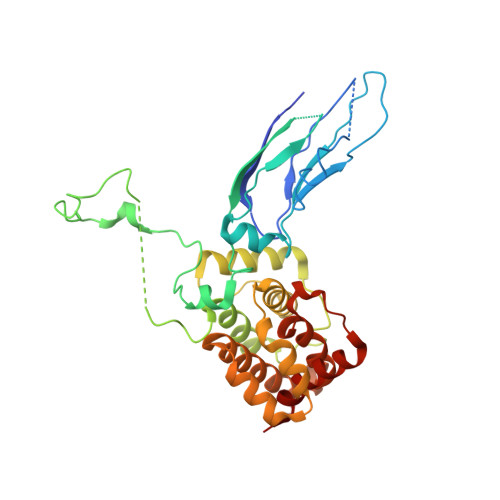
2QV2 | pdb_00002qv2

A role of the Lowe syndrome protein OCRL in early steps of the endocytic pathway


Experimental Data Snapshot

  • Method: X-RAY DIFFRACTION
  • Resolution: 2.40 Å
  • R-Value Free: 
    0.288 (Depositor), 0.287 (DCC) 
  • R-Value Work: 
    0.248 (Depositor), 0.246 (DCC) 

wwPDB Validation 3D Report Full Report

Validation slider image for 2QV2

This is version 1.2 of the entry. See complete history

Literature

A role of the Lowe syndrome protein OCRL in early steps of the endocytic pathway

Erdmann, K.S.Mao, Y.McCrea, H.J.Zoncu, R.Lee, S.Paradise, S.Modregger, J.Biemesderfer, D.Toomre, D.De Camilli, P.

(2007) Dev Cell 13: 377-390

  • DOI: https://doi.org/10.1016/j.devcel.2007.08.004
  • Primary Citation Related Structures: 
    2QV2

  • PubMed Abstract: 

    Mutations in the inositol 5-phosphatase OCRL are responsible for Lowe syndrome, whose manifestations include mental retardation and renal Fanconi syndrome. OCRL has been implicated in membrane trafficking, but disease mechanisms remain unclear. We show that OCRL visits late-stage, endocytic clathrin-coated pits and binds the Rab5 effector APPL1 on peripheral early endosomes. The interaction with APPL1, which is mediated by the ASH-RhoGAP-like domains of OCRL and is abolished by disease mutations, provides a link to protein networks implicated in the reabsorptive function of the kidney and in the trafficking and signaling of growth factor receptors in the brain. Crystallographic studies reveal a role of the ASH-RhoGAP-like domains in positioning the phosphatase domain at the membrane interface and a clathrin box protruding from the RhoGAP-like domain. Our results support a role of OCRL in the early endocytic pathway, consistent with the predominant localization of its preferred substrates, PI(4,5)P(2) and PI(3,4,5)P(3), at the cell surface.


  • Organizational Affiliation
    • Department of Cell Biology, School of Medicine, Yale University, New Haven, CT 06510, USA.

Macromolecule Content 

  • Total Structure Weight: 39.47 kDa 
  • Atom Count: 2,531 
  • Modeled Residue Count: 305 
  • Deposited Residue Count: 342 
  • Unique protein chains: 1

Macromolecules

Find similar proteins by:|  3D Structure
Entity ID: 1
MoleculeChains  Sequence LengthOrganismDetailsImage
Inositol polyphosphate 5-phosphatase OCRL-1342Homo sapiensMutation(s): 0 
Gene Names: OCRLINPP5FOCRL1
EC: 3.1.3.36 (PDB Primary Data), 3.1.3.56 (UniProt), 3.1.3.86 (UniProt)
UniProt & NIH Common Fund Data Resources
Find proteins for Q01968 (Homo sapiens)
Explore Q01968 
Go to UniProtKB:  Q01968
PHAROS:  Q01968
GTEx:  ENSG00000122126 
Entity Groups
Sequence Clusters30% Identity50% Identity70% Identity90% Identity95% Identity100% Identity
UniProt GroupQ01968
Sequence Annotations
Expand
Reference Sequence

Experimental Data & Validation

Experimental Data

  • Method: X-RAY DIFFRACTION
  • Resolution: 2.40 Å
  • R-Value Free:  0.288 (Depositor), 0.287 (DCC) 
  • R-Value Work:  0.248 (Depositor), 0.246 (DCC) 
Space Group: P 32 2 1
Unit Cell:
Length ( Å )Angle ( ˚ )
a = 91.3α = 90
b = 91.3β = 90
c = 103.9γ = 120
Software Package:
Software NamePurpose
HKL-2000data collection
CNSrefinement
HKL-2000data reduction
HKL-2000data scaling
CNSphasing

Structure Validation

View Full Validation Report


Entry History 

Deposition Data

Revision History  (Full details and data files)

  • Version 1.0: 2007-08-21
    Type: Initial release
  • Version 1.1: 2011-07-13
    Changes: Version format compliance
  • Version 1.2: 2024-02-21
    Changes: Data collection, Database references