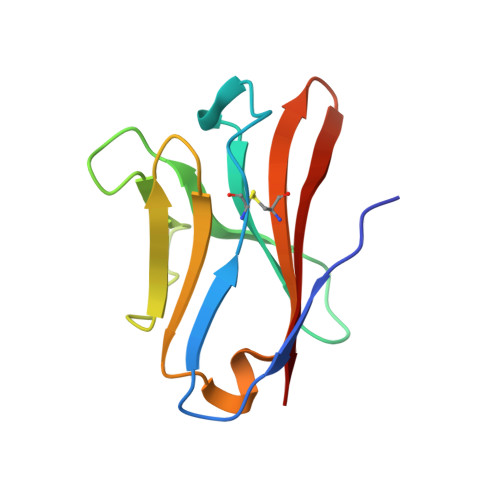
2QJD | pdb_00002qjd

Crystal Structure of Novel Immune-Type Receptor 10 Extracellular Fragment Mutant N30D


Experimental Data Snapshot

  • Method: X-RAY DIFFRACTION
  • Resolution: 2.44 Å
  • R-Value Free: 
    0.239 (Depositor), 0.238 (DCC) 
  • R-Value Work: 
    0.184 (Depositor), 0.183 (DCC) 
  • R-Value Observed: 
    0.186 (Depositor) 

wwPDB Validation 3D Report Full Report

Validation slider image for 2QJD

This is version 1.5 of the entry. See complete history

Literature

A bony fish immunological receptor of the NITR multigene family mediates allogeneic recognition.

Cannon, J.P.Haire, R.N.Magis, A.T.Eason, D.D.Winfrey, K.N.Hernandez Prada, J.A.Bailey, K.M.Jakoncic, J.Litman, G.W.Ostrov, D.A.

(2008) Immunity 29: 228-237

  • DOI: https://doi.org/10.1016/j.immuni.2008.05.018
  • Primary Citation Related Structures: 
    2QHL, 2QJD, 2QQQ, 2QTE, 3B5T, 3BDB

  • PubMed Abstract: 

    Novel immune-type receptors (NITRs) comprise an exceptionally large, diversified family of activating and inhibitory receptors that has been identified in bony fish. Here, we characterized the structure of an activating NITR that is expressed by a cytotoxic natural killer (NK)-like cell line and that specifically binds an allogeneic B cell target. A single amino acid residue within the NITR immunoglobulin variable (V)-type domain accounts for specificity of the interaction. Structures solved by X-ray crystallography revealed that the V-type domains of NITRs form homodimers resembling rearranging antigen-binding receptor heterodimers. CDR1 elements of both subunits of NITR dimers form ligand-binding surfaces that determine specificity for the nonself target. In the evolution of immune function, it appears that a specific NK type of innate recognition may be mediated by a complex germline multigene family of V structures resembling those that are somatically diversified in adaptive immunological responses.


  • Organizational Affiliation
    • Department of Pediatrics, University of South Florida College of Medicine, St. Petersburg, FL 33701, USA.

Macromolecule Content 

  • Total Structure Weight: 25.58 kDa 
  • Atom Count: 1,924 
  • Modeled Residue Count: 218 
  • Deposited Residue Count: 220 
  • Unique protein chains: 1

Macromolecules

Find similar proteins by:|  3D Structure
Entity ID: 1
MoleculeChains  Sequence LengthOrganismDetailsImage
Novel immune-type receptor 10
A, B
110Ictalurus punctatusMutation(s): 1 
Gene Names: NITR10
UniProt
Find proteins for Q8UWK5 (Ictalurus punctatus)
Explore Q8UWK5 
Go to UniProtKB:  Q8UWK5
Entity Groups
Sequence Clusters30% Identity50% Identity70% Identity90% Identity95% Identity100% Identity
UniProt GroupQ8UWK5
Sequence Annotations
Expand
Reference Sequence

Experimental Data & Validation

Experimental Data

  • Method: X-RAY DIFFRACTION
  • Resolution: 2.44 Å
  • R-Value Free:  0.239 (Depositor), 0.238 (DCC) 
  • R-Value Work:  0.184 (Depositor), 0.183 (DCC) 
  • R-Value Observed: 0.186 (Depositor) 
Space Group: P 32 2 1
Unit Cell:
Length ( Å )Angle ( ˚ )
a = 94.952α = 90
b = 94.952β = 90
c = 67.668γ = 120
Software Package:
Software NamePurpose
REFMACrefinement
SCALEPACKdata scaling
CNSrefinement
PDB_EXTRACTdata extraction
HKL-2000data collection
HKL-2000data reduction
HKL-2000data scaling
MOLREPphasing
DENZOdata reduction

Structure Validation

View Full Validation Report


Entry History 

Deposition Data

Revision History  (Full details and data files)

  • Version 1.0: 2008-06-17
    Type: Initial release
  • Version 1.1: 2011-07-13
    Changes: Version format compliance
  • Version 1.2: 2017-10-18
    Changes: Refinement description
  • Version 1.3: 2019-07-24
    Changes: Data collection, Refinement description
  • Version 1.4: 2021-10-20
    Changes: Database references
  • Version 1.5: 2024-10-16
    Changes: Data collection, Structure summary