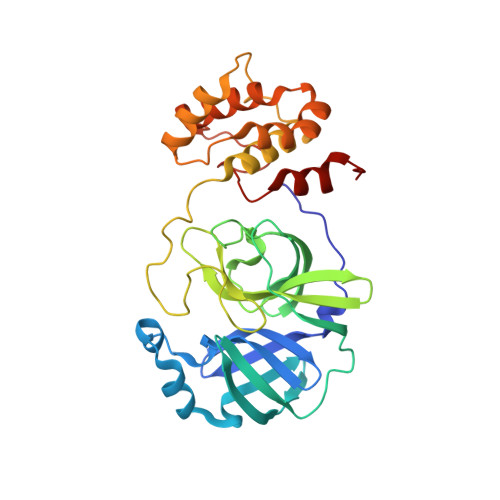
2QCY | pdb_00002qcy

Crystal Structure of a monomeric form of Severe Acute Respiratory Syndrome (SARS) 3C-like protease mutant


Experimental Data Snapshot

  • Method: X-RAY DIFFRACTION
  • Resolution: 1.75 Å
  • R-Value Free: 
    0.208 (Depositor), 0.174 (DCC) 
  • R-Value Work: 
    0.168 (Depositor), 0.178 (DCC) 

wwPDB Validation 3D Report Full Report

Validation slider image for 2QCY

This is version 1.4 of the entry. See complete history

Literature

Mechanism for controlling the dimer-monomer switch and coupling dimerization to catalysis of the severe acute respiratory syndrome coronavirus 3C-like protease.

Shi, J.Sivaraman, J.Song, J.

(2008) J Virol 82: 4620-4629

  • DOI: https://doi.org/10.1128/JVI.02680-07
  • Primary Citation Related Structures: 
    2QCY

  • PubMed Abstract: 

    Unlike 3C protease, the severe acute respiratory syndrome coronavirus (SARS-CoV) 3C-like protease (3CLpro) is only enzymatically active as a homodimer and its catalysis is under extensive regulation by the unique extra domain. Despite intense studies, two puzzles still remain: (i) how the dimer-monomer switch is controlled and (ii) why dimerization is absolutely required for catalysis. Here we report the monomeric crystal structure of the SARS-CoV 3CLpro mutant R298A at a resolution of 1.75 A. Detailed analysis reveals that Arg298 serves as a key component for maintaining dimerization, and consequently, its mutation will trigger a cooperative switch from a dimer to a monomer. The monomeric enzyme is irreversibly inactivated because its catalytic machinery is frozen in the collapsed state, characteristic of the formation of a short 3(10)-helix from an active-site loop. Remarkably, dimerization appears to be coupled to catalysis in 3CLpro through the use of overlapped residues for two networks, one for dimerization and another for the catalysis.


  • Organizational Affiliation
    • Department of Biological Sciences, National University of Singapore, 14 Science Drive 4, Singapore 117543, Republic of Singapore. bchsj@nus.edu.sg

Macromolecule Content 

  • Total Structure Weight: 33.79 kDa 
  • Atom Count: 2,784 
  • Modeled Residue Count: 306 
  • Deposited Residue Count: 306 
  • Unique protein chains: 1

Macromolecules

Find similar proteins by:|  3D Structure
Entity ID: 1
MoleculeChains  Sequence LengthOrganismDetailsImage
3C-like proteinase306Severe acute respiratory syndrome-related coronavirusMutation(s): 1 
Gene Names: rep
EC: 3.4.22
UniProt
Find proteins for P0C6X7 (Severe acute respiratory syndrome coronavirus)
Explore P0C6X7 
Go to UniProtKB:  P0C6X7
Entity Groups
Sequence Clusters30% Identity50% Identity70% Identity90% Identity95% Identity100% Identity
UniProt GroupP0C6X7
Sequence Annotations
Expand
Reference Sequence

Experimental Data & Validation

Experimental Data

  • Method: X-RAY DIFFRACTION
  • Resolution: 1.75 Å
  • R-Value Free:  0.208 (Depositor), 0.174 (DCC) 
  • R-Value Work:  0.168 (Depositor), 0.178 (DCC) 
Space Group: P 1 21 1
Unit Cell:
Length ( Å )Angle ( ˚ )
a = 33.389α = 90
b = 66.225β = 100.77
c = 62.21γ = 90
Software Package:
Software NamePurpose
DENZOdata reduction
SCALEPACKdata scaling
PHASERphasing
CNSrefinement
PDB_EXTRACTdata extraction
HKL-2000data scaling

Structure Validation

View Full Validation Report


Entry History 

Deposition Data

Revision History  (Full details and data files)

  • Version 1.0: 2008-03-11
    Type: Initial release
  • Version 1.1: 2011-07-13
    Changes: Version format compliance
  • Version 1.2: 2017-10-18
    Changes: Refinement description
  • Version 1.3: 2021-10-20
    Changes: Database references
  • Version 1.4: 2024-02-21
    Changes: Data collection