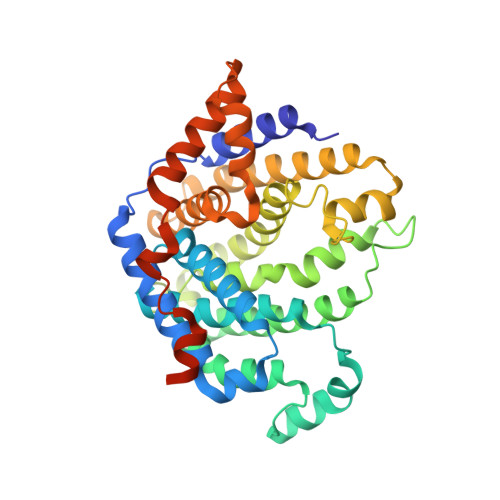
2Q9Y | pdb_00002q9y

Trichodiene synthase: Complex with Mg, inorganic pyrophosphate, and benzyl triethyl ammonium cation


Experimental Data Snapshot

  • Method: X-RAY DIFFRACTION
  • Resolution: 2.85 Å
  • R-Value Free: 
    0.265 (Depositor), 0.276 (DCC) 
  • R-Value Work: 
    0.216 (Depositor), 0.224 (DCC) 

Starting Model: experimental
View more details

wwPDB Validation 3D Report Full Report

Validation slider image for 2Q9Y

Ligand Structure Quality Assessment 


This is version 1.2 of the entry. See complete history

Literature

Exploring biosynthetic diversity with trichodiene synthase.

Vedula, L.S.Zhao, Y.Coates, R.M.Koyama, T.Cane, D.E.Christianson, D.W.

(2007) Arch Biochem Biophys 466: 260-266

  • DOI: https://doi.org/10.1016/j.abb.2007.06.016
  • Primary Citation Related Structures: 
    2Q9Y, 2Q9Z

  • PubMed Abstract: 

    Trichodiene synthase is a terpenoid cyclase that catalyzes the cyclization of farnesyl diphosphate (FPP) to form the bicyclic sesquiterpene hydrocarbon trichodiene (89%), at least five sesquiterpene side products (11%), and inorganic pyrophosphate (PP(i)). Incubation of trichodiene synthase with 2-fluorofarnesyl diphosphate or 4-methylfarnesyl diphosphate similarly yields sesquiterpene mixtures despite the electronic effects or steric bulk introduced by substrate derivatization. The versatility of the enzyme is also demonstrated in the 2.85A resolution X-ray crystal structure of the complex with Mg(2+) (3)-PP(i) and the benzyl triethylammonium cation, which is a bulkier mimic of the bisabolyl carbocation intermediate in catalysis. Taken together, these findings show that the active site of trichodiene synthase is sufficiently flexible to accommodate bulkier and electronically-diverse substrates and intermediates, which could indicate additional potential for the biosynthetic utility of this terpenoid cyclase.


  • Organizational Affiliation
    • Roy and Diana Vagelos Laboratories, Department of Chemistry, University of Pennsylvania, Philadelphia, PA 19104-6323, USA.

Macromolecule Content 

  • Total Structure Weight: 88.67 kDa 
  • Atom Count: 5,906 
  • Modeled Residue Count: 704 
  • Deposited Residue Count: 748 
  • Unique protein chains: 1

Macromolecules

Find similar proteins by:|  3D Structure
Entity ID: 1
MoleculeChains  Sequence LengthOrganismDetailsImage
Trichodiene synthase
A, B
374Fusarium sporotrichioidesMutation(s): 0 
Gene Names: TRI5TOX 5
EC: 4.2.3.6
UniProt
Find proteins for P13513 (Fusarium sporotrichioides)
Explore P13513 
Go to UniProtKB:  P13513
Entity Groups
Sequence Clusters30% Identity50% Identity70% Identity90% Identity95% Identity100% Identity
UniProt GroupP13513
Sequence Annotations
Expand
Reference Sequence

Small Molecules

Ligands 4 Unique
IDChains Name / Formula / InChI Key2D Diagram3D Interactions
BTM

Query on BTM


Download:Ideal Coordinates CCD File
H [auth B]N-benzyl-N,N-diethylethanaminium
C13 H22 N
VBQDSLGFSUGBBE-UHFFFAOYSA-N
POP

Query on POP


Download:Ideal Coordinates CCD File
G [auth B]PYROPHOSPHATE 2-
H2 O7 P2
XPPKVPWEQAFLFU-UHFFFAOYSA-L
EDO

Query on EDO


Download:Ideal Coordinates CCD File
C [auth A],
I [auth B]
1,2-ETHANEDIOL
C2 H6 O2
LYCAIKOWRPUZTN-UHFFFAOYSA-N
MG

Query on MG


Download:Ideal Coordinates CCD File
D [auth B],
E [auth B],
F [auth B]
MAGNESIUM ION
Mg
JLVVSXFLKOJNIY-UHFFFAOYSA-N

Experimental Data & Validation

Experimental Data

  • Method: X-RAY DIFFRACTION
  • Resolution: 2.85 Å
  • R-Value Free:  0.265 (Depositor), 0.276 (DCC) 
  • R-Value Work:  0.216 (Depositor), 0.224 (DCC) 
Space Group: P 31 2 1
Unit Cell:
Length ( Å )Angle ( ˚ )
a = 122.488α = 90
b = 122.488β = 90
c = 150.494γ = 120
Software Package:
Software NamePurpose
ADSCdata collection
CNSrefinement
HKL-2000data reduction
HKL-2000data scaling
CNSphasing

Structure Validation

View Full Validation Report


Ligand Structure Quality Assessment 


Entry History 

Deposition Data

Revision History  (Full details and data files)

  • Version 1.0: 2008-04-22
    Type: Initial release
  • Version 1.1: 2011-07-13
    Changes: Version format compliance
  • Version 1.2: 2023-08-30
    Changes: Data collection, Database references, Derived calculations, Refinement description