2Q7Y | pdb_00002q7y

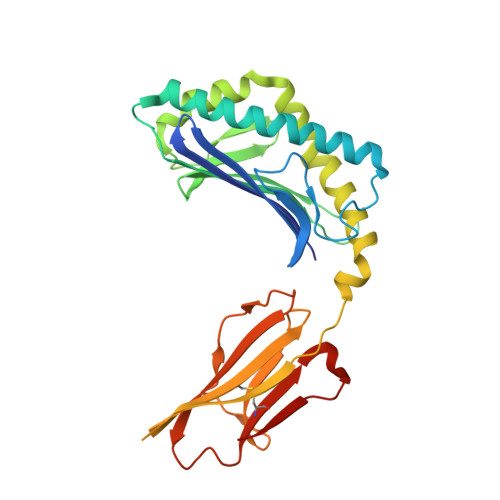
Structure of the endogenous iNKT cell ligand iGb3 bound to mCD1d


Experimental Data Snapshot

  • Method: X-RAY DIFFRACTION
  • Resolution: 1.95 Å
  • R-Value Free: 
    0.245 (Depositor), 0.247 (DCC) 
  • R-Value Work: 
    0.199 (Depositor), 0.198 (DCC) 
  • R-Value Observed: 
    0.200 (Depositor) 

Starting Model: experimental
View more details

wwPDB Validation 3D Report Full Report

Validation slider image for 2Q7Y

Ligand Structure Quality Assessment 


This is version 2.2 of the entry. See complete history

Literature

Crystal Structures of Mouse CD1d-iGb3 Complex and its Cognate Valpha14 T Cell Receptor Suggest a Model for Dual Recognition of Foreign and Self Glycolipids.

Zajonc, D.M.Savage, P.B.Bendelac, A.Wilson, I.A.Teyton, L.

(2008) J Mol Biology 377: 1104-1116

  • DOI: https://doi.org/10.1016/j.jmb.2008.01.061
  • Primary Citation Related Structures: 
    2Q7Y, 2Q86

  • PubMed Abstract: 

    The semi-invariant Valpha14Jalpha18 T cell receptor (TCR) is expressed by regulatory NKT cells and has the unique ability to recognize chemically diverse ligands presented by CD1d. The crystal structure of CD1d complexed to a natural, endogenous ligand, isoglobotrihexosylceramide (iGb3), illustrates the extent of this diversity when compared to the binding of potent, exogenous ligands, such as alpha-galactosylceramide (alpha-GalCer). A single mode of recognition for these two classes of ligands would then appear problematic for a single T cell receptor. However, the Valpha14 TCR adopts two different conformations in the crystal where, in one configuration, the presence of a larger cavity between the two CDR3 regions could accommodate iGb3 and, in the other, a smaller cavity fits alpha-GalCer more snugly. Alternatively, the extended iGb3 headgroup could be "squashed" upon docking of the TCR and accommodated between the CD1 and TCR surfaces. Thus, the same TCR may adopt alternative modes of recognition for these foreign and self-ligands for NKT cell activation.


  • Organizational Affiliation
    • Department of Molecular Biology, The Scripps Research Institute, 10550 North Torrey Pines Rd., La Jolla, CA 92037, USA.

Macromolecule Content 

  • Total Structure Weight: 93.35 kDa 
  • Atom Count: 6,589 
  • Modeled Residue Count: 734 
  • Deposited Residue Count: 768 
  • Unique protein chains: 2

Macromolecules

Find similar proteins by:|  3D Structure
Entity ID: 1
MoleculeChains  Sequence LengthOrganismDetailsImage
T-cell surface glycoprotein CD1d1
A, C
285Mus musculusMutation(s): 0 
Gene Names: Cd1d1Cd1.1
UniProt & NIH Common Fund Data Resources
Find proteins for P11609 (Mus musculus)
Explore P11609 
Go to UniProtKB:  P11609
IMPC:  MGI:107674
Entity Groups
Sequence Clusters30% Identity50% Identity70% Identity90% Identity95% Identity100% Identity
UniProt GroupP11609
Glycosylation
Glycosylation Sites: 3Go to GlyGen: P11609-1
Sequence Annotations
Expand
Reference Sequence
Find similar proteins by:|  3D Structure
Entity ID: 2
MoleculeChains  Sequence LengthOrganismDetailsImage
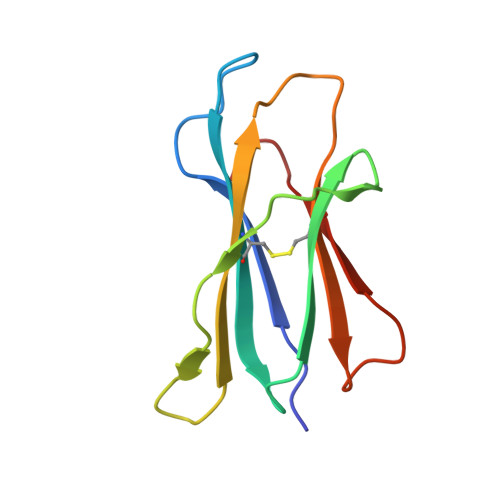
Beta-2-microglobulin
B, D
99Mus musculusMutation(s): 1 
Gene Names: B2m
UniProt & NIH Common Fund Data Resources
Find proteins for P01887 (Mus musculus)
Explore P01887 
Go to UniProtKB:  P01887
IMPC:  MGI:88127
Entity Groups
Sequence Clusters30% Identity50% Identity70% Identity90% Identity95% Identity100% Identity
UniProt GroupP01887
Sequence Annotations
Expand
Reference Sequence

Oligosaccharides

Help  
Entity ID: 3
MoleculeChains Length2D Diagram GlycosylationD Interactions
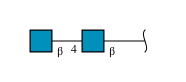
2-acetamido-2-deoxy-beta-D-glucopyranose-(1-4)-2-acetamido-2-deoxy-beta-D-glucopyranose
E, G
2N-Glycosylation
Glycosylation Resources
GlyTouCan: G42666HT
GlyCosmos: G42666HT
GlyGen: G42666HT
Entity ID: 4
MoleculeChains Length2D Diagram GlycosylationD Interactions
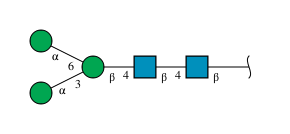
alpha-D-mannopyranose-(1-3)-[alpha-D-mannopyranose-(1-6)]beta-D-mannopyranose-(1-4)-2-acetamido-2-deoxy-beta-D-glucopyranose-(1-4)-2-acetamido-2-deoxy-beta-D-glucopyranose
F
5N-Glycosylation
Glycosylation Resources
GlyTouCan: G22768VO
GlyCosmos: G22768VO
GlyGen: G22768VO

Small Molecules

Ligands 3 Unique
IDChains Name / Formula / InChI Key2D Diagram3D Interactions
IGC

Query on IGC


Download:Ideal Coordinates CCD File
I [auth A],
M [auth C]
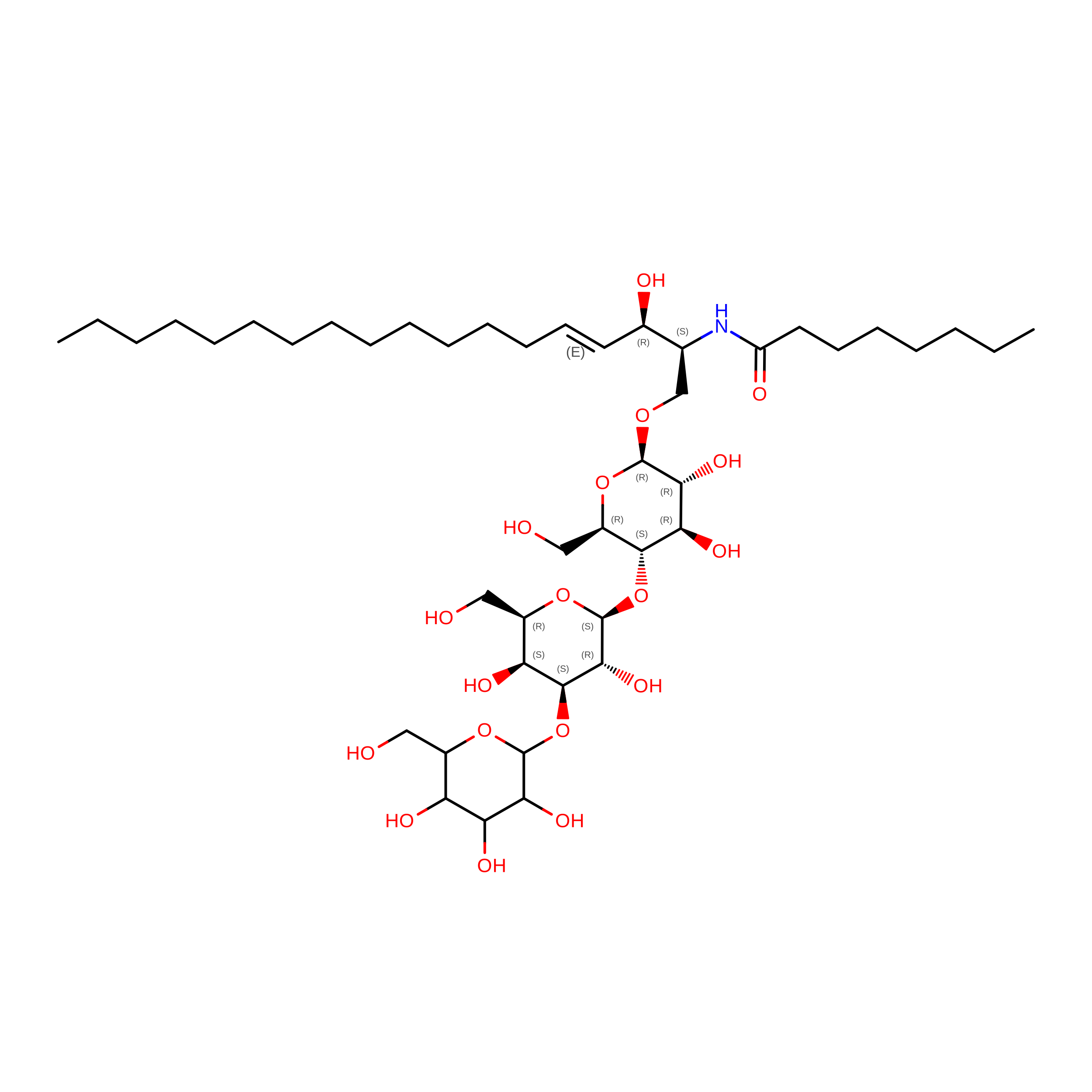
N-[(1S,2R,3E)-1-({[ALPHA-D-GALACTOPYRANOSYL-(1->3)-BETA-D-GALACTOPYRANOSYL-(1->4)-BETA-D-GLUCOPYRANOSYL]OXY}METHYL)-2-H YDROXYHEPTADEC-3-EN-1-YL]OCTANAMIDE
C44 H81 N O18
RWHPBLFPAUXKDB-WOYQYECOSA-N
PLM

Query on PLM


Download:Ideal Coordinates CCD File
J [auth A],
N [auth C]
PALMITIC ACID
C16 H32 O2
IPCSVZSSVZVIGE-UHFFFAOYSA-N
NAG

Query on NAG


Download:Ideal Coordinates CCD File
H [auth A],
K [auth C],
L [auth C]
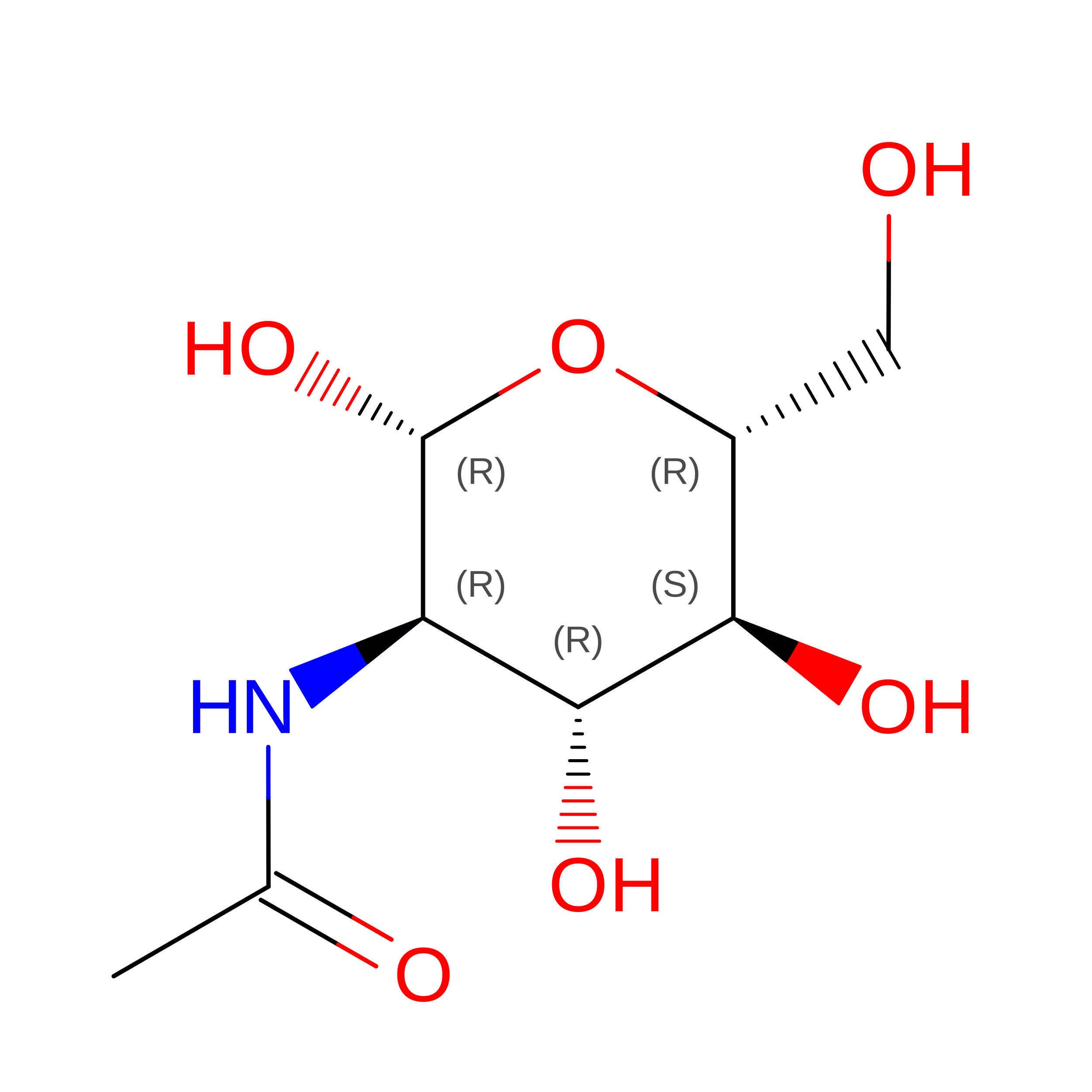
2-acetamido-2-deoxy-beta-D-glucopyranose
C8 H15 N O6
OVRNDRQMDRJTHS-FMDGEEDCSA-N

Experimental Data & Validation

Experimental Data

  • Method: X-RAY DIFFRACTION
  • Resolution: 1.95 Å
  • R-Value Free:  0.245 (Depositor), 0.247 (DCC) 
  • R-Value Work:  0.199 (Depositor), 0.198 (DCC) 
  • R-Value Observed: 0.200 (Depositor) 
Space Group: P 1 21 1
Unit Cell:
Length ( Å )Angle ( ˚ )
a = 58.941α = 90
b = 96.224β = 106.23
c = 77.926γ = 90
Software Package:
Software NamePurpose
REFMACrefinement
PDB_EXTRACTdata extraction
HKL-2000data collection
HKL-2000data reduction
HKL-2000data scaling
AMoREphasing

Structure Validation

View Full Validation Report


Ligand Structure Quality Assessment 


Entry History 

Deposition Data

Revision History  (Full details and data files)

  • Version 1.0: 2008-04-01
    Type: Initial release
  • Version 1.1: 2011-07-13
    Changes: Non-polymer description, Version format compliance
  • Version 2.0: 2020-07-29
    Type: Remediation
    Reason: Carbohydrate remediation
    Changes: Advisory, Atomic model, Data collection, Database references, Derived calculations, Structure summary
  • Version 2.1: 2023-08-30
    Changes: Data collection, Database references, Refinement description, Structure summary
  • Version 2.2: 2024-11-20
    Changes: Structure summary