2Q3Z | pdb_00002q3z

Transglutaminase 2 undergoes large conformational change upon activation


Experimental Data Snapshot

  • Method: X-RAY DIFFRACTION
  • Resolution: 2.00 Å
  • R-Value Free: 
    0.266 (Depositor), 0.268 (DCC) 
  • R-Value Work: 
    0.228 (Depositor), 0.228 (DCC) 
  • R-Value Observed: 
    0.231 (Depositor) 

Starting Model: experimental
View more details

wwPDB Validation 3D Report Full Report

Validation slider image for 2Q3Z

This is version 1.5 of the entry. See complete history

Literature

Transglutaminase 2 undergoes a large conformational change upon activation

Pinkas, D.M.Strop, P.Brunger, A.T.Khosla, C.

(2007) PLoS Biol 5: e327-e327

  • DOI: https://doi.org/10.1371/journal.pbio.0050327
  • Primary Citation Related Structures: 
    2Q3Z

  • PubMed Abstract: 

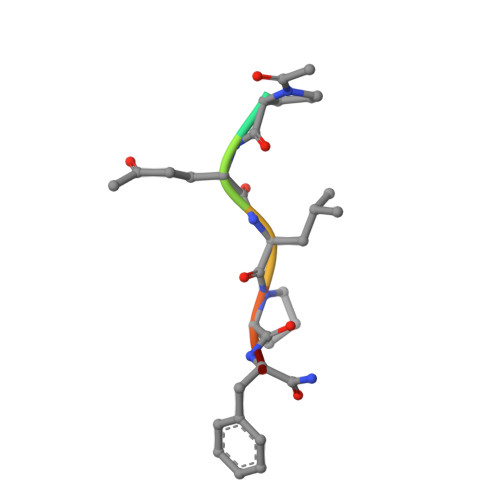
    Human transglutaminase 2 (TG2), a member of a large family of enzymes that catalyze protein crosslinking, plays an important role in the extracellular matrix biology of many tissues and is implicated in the gluten-induced pathogenesis of celiac sprue. Although vertebrate transglutaminases have been studied extensively, thus far all structurally characterized members of this family have been crystallized in conformations with inaccessible active sites. We have trapped human TG2 in complex with an inhibitor that mimics inflammatory gluten peptide substrates and have solved, at 2-A resolution, its x-ray crystal structure. The inhibitor stabilizes TG2 in an extended conformation that is dramatically different from earlier transglutaminase structures. The active site is exposed, revealing that catalysis takes place in a tunnel, bridged by two tryptophan residues that separate acyl-donor from acyl-acceptor and stabilize the tetrahedral reaction intermediates. Site-directed mutagenesis was used to investigate the acyl-acceptor side of the tunnel, yielding mutants with a marked increase in preference for hydrolysis over transamidation. By providing the ability to visualize this activated conformer, our results create a foundation for understanding the catalytic as well as the non-catalytic roles of TG2 in biology, and for dissecting the process by which the autoantibody response to TG2 is induced in celiac sprue patients.


  • Organizational Affiliation
    • Department of Chemical Engineering, Stanford University, Stanford, California, United States of America.

Macromolecule Content 

  • Total Structure Weight: 78.45 kDa 
  • Atom Count: 5,519 
  • Modeled Residue Count: 662 
  • Deposited Residue Count: 694 
  • Unique protein chains: 2

Macromolecules

Find similar proteins by:|  3D Structure
Entity ID: 1
MoleculeChains  Sequence LengthOrganismDetailsImage
Transglutaminase 2687Homo sapiensMutation(s): 0 
Gene Names: TGM2
EC: 2.3.2.13 (PDB Primary Data), 2.3.1 (UniProt), 3.4 (UniProt), 3.5.1.44 (UniProt)
UniProt & NIH Common Fund Data Resources
Find proteins for P21980 (Homo sapiens)
Explore P21980 
Go to UniProtKB:  P21980
PHAROS:  P21980
GTEx:  ENSG00000198959 
Entity Groups
Sequence Clusters30% Identity50% Identity70% Identity90% Identity95% Identity100% Identity
UniProt GroupP21980
Sequence Annotations
Expand
Reference Sequence
Find similar proteins by:  Sequence   |   3D Structure  
Entity ID: 2
MoleculeChains  Sequence LengthOrganismDetailsImage
PolypeptideB [auth X]7N/AMutation(s): 0 

Experimental Data & Validation

Experimental Data

  • Method: X-RAY DIFFRACTION
  • Resolution: 2.00 Å
  • R-Value Free:  0.266 (Depositor), 0.268 (DCC) 
  • R-Value Work:  0.228 (Depositor), 0.228 (DCC) 
  • R-Value Observed: 0.231 (Depositor) 
Space Group: P 41 21 2
Unit Cell:
Length ( Å )Angle ( ˚ )
a = 71.671α = 90
b = 71.671β = 90
c = 309.01γ = 90
Software Package:
Software NamePurpose
DENZOdata reduction
SCALEPACKdata scaling
REFMACrefinement
PDB_EXTRACTdata extraction
Blu-Icedata collection
PHASERphasing

Structure Validation

View Full Validation Report


Entry History 

Deposition Data

Revision History  (Full details and data files)

  • Version 1.0: 2007-10-23
    Type: Initial release
  • Version 1.1: 2011-07-13
    Changes: Advisory, Derived calculations, Version format compliance
  • Version 1.2: 2017-10-18
    Changes: Advisory, Refinement description
  • Version 1.3: 2018-02-14
    Changes: Experimental preparation
  • Version 1.4: 2023-08-30
    Changes: Advisory, Data collection, Database references, Derived calculations, Refinement description
  • Version 1.5: 2023-11-15
    Changes: Data collection