Download Mendeley
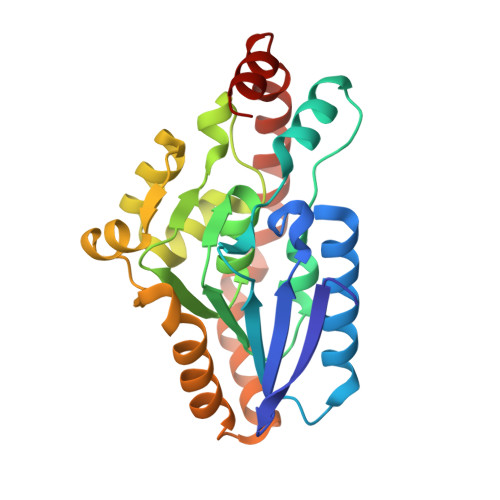
Crystal structure of the ECH2 catalytic domain of CurF from Lyngbya majuscula. Insights into a decarboxylase involved in polyketide chain beta-branching.
Geders, T.W., Gu, L., Mowers, J.C., Liu, H., Gerwick, W.H., Hakansson, K., Sherman, D.H., Smith, J.L.(2007) J Biol Chem 282: 35954-35963
- PubMed: 17928301 Search on PubMed
- DOI: https://doi.org/10.1074/jbc.M703921200
- Primary Citation Related Structures:
2Q2X, 2Q34, 2Q35 - PubMed Abstract:
Curacin A is a mixed polyketide/nonribosomal peptide possessing anti-mitotic and anti-proliferative activity. In the biosynthesis of curacin A, the N-terminal domain of the CurF multifunctional protein catalyzes decarboxylation of 3-methylglutaconyl-acyl carrier protein (ACP) to 3-methylcrotonyl-ACP, the postulated precursor of the cyclopropane ring of curacin A. This decarboxylase is encoded within an "HCS cassette" that is used by several other polyketide biosynthetic systems to generate chemical diversity by introduction of a beta-branch functional group to the natural product. The crystal structure of the CurF N-terminal ECH(2) domain establishes that the protein is a crotonase superfamily member. Ala(78) and Gly(118) form an oxyanion hole in the active site that includes only three polar side chains as potential catalytic residues. Site-directed mutagenesis and a biochemical assay established critical functions for His(240) and Lys(86), whereas Tyr(82) was nonessential. A decarboxylation mechanism is proposed in which His(240) serves to stabilize the substrate carboxylate and Lys(86) donates a proton to C-4 of the acyl-ACP enolate intermediate to form the Delta(2) unsaturated isopentenoyl-ACP product. The CurF ECH(2) domain showed a 20-fold selectivity for ACP-over CoA-linked substrates. Specificity for ACP-linked substrates has not been reported for any other crotonase superfamily decarboxylase. Tyr(73) may select against CoA-linked substrates by blocking a contact of Arg(38) with the CoA adenosine 5'-phosphate.
- Life Sciences Institute, Department of Biological Chemistry, University of Michigan, Ann Arbor, Michigan 48109, USA.
Organizational Affiliation: