2PYH | pdb_00002pyh

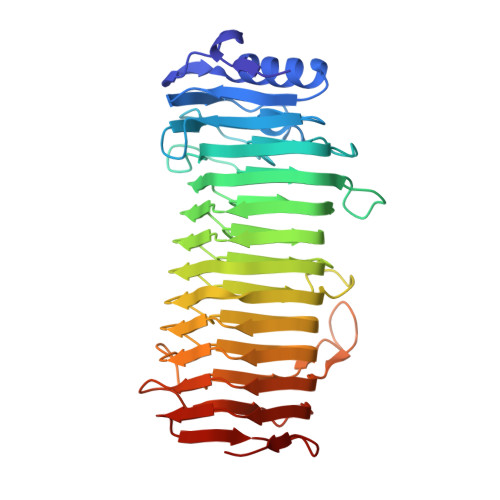
Azotobacter vinelandii Mannuronan C-5 epimerase AlgE4 A-module complexed with mannuronan trisaccharide


Experimental Data Snapshot

  • Method: X-RAY DIFFRACTION
  • Resolution: 2.70 Å
  • R-Value Free: 
    0.279 (Depositor), 0.279 (DCC) 
  • R-Value Work: 
    0.233 (Depositor), 0.237 (DCC) 

Starting Model: experimental
View more details

wwPDB Validation 3D Report Full Report

Validation slider image for 2PYH

This is version 3.2 of the entry. See complete history

Literature

Structural and Mutational Characterization of the Catalytic A-module of the Mannuronan C-5-epimerase AlgE4 from Azotobacter vinelandii.

Rozeboom, H.J.Bjerkan, T.M.Kalk, K.H.Ertesvag, H.Holtan, S.Aachmann, F.L.Valla, S.Dijkstra, B.W.

(2008) J Biological Chem 283: 23819-23828

  • DOI: https://doi.org/10.1074/jbc.M804119200
  • Primary Citation Related Structures: 
    2PYG, 2PYH

  • PubMed Abstract: 

    Alginate is a family of linear copolymers of (1-->4)-linked beta-d-mannuronic acid and its C-5 epimer alpha-l-guluronic acid. The polymer is first produced as polymannuronic acid and the guluronic acid residues are then introduced at the polymer level by mannuronan C-5-epimerases. The structure of the catalytic A-module of the Azotobacter vinelandii mannuronan C-5-epimerase AlgE4 has been determined by x-ray crystallography at 2.1-A resolution. AlgE4A folds into a right-handed parallel beta-helix structure originally found in pectate lyase C and subsequently in several polysaccharide lyases and hydrolases. The beta-helix is composed of four parallel beta-sheets, comprising 12 complete turns, and has an amphipathic alpha-helix near the N terminus. The catalytic site is positioned in a positively charged cleft formed by loops extending from the surface encompassing Asp(152), an amino acid previously shown to be important for the reaction. Site-directed mutagenesis further implicates Tyr(149), His(154), and Asp(178) as being essential for activity. Tyr(149) probably acts as the proton acceptor, whereas His(154) is the proton donor in the epimerization reaction.


  • Organizational Affiliation
    • Laboratory of Biophysical Chemistry, GBB, University of Groningen, Nijenborgh 4, Groningen, The Netherlands.

Macromolecule Content 

  • Total Structure Weight: 80.67 kDa 
  • Atom Count: 5,709 
  • Modeled Residue Count: 753 
  • Deposited Residue Count: 754 
  • Unique protein chains: 1

Macromolecules

Find similar proteins by:|  3D Structure
Entity ID: 1
MoleculeChains  Sequence LengthOrganismDetailsImage
Poly(beta-D-mannuronate) C5 epimerase 4
A, B
377Azotobacter vinelandiiMutation(s): 0 
Gene Names: algE4
EC: 5.1.3 (PDB Primary Data), 5.1.3.37 (UniProt)
UniProt
Find proteins for Q44493 (Azotobacter vinelandii)
Explore Q44493 
Go to UniProtKB:  Q44493
Entity Groups
Sequence Clusters30% Identity50% Identity70% Identity90% Identity95% Identity100% Identity
UniProt GroupQ44493
Sequence Annotations
Expand
Reference Sequence

Oligosaccharides

Help  
Entity ID: 2
MoleculeChains Length2D Diagram GlycosylationD Interactions
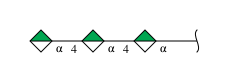
alpha-D-mannopyranuronic acid-(1-4)-alpha-D-mannopyranuronic acid-(1-4)-alpha-D-mannopyranuronic acid
C
3N/A
Glycosylation Resources
GlyTouCan: G65070FG
GlyCosmos: G65070FG

Experimental Data & Validation

Experimental Data

  • Method: X-RAY DIFFRACTION
  • Resolution: 2.70 Å
  • R-Value Free:  0.279 (Depositor), 0.279 (DCC) 
  • R-Value Work:  0.233 (Depositor), 0.237 (DCC) 
Space Group: P 21 21 2
Unit Cell:
Length ( Å )Angle ( ˚ )
a = 169.551α = 90
b = 121.79β = 90
c = 45.068γ = 90
Software Package:
Software NamePurpose
CNSrefinement
PDB_EXTRACTdata extraction
PROTEUM PLUSdata collection
XPREPdata reduction
CNSphasing
REFMACrefinement

Structure Validation

View Full Validation Report


Entry History 

Deposition Data

Revision History  (Full details and data files)

  • Version 1.0: 2008-05-27
    Type: Initial release
  • Version 1.1: 2011-07-13
    Changes: Non-polymer description, Version format compliance
  • Version 2.0: 2019-07-24
    Changes: Advisory, Atomic model, Data collection, Derived calculations, Refinement description, Source and taxonomy
  • Version 3.0: 2020-07-29
    Type: Remediation
    Reason: Carbohydrate remediation
    Changes: Advisory, Atomic model, Data collection, Derived calculations, Structure summary
  • Version 3.1: 2024-02-21
    Changes: Data collection, Database references, Derived calculations, Structure summary
  • Version 3.2: 2024-04-03
    Changes: Refinement description