2PV3 | pdb_00002pv3

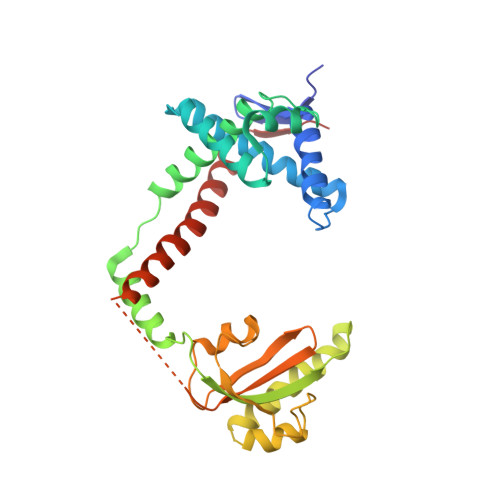
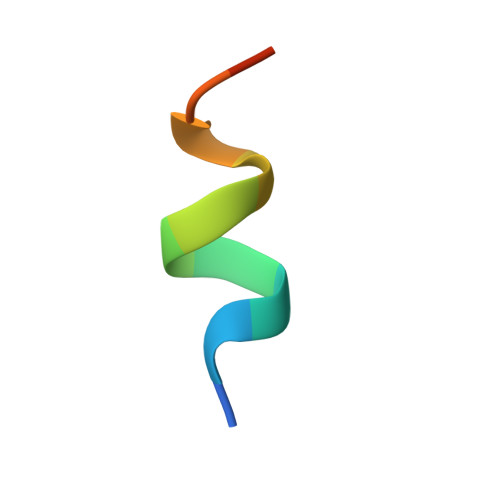
Crystallographic Structure of SurA fragment lacking the second peptidyl-prolyl isomerase domain complexed with peptide NFTLKFWDIFRK


Experimental Data Snapshot

  • Method: X-RAY DIFFRACTION
  • Resolution: 3.39 Å
  • R-Value Free: 
    0.299 (Depositor) 
  • R-Value Work: 
    0.284 (Depositor) 
  • R-Value Observed: 
    0.284 (Depositor) 

Starting Model: experimental
View more details

wwPDB Validation 3D Report Full Report

Validation slider image for 2PV3

This is version 1.4 of the entry. See complete history

Literature

The Periplasmic Bacterial Molecular Chaperone SurA Adapts its Structure to Bind Peptides in Different Conformations to Assert a Sequence Preference for Aromatic Residues.

Xu, X.Wang, S.Hu, Y.X.McKay, D.B.

(2007) J Mol Biology 373: 367-381

  • DOI: https://doi.org/10.1016/j.jmb.2007.07.069
  • Primary Citation Related Structures: 
    2PV1, 2PV2, 2PV3

  • PubMed Abstract: 

    The periplasmic molecular chaperone protein SurA facilitates correct folding and maturation of outer membrane proteins in Gram-negative bacteria. It preferentially binds peptides that have a high fraction of aromatic amino acids. Phage display selections, isothermal titration calorimetry and crystallographic structure determination have been used to elucidate the basis of the binding specificity. The peptide recognition is imparted by the first peptidyl-prolyl isomerase (PPIase) domain of SurA. Crystal structures of complexes between peptides of sequence WEYIPNV and NFTLKFWDIFRK with the first PPIase domain of the Escherichia coli SurA protein at 1.3 A resolution, and of a complex between the dodecapeptide and a SurA fragment lacking the second PPIase domain at 3.4 A resolution, have been solved. SurA binds as a monomer to the heptapeptide in an extended conformation. It binds as a dimer to the dodecapeptide in an alpha-helical conformation, predicated on a substantial structural rearrangement of the SurA protein. In both cases, side-chains of aromatic residues of the peptides contribute a large fraction of the binding interactions. SurA therefore asserts a recognition preference for aromatic amino acids in a variety of sequence configurations by adopting alternative tertiary and quaternary structures to bind peptides in different conformations.


  • Organizational Affiliation
    • Department of Structural Biology, Stanford University School of Medicine, Stanford, CA 94305, USA.

Macromolecule Content 

  • Total Structure Weight: 68.06 kDa 
  • Atom Count: 4,529 
  • Modeled Residue Count: 578 
  • Deposited Residue Count: 610 
  • Unique protein chains: 2

Macromolecules

Find similar proteins by:|  3D Structure
Entity ID: 1
MoleculeChains  Sequence LengthOrganismDetailsImage
Chaperone surA
A, B
299Escherichia coliMutation(s): 0 
Gene Names: surA
EC: 5.2.1.8
UniProt
Find proteins for P0ABZ6 (Escherichia coli (strain K12))
Explore P0ABZ6 
Go to UniProtKB:  P0ABZ6
Entity Groups
Sequence Clusters30% Identity50% Identity70% Identity90% Identity95% Identity100% Identity
UniProt GroupP0ABZ6
Sequence Annotations
Expand
Reference Sequence
Find similar proteins by:  Sequence   |   3D Structure  
Entity ID: 2
MoleculeChains  Sequence LengthOrganismDetailsImage
C-peptide12N/AMutation(s): 0 

Experimental Data & Validation

Experimental Data

  • Method: X-RAY DIFFRACTION
  • Resolution: 3.39 Å
  • R-Value Free:  0.299 (Depositor) 
  • R-Value Work:  0.284 (Depositor) 
  • R-Value Observed: 0.284 (Depositor) 
Space Group: P 32 2 1
Unit Cell:
Length ( Å )Angle ( ˚ )
a = 148.33α = 90
b = 148.33β = 90
c = 188.68γ = 120
Software Package:
Software NamePurpose
SCALAdata scaling
REFMACrefinement
PDB_EXTRACTdata extraction
d*TREKdata scaling
HKL-2000data reduction
DENZOdata reduction
SCALEPACKdata scaling
SnBphasing

Structure Validation

View Full Validation Report


Entry History 

Deposition Data

Revision History  (Full details and data files)

  • Version 1.0: 2007-10-02
    Type: Initial release
  • Version 1.1: 2011-07-13
    Changes: Derived calculations, Version format compliance
  • Version 1.2: 2017-08-16
    Changes: Refinement description, Source and taxonomy
  • Version 1.3: 2017-10-18
    Changes: Refinement description
  • Version 1.4: 2023-08-30
    Changes: Data collection, Database references, Refinement description