2OAP | pdb_00002oap

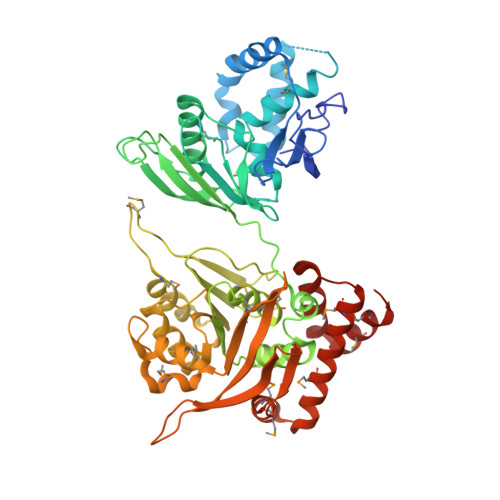
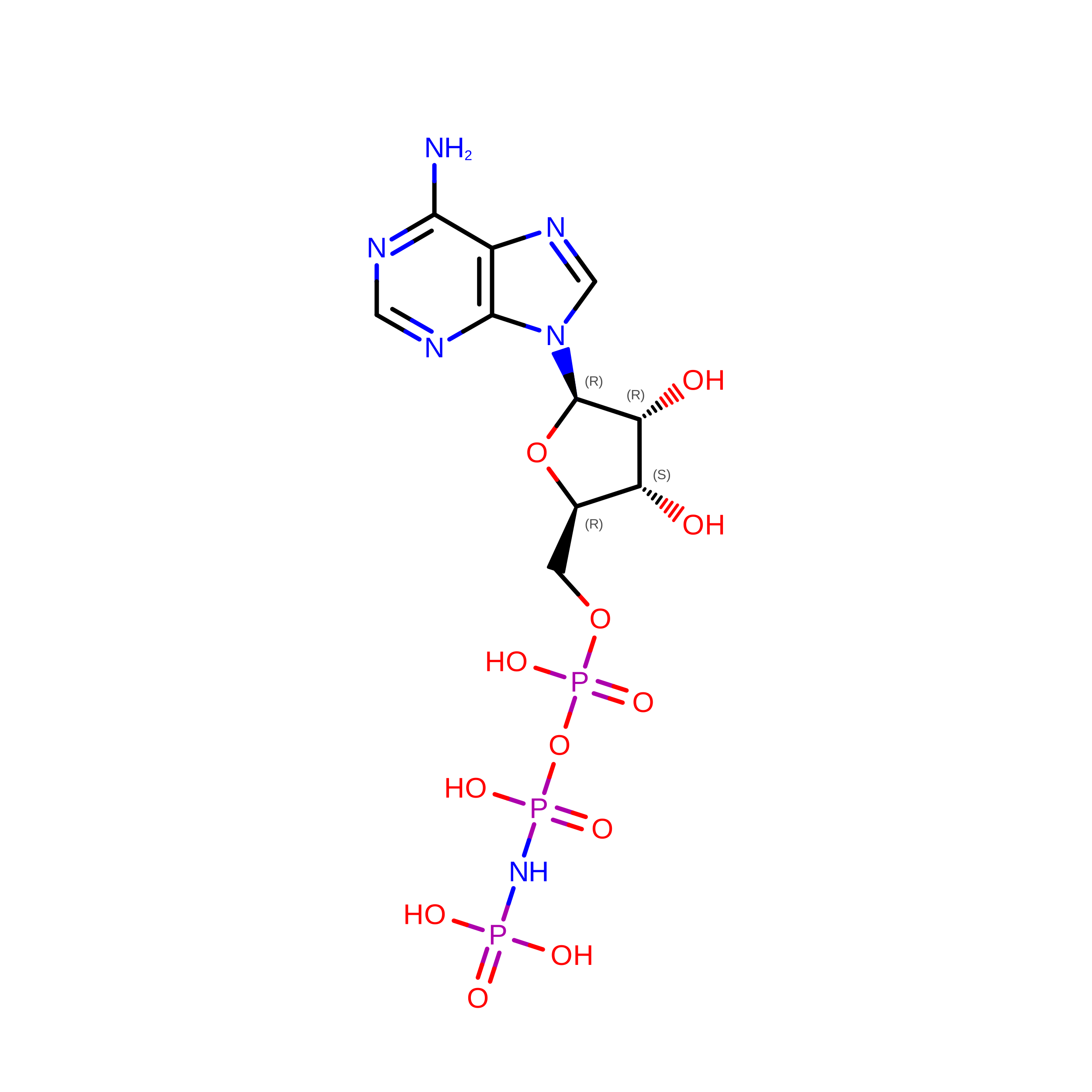
Crystal structure of the archaeal secretion ATPase GspE in complex with AMP-PNP


Experimental Data Snapshot

  • Method: X-RAY DIFFRACTION
  • Resolution: 2.95 Å
  • R-Value Free: 
    0.234 (Depositor), 0.232 (DCC) 
  • R-Value Work: 
    0.226 (Depositor), 0.222 (DCC) 

wwPDB Validation 3D Report Full Report

Validation slider image for 2OAP

Ligand Structure Quality Assessment 


This is version 1.5 of the entry. See complete history

Literature

Hexameric structures of the archaeal secretion ATPase GspE and implications for a universal secretion mechanism.

Yamagata, A.Tainer, J.A.

(2007) EMBO J 26: 878-890

  • DOI: https://doi.org/10.1038/sj.emboj.7601544
  • Primary Citation Related Structures: 
    2OAP, 2OAQ

  • PubMed Abstract: 

    The secretion superfamily ATPases are conserved motors in key microbial membrane transport and filament assembly machineries, including bacterial type II and IV secretion, type IV pilus assembly, natural competence, and archaeal flagellae assembly. We report here crystal structures and small angle X-ray scattering (SAXS) solution analyses of the Archaeoglobus fulgidus secretion superfamily ATPase, afGspE. AfGspE structures in complex with ATP analogue AMP-PNP and Mg(2+) reveal for the first time, alternating open and closed subunit conformations within a hexameric ring. The closed-form active site with bound Mg(2+) evidently reveals the catalytically active conformation. Furthermore, nucleotide binding results and SAXS analyses of ADP, ATPgammaS, ADP-Vi, and AMP-PNP-bound states in solution showed that asymmetric assembly involves ADP binding, but clamped closed conformations depend on both ATP gamma-phosphate and Mg(2+) plus the conserved motifs, arginine fingers, and subdomains of the secretion ATPase superfamily. Moreover, protruding N-terminal domain shifts caused by the closed conformation suggest a unified piston-like, push-pull mechanism for ATP hydrolysis-dependent conformational changes, suitable to drive diverse microbial secretion and assembly processes by a universal mechanism.


  • Organizational Affiliation
    • Department of Molecular Biology, The Skaggs Institute for Chemical Biology, The Scripps Research Institute, La Jolla, CA 92037, USA.

Macromolecule Content 

  • Total Structure Weight: 120.83 kDa 
  • Atom Count: 8,040 
  • Modeled Residue Count: 1,001 
  • Deposited Residue Count: 1,022 
  • Unique protein chains: 1

Macromolecules

Find similar proteins by:|  3D Structure
Entity ID: 1
MoleculeChains  Sequence LengthOrganismDetailsImage
Type II secretion system proteinA [auth 1],
B [auth 2]
511Archaeoglobus fulgidus DSM 4304Mutation(s): 18 
UniProt
Find proteins for O29598 (Archaeoglobus fulgidus (strain ATCC 49558 / DSM 4304 / JCM 9628 / NBRC 100126 / VC-16))
Explore O29598 
Go to UniProtKB:  O29598
Entity Groups
Sequence Clusters30% Identity50% Identity70% Identity90% Identity95% Identity100% Identity
UniProt GroupO29598
Sequence Annotations
Expand
Reference Sequence

Small Molecules

Modified Residues  1 Unique
IDChains TypeFormula2D DiagramParent
MSE
Query on MSE
A [auth 1],
B [auth 2]
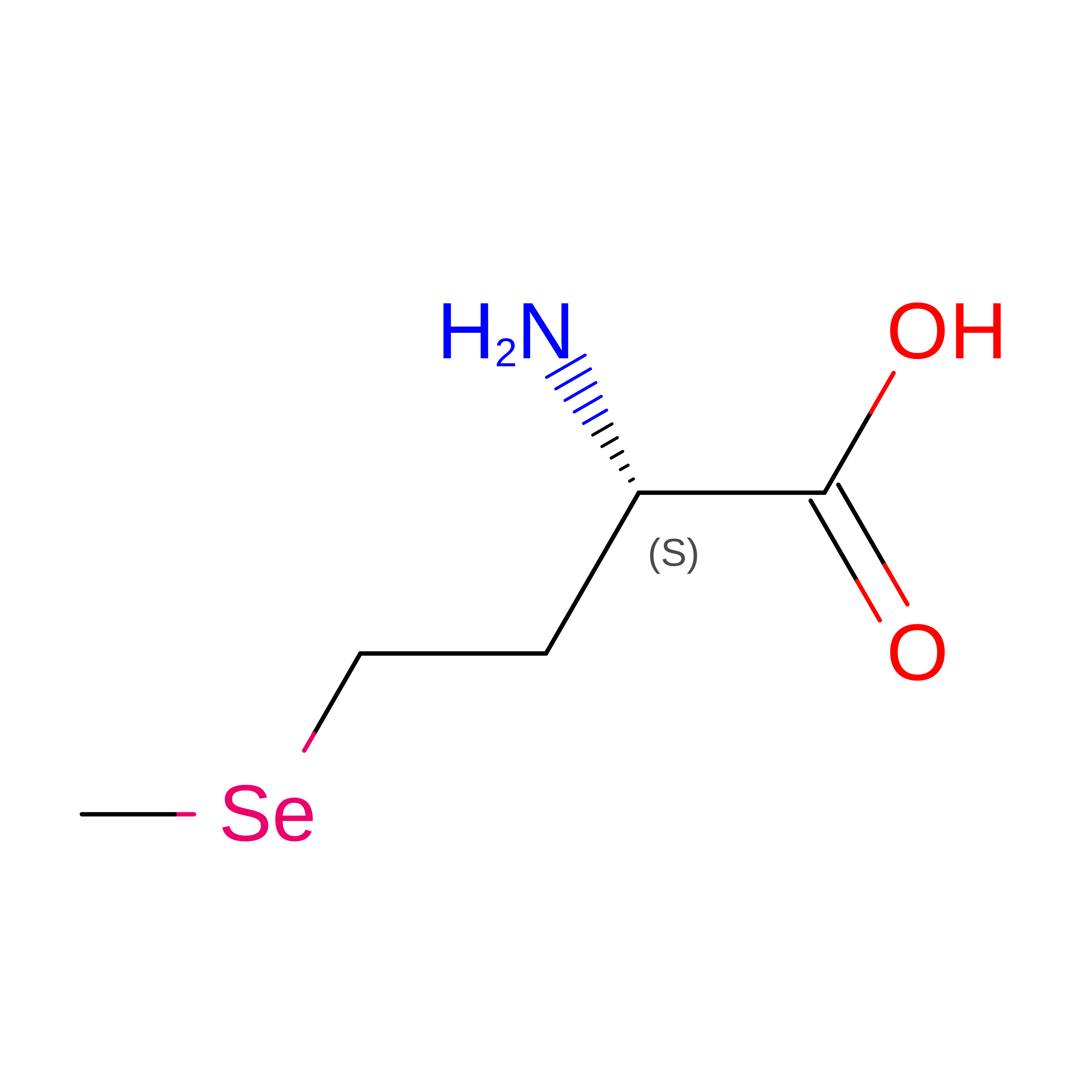
L-PEPTIDE LINKINGC5 H11 N O2 SeMET

Experimental Data & Validation

Experimental Data

  • Method: X-RAY DIFFRACTION
  • Resolution: 2.95 Å
  • R-Value Free:  0.234 (Depositor), 0.232 (DCC) 
  • R-Value Work:  0.226 (Depositor), 0.222 (DCC) 
Space Group: H 3 2
Unit Cell:
Length ( Å )Angle ( ˚ )
a = 132.864α = 90
b = 132.864β = 90
c = 442.261γ = 120
Software Package:
Software NamePurpose
DENZOdata reduction
SCALEPACKdata scaling
SHARPphasing
SOLOMONphasing
CNSrefinement
PDB_EXTRACTdata extraction
HKL-2000data collection
HKL-2000data reduction
HKL-2000data scaling

Structure Validation

View Full Validation Report


Ligand Structure Quality Assessment 


Entry History 

Deposition Data

Revision History  (Full details and data files)

  • Version 1.0: 2007-02-13
    Type: Initial release
  • Version 1.1: 2008-05-01
    Changes: Version format compliance
  • Version 1.2: 2011-07-13
    Changes: Source and taxonomy, Version format compliance
  • Version 1.3: 2017-10-18
    Changes: Refinement description
  • Version 1.4: 2023-12-27
    Changes: Data collection, Database references, Derived calculations
  • Version 1.5: 2024-11-13
    Changes: Structure summary