2NPM | pdb_00002npm

crystal structure of Cryptosporidium parvum 14-3-3 protein in complex with peptide


Experimental Data Snapshot

  • Method: X-RAY DIFFRACTION
  • Resolution: 2.52 Å
  • R-Value Free: 
    0.275 (Depositor) 
  • R-Value Work: 
    0.221 (Depositor) 
  • R-Value Observed: 
    0.222 (Depositor) 

Starting Model: experimental
View more details

wwPDB Validation 3D Report Full Report

Validation slider image for 2NPM

This is version 1.6 of the entry. See complete history

Literature

Characterization of 14-3-3 proteins from Cryptosporidium parvum.

Brokx, S.J.Wernimont, A.K.Dong, A.Wasney, G.A.Lin, Y.H.Lew, J.Vedadi, M.Lee, W.H.Hui, R.

(2011) PLoS One 6: e14827-e14827

  • DOI: https://doi.org/10.1371/journal.pone.0014827
  • Primary Citation Related Structures: 
    2NPM, 2O8P, 3EFZ

  • PubMed Abstract: 

    The parasite Cryptosporidium parvum has three 14-3-3 proteins: Cp14ε, Cp14a and Cp14b, with only Cp14ε similar to human 14-3-3 proteins in sequence, peptide-binding properties and structure. Structurally, Cp14a features the classical 14-3-3 dimer but with a uniquely wide pocket and a disoriented RRY triad potentially incapable of binding phosphopeptides. The Cp14b protein deviates from the norm significantly: (i) In one subunit, the phosphorylated C-terminal tail is bound in the binding groove like a phosphopeptide. This supports our binding study indicating this protein was stabilized by a peptide mimicking its last six residues. (ii) The other subunit has eight helices instead of nine, with αA and αB forming a single helix and occluding the peptide-binding cleft. (iii) The protein forms a degenerate dimer with the two binding grooves divided and facing opposite directions. These features conspire to block and disrupt the bicameral substrate-binding pocket, suggesting a possible tripartite auto-regulation mechanism that has not been observed previously. This article can also be viewed as an enhanced version in which the text of the article is integrated with interactive 3D representations and animated transitions. Please note that a web plugin is required to access this enhanced functionality. Instructions for the installation and use of the web plugin are available in Text S1.


  • Organizational Affiliation
    • Structural Genomics Consortium, University of Toronto, Toronto, Ontario, Canada.

Macromolecule Content 

  • Total Structure Weight: 61.02 kDa 
  • Atom Count: 3,756 
  • Modeled Residue Count: 484 
  • Deposited Residue Count: 532 
  • Unique protein chains: 2

Macromolecules

Find similar proteins by:|  3D Structure
Entity ID: 1
MoleculeChains  Sequence LengthOrganismDetailsImage
14-3-3 domain containing proteinA,
C [auth B]
260Cryptosporidium parvumMutation(s): 0 
Gene Names: cgd3_1290
UniProt
Find proteins for Q5CUW0 (Cryptosporidium parvum (strain Iowa II))
Explore Q5CUW0 
Go to UniProtKB:  Q5CUW0
Entity Groups
Sequence Clusters30% Identity50% Identity70% Identity90% Identity95% Identity100% Identity
UniProt GroupQ5CUW0
Sequence Annotations
Expand
Reference Sequence
Find similar proteins by:  Sequence   |   3D Structure  
Entity ID: 2
MoleculeChains  Sequence LengthOrganismDetailsImage
CONSENSUS PEPTIDE FOR 14-3-3 PROTEINSB [auth X],
D [auth Y]
6N/AMutation(s): 0 

Small Molecules

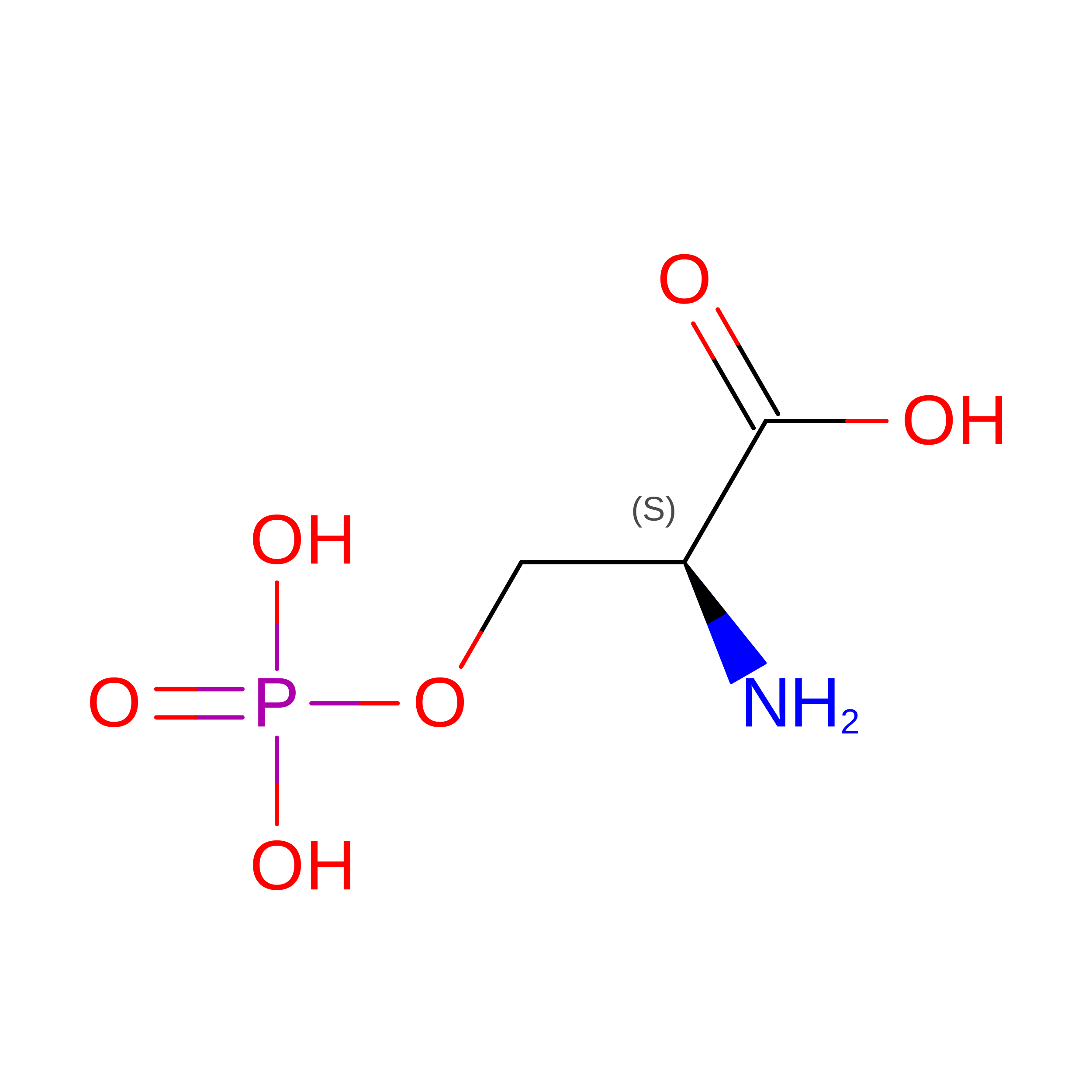
Modified Residues  1 Unique
IDChains TypeFormula2D DiagramParent
SEP
Query on SEP
B [auth X],
D [auth Y]
L-PEPTIDE LINKINGC3 H8 N O6 PSER

Experimental Data & Validation

Experimental Data

  • Method: X-RAY DIFFRACTION
  • Resolution: 2.52 Å
  • R-Value Free:  0.275 (Depositor) 
  • R-Value Work:  0.221 (Depositor) 
  • R-Value Observed: 0.222 (Depositor) 
Space Group: P 41 21 2
Unit Cell:
Length ( Å )Angle ( ˚ )
a = 104.125α = 90
b = 104.125β = 90
c = 148.877γ = 90
Software Package:
Software NamePurpose
REFMACrefinement
JDirectordata collection
HKL-2000data reduction
HKL-2000data scaling
PHASERphasing
Cootmodel building

Structure Validation

View Full Validation Report


Entry History 

Revision History  (Full details and data files)

  • Version 1.0: 2006-11-07
    Type: Initial release
  • Version 1.1: 2008-05-01
    Changes: Version format compliance
  • Version 1.2: 2011-07-13
    Changes: Version format compliance
  • Version 1.3: 2012-02-22
    Changes: Database references
  • Version 1.4: 2017-10-18
    Changes: Refinement description
  • Version 1.5: 2023-08-30
    Changes: Data collection, Database references, Derived calculations, Refinement description
  • Version 1.6: 2024-11-20
    Changes: Structure summary