Download Mendeley
Suppression of subtelomeric VSG switching by Trypanosoma brucei TRF requires its TTAGGG repeat-binding activity.
Jehi, S.E., Li, X., Sandhu, R., Ye, F., Benmerzouga, I., Zhang, M., Zhao, Y., Li, B.(2014) Nucleic Acids Res 42: 12899-12911
- PubMed: 25313155 Search on PubMedSearch on PubMed Central
- DOI: https://doi.org/10.1093/nar/gku942
- Primary Citation Related Structures:
2M9H - PubMed Abstract:
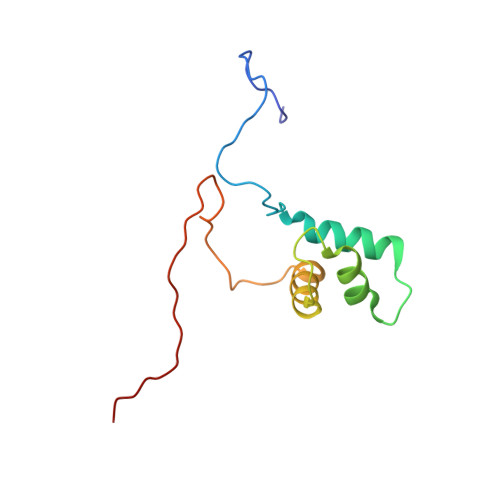
Trypanosoma brucei causes human African trypanosomiasis and regularly switches its major surface antigen, VSG, in the bloodstream of its mammalian host to evade the host immune response. VSGs are expressed exclusively from subtelomeric loci, and we have previously shown that telomere proteins TbTIF2 and TbRAP1 play important roles in VSG switching and VSG silencing regulation, respectively. We now discover that the telomere duplex DNA-binding factor, TbTRF, also plays a critical role in VSG switching regulation, as a transient depletion of TbTRF leads to significantly more VSG switching events. We solved the NMR structure of the DNA-binding Myb domain of TbTRF, which folds into a canonical helix-loop-helix structure that is conserved to the Myb domains of mammalian TRF proteins. The TbTRF Myb domain tolerates well the bulky J base in T. brucei telomere DNA, and the DNA-binding affinity of TbTRF is not affected by the presence of J both in vitro and in vivo. In addition, we find that point mutations in TbTRF Myb that significantly reduced its in vivo telomere DNA-binding affinity also led to significantly increased VSG switching frequencies, indicating that the telomere DNA-binding activity is critical for TbTRF's role in VSG switching regulation.
- Center for Gene Regulation in Health and Disease, Department of Biological, Geological, and Environmental Sciences, Cleveland State University, Cleveland, OH 44115, USA.
Organizational Affiliation: