Download Mendeley
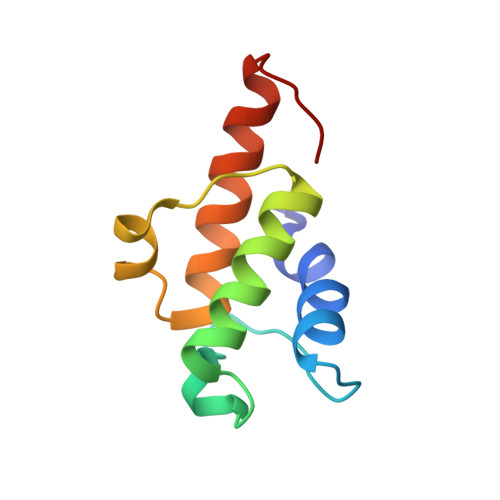
Solution structure of 4'-phosphopantetheine - GmACP3 from Geobacter metallireducens: a specialized acyl carrier protein with atypical structural features and a putative role in lipopolysaccharide biosynthesis.
Ramelot, T.A., Smola, M.J., Lee, H.W., Ciccosanti, C., Hamilton, K., Acton, T.B., Xiao, R., Everett, J.K., Prestegard, J.H., Montelione, G.T., Kennedy, M.A.(2011) Biochemistry 50: 1442-1453
- PubMed: 21235239 Search on PubMedSearch on PubMed Central
- DOI: https://doi.org/10.1021/bi101932s
- Primary Citation Related Structures:
2LML - PubMed Abstract:
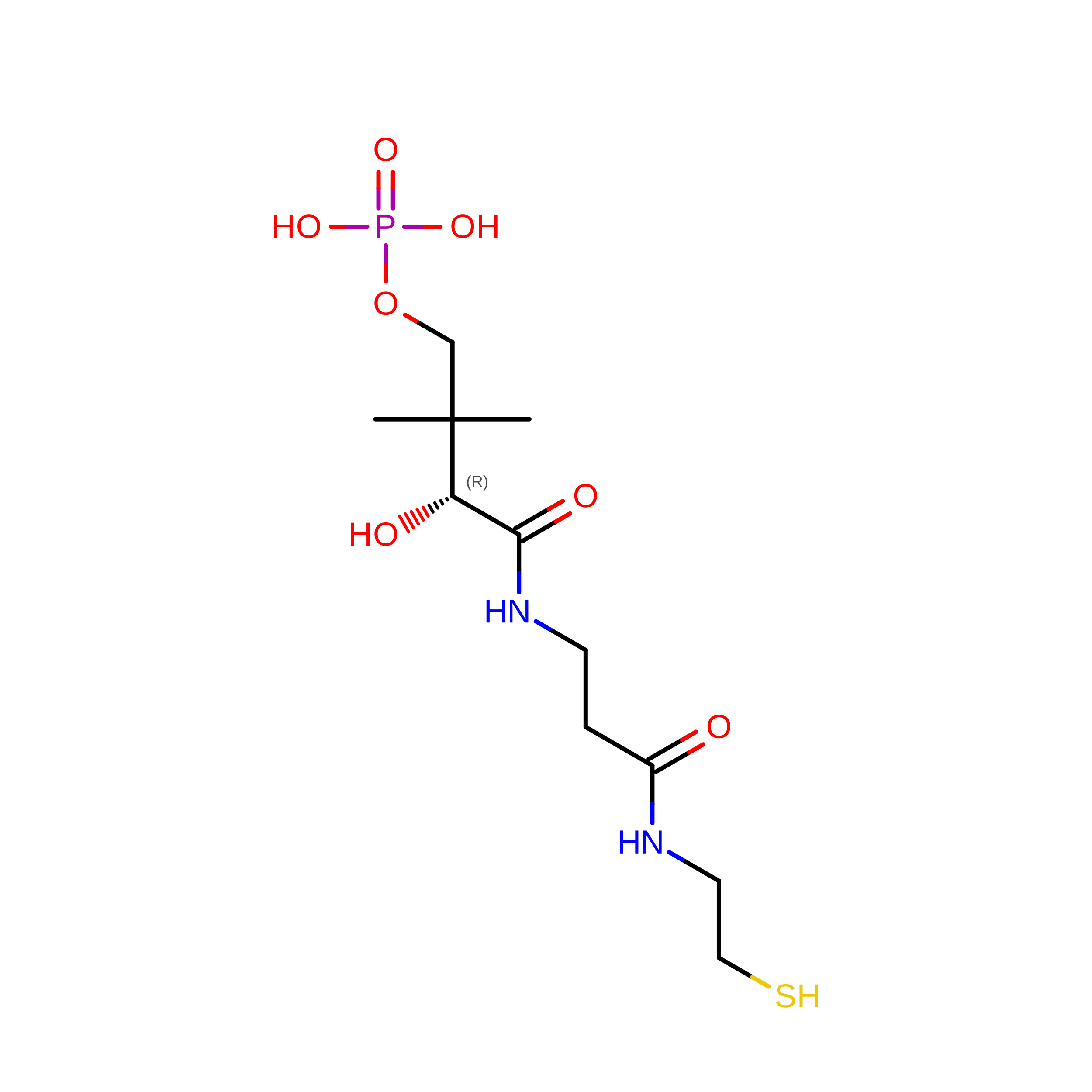
GmACP3 from Geobacter metallireducens is a specialized acyl carrier protein (ACP) whose gene, gmet_2339, is located near genes encoding many proteins involved in lipopolysaccharide (LPS) biosynthesis, indicating a likely function for GmACP3 in LPS production. By overexpression in Escherichia coli, about 50% holo-GmACP3 and 50% apo-GmACP3 were obtained. Apo-GmACP3 exhibited slow precipitation and non-monomeric behavior by (15)N NMR relaxation measurements. Addition of 4'-phosphopantetheine (4'-PP) via enzymatic conversion by E. coli holo-ACP synthase resulted in stable >95% holo-GmACP3 that was characterized as monomeric by (15)N relaxation measurements and had no indication of conformational exchange. We have determined a high-resolution solution structure of holo-GmACP3 by standard NMR methods, including refinement with two sets of NH residual dipolar couplings, allowing for a detailed structural analysis of the interactions between 4'-PP and GmACP3. Whereas the overall four helix bundle topology is similar to previously solved ACP structures, this structure has unique characteristics, including an ordered 4'-PP conformation that places the thiol at the entrance to a central hydrophobic cavity near a conserved hydrogen-bonded Trp-His pair. These residues are part of a conserved WDSLxH/N motif found in GmACP3 and its orthologs. The helix locations and the large hydrophobic cavity are more similar to medium- and long-chain acyl-ACPs than to other apo- and holo-ACP structures. Taken together, structural characterization along with bioinformatic analysis of nearby genes suggests that GmACP3 is involved in lipid A acylation, possibly by atypical long-chain hydroxy fatty acids, and potentially is involved in synthesis of secondary metabolites.
- Department of Chemistry and Biochemistry, Miami University, Oxford, Ohio 45056, United States.
Organizational Affiliation: