Download Mendeley
Rapid, robotic, small-scale protein production for NMR screening and structure determination.
Jensen, D.R., Woytovich, C., Li, M., Duvnjak, P., Cassidy, M.S., Frederick, R.O., Bergeman, L.F., Peterson, F.C., Volkman, B.F.(2010) Protein Sci 19: 570-578
- PubMed: 20073081 Search on PubMedSearch on PubMed Central
- DOI: https://doi.org/10.1002/pro.335
- Primary Citation Related Structures:
2KOM - PubMed Abstract:
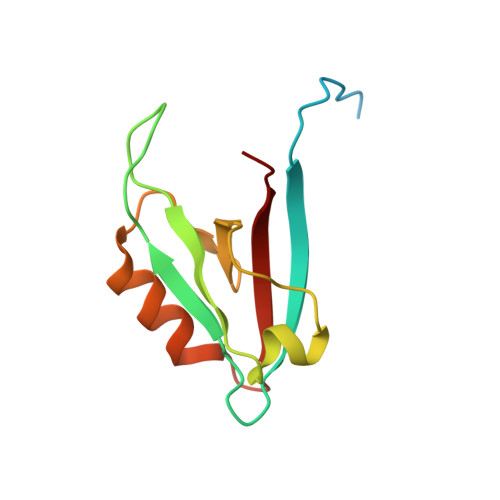
Three-dimensional protein structure determination is a costly process due in part to the low success rate within groups of potential targets. Conventional validation methods eliminate the vast majority of proteins from further consideration through a time-consuming succession of screens for expression, solubility, purification, and folding. False negatives at each stage incur unwarranted reductions in the overall success rate. We developed a semi-automated protocol for isotopically-labeled protein production using the Maxwell-16, a commercially available bench top robot, that allows for single-step target screening by 2D NMR. In the span of a week, one person can express, purify, and screen 48 different (15)N-labeled proteins, accelerating the validation process by more than 10-fold. The yield from a single channel of the Maxwell-16 is sufficient for acquisition of a high-quality 2D (1)H-(15)N-HSQC spectrum using a 3-mm sample cell and 5-mm cryogenic NMR probe. Maxwell-16 screening of a control group of proteins reproduced previous validation results from conventional small-scale expression screening and large-scale production approaches currently employed by our structural genomics pipeline. Analysis of 18 new protein constructs identified two potential structure targets that included the second PDZ domain of human Par-3. To further demonstrate the broad utility of this production strategy, we solved the PDZ2 NMR structure using [U-(15)N,(13)C] protein prepared using the Maxwell-16. This novel semi-automated protein production protocol reduces the time and cost associated with NMR structure determination by eliminating unnecessary screening and scale-up steps.
- Department of Biochemistry and Center for Eukaryotic Structural Genomics, Medical College of Wisconsin, Milwaukee, Wisconsin 53226, USA.
Organizational Affiliation: