Download Mendeley
Structures of human host defense cathelicidin LL-37 and its smallest antimicrobial peptide KR-12 in lipid micelles
Wang, G.(2008) J Biol Chem 283: 32637-32643
- PubMed: 18818205 Search on PubMed
- DOI: https://doi.org/10.1074/jbc.M805533200
- Primary Citation Related Structures:
2K6O - PubMed Abstract:
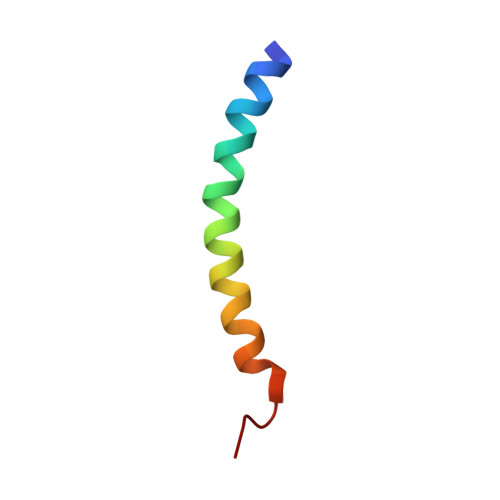
As a key component of the innate immunity system, human cathelicidin LL-37 plays an essential role in protecting humans against infectious diseases. To elucidate the structural basis for its targeting bacterial membrane, we have determined the high quality structure of (13)C,(15)N-labeled LL-37 by three-dimensional triple-resonance NMR spectroscopy, because two-dimensional (1)H NMR did not provide sufficient spectral resolution. The structure of LL-37 in SDS micelles is composed of a curved amphipathic helix-bend-helix motif spanning residues 2-31 followed by a disordered C-terminal tail. The helical bend is located between residues Gly-14 and Glu-16. Similar chemical shifts and (15)N nuclear Overhauser effect (NOE) patterns of the peptide in complex with dioctanoylphosphatidylglycerol (D8PG) micelles indicate a similar structure. The aromatic rings of Phe-5, Phe-6, Phe-17, and Phe-27 of LL-37, as well as arginines, showed intermolecular NOE cross-peaks with D8PG, providing direct evidence for the association of the entire amphipathic helix with anionic lipid micelles. The structure of LL-37 serves as a model for understanding the structure and function relationship of homologous primate cathelicidins. Using synthetic peptides, we also identified the smallest antibacterial peptide KR-12 corresponding to residues 18-29 of LL-37. Importantly, KR-12 displayed a selective toxic effect on bacteria but not human cells. NMR structural analysis revealed a short three-turn amphipathic helix rich in positively charged side chains, allowing for effective competition for anionic phosphatidylglycerols in bacterial membranes. KR-12 may be a useful peptide template for developing novel antimicrobial agents of therapeutic use.
- Eppley Institute for Research in Cancer and Allied Diseases, University of Nebraska Medical Center, Omaha, Nebraska 68198-6805, USA. gwang@unmc.edu
Organizational Affiliation: