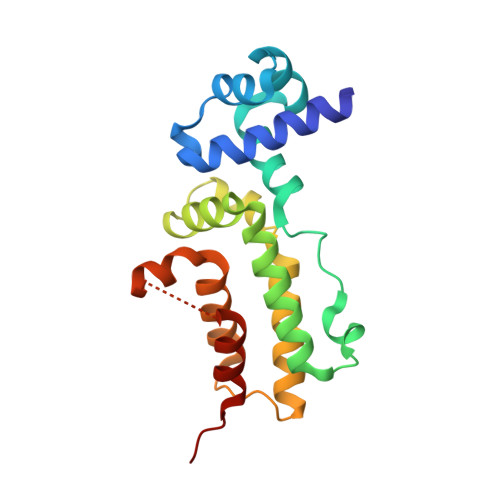
2JK3 | pdb_00002jk3

CRYSTAL STRUCTURE OF THE HLYIIR MUTANT PROTEIN WITH RESIDUES 169-186 SUBSTITUTED BY GSSGSSG LINKER


Experimental Data Snapshot

  • Method: X-RAY DIFFRACTION
  • Resolution: 2.20 Å
  • R-Value Free: 
    0.254 (Depositor), 0.282 (DCC) 
  • R-Value Work: 
    0.198 (Depositor), 0.231 (DCC) 
  • R-Value Observed: 
    0.201 (Depositor) 

Starting Model: experimental
View more details

wwPDB Validation 3D Report Full Report

Validation slider image for 2JK3

This is version 1.3 of the entry. See complete history

Literature

Structural Investigation of Transcriptional Regulator Hlyiir: Influence of a Disordered Region on Protein Fold and Dimerization.

Kovalevskiy, O.V.Solonin, A.S.Antson, A.A.

(2010) Proteins 78: 1870

  • DOI: https://doi.org/10.1002/prot.22700
  • Primary Citation Related Structures: 
    2JK3, 2WV1

  • PubMed Abstract: 

    B. cereus HlyIIR belongs to the TetR family of dimeric transcriptional regulators. Unlike other members of the TetR family, HlyIIR contains an insert between alpha-helices alpha8 and alpha9, which is located at the subunit-subunit interface. N-terminal segment of this insert (amino acids, Pro161-Ser169) forms a short alpha-helix alpha8* that occupies a complementary cavity on the surface of the adjacent subunit, whereas the C-terminal segment comprising 16 amino acids (Leu170-Glu185) is disordered. To understand whether this disordered segment is important for protein's function, we determined crystal structures of two engineered HlyIIR proteins where this segment was either substituted by a seven-residue flexible Ser-Gly linker or replaced by a cleavable peptide containing proteolytic sites at both ends. Unexpectedly, alteration or proteolytic removal of the disordered segment resulted in changes in protein's conformation and in a remarkable rearrangement at the subunit-subunit interface. X-ray structures of the two engineered proteins revealed an unusual plasticity at the dimerization interface of HlyIIR enabling it to form dimers stabilized by different sets of interactions. Structural comparison indicates that in spite of the flexible nature of the disordered segment, it is critical for maintaining the native structure as it influences the position of alpha8*. The data demonstrate how disordered loops on protein surfaces may affect folding and subunit-subunit interactions.


  • Organizational Affiliation
    • York Structural Biology Laboratory, Department of Chemistry, University of York, Heslington, York, United Kingdom. oleg@ysbl.york.ac.uk

Macromolecule Content 

  • Total Structure Weight: 43.27 kDa 
  • Atom Count: 3,121 
  • Modeled Residue Count: 363 
  • Deposited Residue Count: 376 
  • Unique protein chains: 1

Macromolecules

Find similar proteins by:|  3D Structure
Entity ID: 1
MoleculeChains  Sequence LengthOrganismDetailsImage
HEMOLYSIN II REGULATORY PROTEIN
A, B
188Bacillus cereusMutation(s): 0 
UniProt
Find proteins for Q7X506 (Bacillus cereus)
Explore Q7X506 
Go to UniProtKB:  Q7X506
Entity Groups
Sequence Clusters30% Identity50% Identity70% Identity90% Identity95% Identity100% Identity
UniProt GroupQ7X506
Sequence Annotations
Expand
Reference Sequence

Small Molecules

Ligands 1 Unique
IDChains Name / Formula / InChI Key2D Diagram3D Interactions
SO4

Query on SO4


Download:Ideal Coordinates CCD File
C [auth B]SULFATE ION
O4 S
QAOWNCQODCNURD-UHFFFAOYSA-L

Experimental Data & Validation

Experimental Data

  • Method: X-RAY DIFFRACTION
  • Resolution: 2.20 Å
  • R-Value Free:  0.254 (Depositor), 0.282 (DCC) 
  • R-Value Work:  0.198 (Depositor), 0.231 (DCC) 
  • R-Value Observed: 0.201 (Depositor) 
Space Group: P 21 21 21
Unit Cell:
Length ( Å )Angle ( ˚ )
a = 38.383α = 90
b = 78.99β = 90
c = 143.814γ = 90
Software Package:
Software NamePurpose
REFMACrefinement
DENZOdata reduction
SCALEPACKdata scaling
MOLREPphasing

Structure Validation

View Full Validation Report


Entry History 

Deposition Data

Revision History  (Full details and data files)

  • Version 1.0: 2008-08-19
    Type: Initial release
  • Version 1.1: 2011-07-13
    Changes: Advisory, Version format compliance
  • Version 1.2: 2011-10-12
    Changes: Database references, Derived calculations, Structure summary
  • Version 1.3: 2023-12-13
    Changes: Data collection, Database references, Derived calculations, Other, Refinement description