2JAR | pdb_00002jar

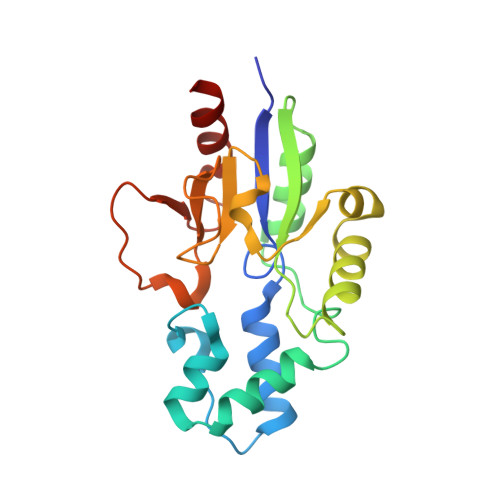
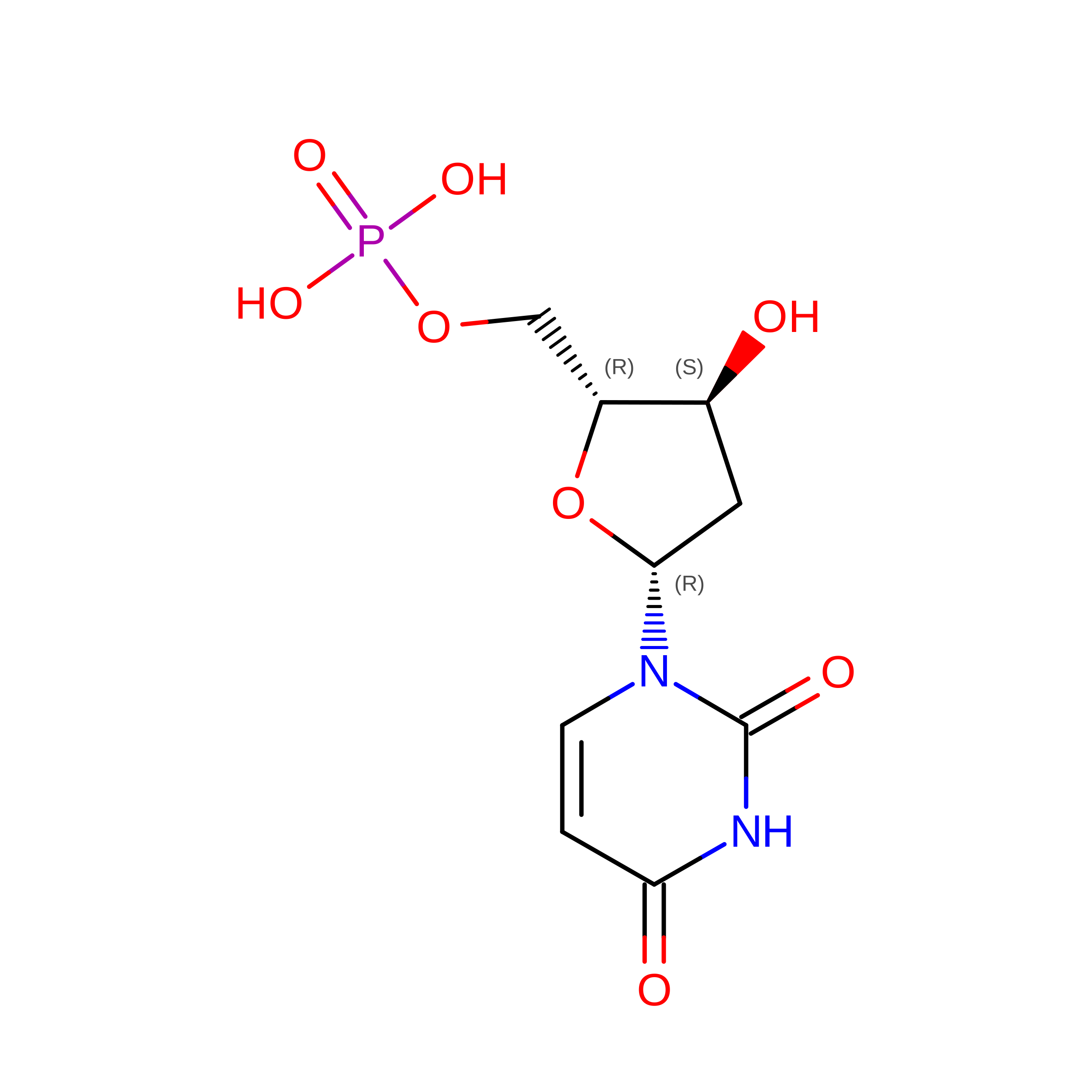
Crystal structure of D12N variant of mouse cytosolic 5'(3')- deoxyribonucleotidase (cdN) in complex with deoxyuridine 5'- monophosphate


Experimental Data Snapshot

  • Method: X-RAY DIFFRACTION
  • Resolution: 1.94 Å
  • R-Value Free: 
    0.201 (Depositor), 0.202 (DCC) 
  • R-Value Work: 
    0.156 (Depositor), 0.155 (DCC) 
  • R-Value Observed: 
    0.158 (Depositor) 

wwPDB Validation 3D Report Full Report

Validation slider image for 2JAR

Ligand Structure Quality Assessment 


This is version 1.4 of the entry. See complete history

Literature

Crystal Structures of Human and Murine Deoxyribonucleotidases: Insights Into Recognition of Substrates and Nucleotide Analogues.

Wallden, K.Rinaldo-Matthis, A.Ruzzenente, B.Rampazzo, C.Bianchi, V.Nordlund, P.

(2007) Biochemistry 46: 13809

  • DOI: https://doi.org/10.1021/bi7014794
  • Primary Citation Related Structures: 
    2JAO, 2JAR, 2JAU, 2JAW

  • PubMed Abstract: 

    Cytosolic 5'(3')-deoxyribonucleotidase (cdN) and mitochondrial 5'(3')-deoxyribonucleotidase (mdN) catalyze the dephosphorylation of deoxyribonucleoside monophosphates and regulate dTTP formation in cytosol and mitochondria, protecting DNA replication from imbalanced precursor pools. They can also interfere with the phosphorylation-dependent activation of nucleoside analogues used in anticancer and antiviral treatment. To understand the relatively narrow substrate specificity of these two enzymes and their ability to use nucleotide analogues as substrates, we determined the crystal structures of human cdN in complex with deoxyuridine, murine cdN in complex with dUMP and dGMP, and human mdN in complex with the nucleotide analogues AZTMP and BVdUMP. Our results show that the active site residues Leu45 and Tyr65 in cdN form a more favorable binding surface for purine nucleotides than the corresponding Trp75 and Trp76 in mdN, explaining why cdN has higher activity for purine nucleotides than does mdN. The molecular interactions of mdN with AZTMP and BVdUMP indicate why these nucleotide analogues are poorer substrates as compared with the physiological substrate, and they provide a structural rationale for the design of drugs that are less prone to inactivation by the deoxyribonucleotidases. We suggest that introduction of substituents in the 3'-position may result in nucleoside analogues with increased resistance to dephosphorylation.


  • Organizational Affiliation
    • Department of Biochemistry and Biophysics, Stockholm University, SE-106 91 Stockholm, Sweden.

Macromolecule Content 

  • Total Structure Weight: 23.44 kDa 
  • Atom Count: 1,908 
  • Modeled Residue Count: 196 
  • Deposited Residue Count: 200 
  • Unique protein chains: 1

Macromolecules

Find similar proteins by:|  3D Structure
Entity ID: 1
MoleculeChains  Sequence LengthOrganismDetailsImage
5'(3')-DEOXYRIBONUCLEOTIDASE200Mus musculusMutation(s): 1 
EC: 3.1.3
UniProt
Find proteins for Q9JM14 (Mus musculus)
Explore Q9JM14 
Go to UniProtKB:  Q9JM14
Entity Groups
Sequence Clusters30% Identity50% Identity70% Identity90% Identity95% Identity100% Identity
UniProt GroupQ9JM14
Sequence Annotations
Expand
Reference Sequence

Small Molecules

Experimental Data & Validation

Experimental Data

  • Method: X-RAY DIFFRACTION
  • Resolution: 1.94 Å
  • R-Value Free:  0.201 (Depositor), 0.202 (DCC) 
  • R-Value Work:  0.156 (Depositor), 0.155 (DCC) 
  • R-Value Observed: 0.158 (Depositor) 
Space Group: P 62
Unit Cell:
Length ( Å )Angle ( ˚ )
a = 75.309α = 90
b = 75.309β = 90
c = 85.174γ = 120
Software Package:
Software NamePurpose
REFMACrefinement
MOSFLMdata reduction
SCALAdata scaling
MOLREPphasing

Structure Validation

View Full Validation Report


Ligand Structure Quality Assessment 


Entry History 

Deposition Data

Revision History  (Full details and data files)

  • Version 1.0: 2007-11-20
    Type: Initial release
  • Version 1.1: 2011-05-08
    Changes: Version format compliance
  • Version 1.2: 2011-07-13
    Changes: Version format compliance
  • Version 1.3: 2019-05-15
    Changes: Data collection, Experimental preparation, Other
  • Version 1.4: 2024-05-08
    Changes: Data collection, Database references, Derived calculations, Other