2J72 | pdb_00002j72

alpha-glucan recognition by a family 41 carbohydrate-binding module from Thermotoga maritima pullulanase PulA


Experimental Data Snapshot

  • Method: X-RAY DIFFRACTION
  • Resolution: 1.49 Å
  • R-Value Free: 
    0.232 (Depositor), 0.239 (DCC) 
  • R-Value Work: 
    0.165 (Depositor), 0.174 (DCC) 
  • R-Value Observed: 
    0.168 (Depositor) 

Starting Model: experimental
View more details

wwPDB Validation 3D Report Full Report

Validation slider image for 2J72

This is version 2.1 of the entry. See complete history

Literature

The Structural Basis of Alpha-Glucan Recognition by a Family 41 Carbohydrate-Binding Module from Thermotoga Maritima

Lammerts Van Bueren, A.Boraston, A.B.

(2007) J Mol Biology 365: 555

  • DOI: https://doi.org/10.1016/j.jmb.2006.10.018
  • Primary Citation Related Structures: 
    2J71, 2J72, 2J73

  • PubMed Abstract: 

    Starch recognition by carbohydrate-binding modules (CBMs) is important for the activity of starch-degrading enzymes. The N-terminal family 41 CBM, TmCBM41 (from pullulanase PulA secreted by Thermotoga maritima) was shown to have alpha-glucan binding activity with specificity for alpha-1,4-glucans but was able to tolerate the alpha-1,6-linkages found roughly every three or four glucose units in pullulan. Using X-ray crystallography, the structures were solved for TmCBM41 in an uncomplexed form and in complex with maltotetraose and 6(3)-alpha-D-glucosyl-maltotriose (GM3). Ligand binding was facilitated by stacking interactions between the alpha-faces of the glucose residues and two tryptophan side-chains in the two main subsites of the carbohydrate-binding site. Overall, this mode of starch binding is quite well conserved by other starch-binding modules. The structure in complex with GM3 revealed a third binding subsite with the flexibility to accommodate an alpha-1,4- or an alpha-1,6-linked glucose.


  • Organizational Affiliation
    • Biochemistry and Microbiology, University of Victoria, PO Box 3055 STN CSC, Victoria, BC, Canada V8W 3P6.

Macromolecule Content 

  • Total Structure Weight: 25.49 kDa 
  • Atom Count: 2,180 
  • Modeled Residue Count: 205 
  • Deposited Residue Count: 206 
  • Unique protein chains: 1

Macromolecules

Find similar proteins by:|  3D Structure
Entity ID: 1
MoleculeChains  Sequence LengthOrganismDetailsImage
PULLULANASE
A, B
103Thermotoga maritimaMutation(s): 0 
EC: 3.2.1.41
UniProt
Find proteins for O33840 (Thermotoga maritima (strain ATCC 43589 / DSM 3109 / JCM 10099 / NBRC 100826 / MSB8))
Explore O33840 
Go to UniProtKB:  O33840
Entity Groups
Sequence Clusters30% Identity50% Identity70% Identity90% Identity95% Identity100% Identity
UniProt GroupO33840
Sequence Annotations
Expand
Reference Sequence

Oligosaccharides

Help  
Entity ID: 2
MoleculeChains Length2D Diagram GlycosylationD Interactions
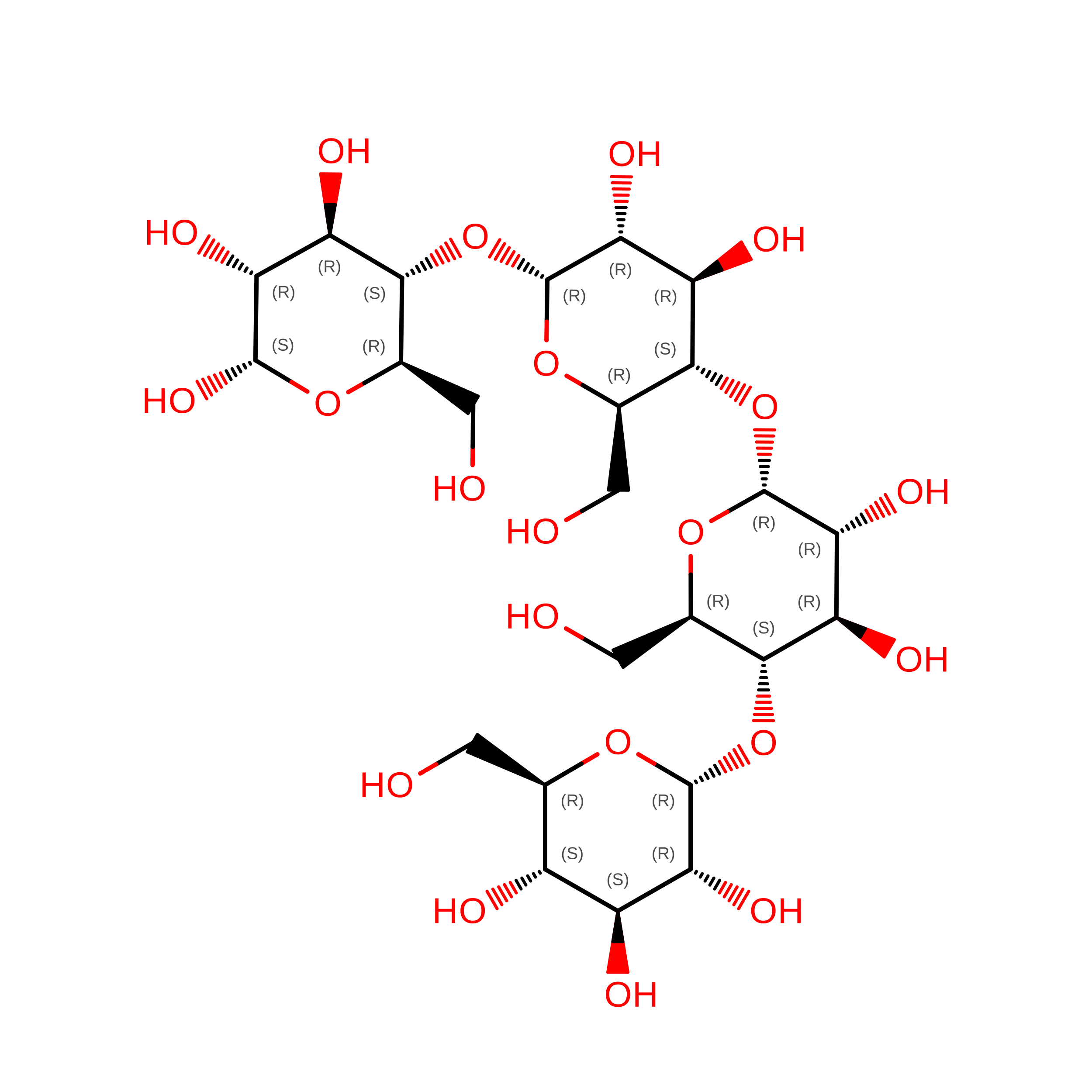
alpha-D-glucopyranose-(1-4)-alpha-D-glucopyranose-(1-4)-alpha-D-glucopyranose-(1-4)-alpha-D-glucopyranose
C, D
4N/A
Glycosylation Resources
GlyTouCan: G87171PZ
GlyCosmos: G87171PZ
GlyGen: G87171PZ

Biologically Interesting Molecules (External Reference) 

1 Unique

Experimental Data & Validation

Experimental Data

  • Method: X-RAY DIFFRACTION
  • Resolution: 1.49 Å
  • R-Value Free:  0.232 (Depositor), 0.239 (DCC) 
  • R-Value Work:  0.165 (Depositor), 0.174 (DCC) 
  • R-Value Observed: 0.168 (Depositor) 
Space Group: C 1 2 1
Unit Cell:
Length ( Å )Angle ( ˚ )
a = 106.429α = 90
b = 37.179β = 112.38
c = 57.213γ = 90
Software Package:
Software NamePurpose
REFMACrefinement
MOLREPphasing

Structure Validation

View Full Validation Report


Entry History 

Deposition Data

Revision History  (Full details and data files)

  • Version 1.0: 2006-10-17
    Type: Initial release
  • Version 1.1: 2011-05-08
    Changes: Version format compliance
  • Version 1.2: 2011-07-13
    Changes: Version format compliance
  • Version 2.0: 2020-07-29
    Type: Remediation
    Reason: Carbohydrate remediation
    Changes: Atomic model, Data collection, Derived calculations, Other, Structure summary
  • Version 2.1: 2023-12-13
    Changes: Data collection, Database references, Refinement description, Structure summary