2IOV | pdb_00002iov

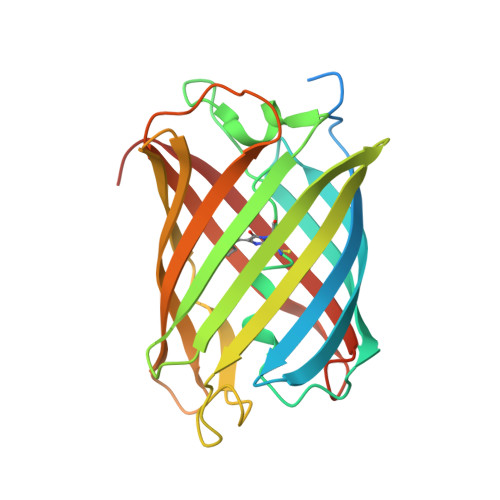
Bright-state structure of the reversibly switchable fluorescent protein Dronpa


Experimental Data Snapshot

  • Method: X-RAY DIFFRACTION
  • Resolution: 1.80 Å
  • R-Value Free: 
    0.216 (Depositor), 0.214 (DCC) 
  • R-Value Work: 
    0.185 (Depositor), 0.183 (DCC) 
  • R-Value Observed: 
    0.187 (Depositor) 

Starting Model: experimental
View more details

wwPDB Validation 3D Report Full Report

Validation slider image for 2IOV

This is version 3.0 of the entry. See complete history

Literature

1.8 A bright-state structure of the reversibly switchable fluorescent protein Dronpa guides the generation of fast switching variants

Stiel, A.C.Trowitzsch, S.Weber, G.Andresen, M.Eggeling, C.Hell, S.W.Jakobs, S.Wahl, M.C.

(2007) Biochem J 402: 35-42

  • DOI: https://doi.org/10.1042/BJ20061401
  • Primary Citation Related Structures: 
    2IOV

  • PubMed Abstract: 

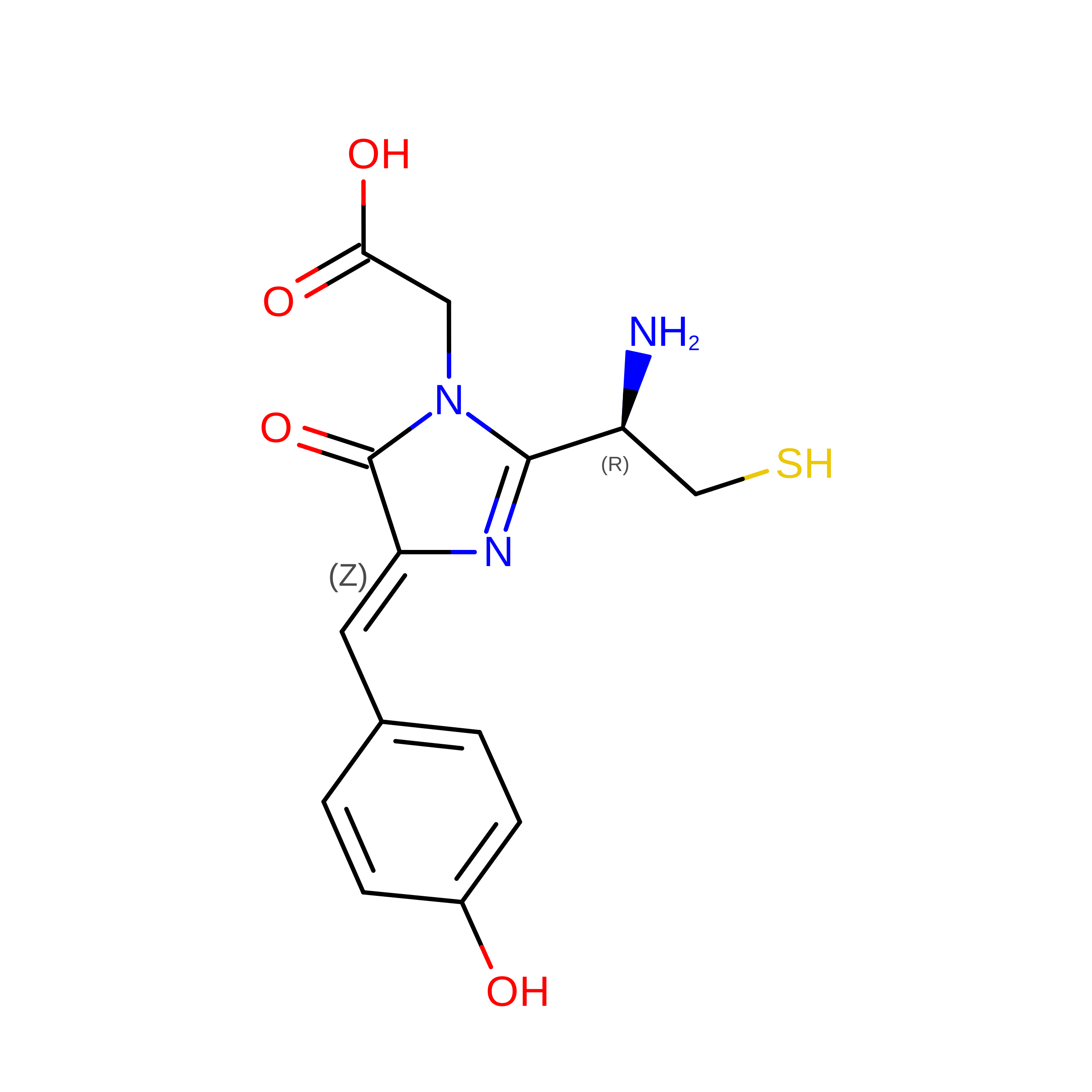
    RSFPs (reversibly switchable fluorescent proteins) may be repeatedly converted between a fluorescent and a non-fluorescent state by irradiation and have attracted widespread interest for many new applications. The RSFP Dronpa may be switched with blue light from a fluorescent state into a non-fluorescent state, and back again with UV light. To obtain insight into the underlying molecular mechanism of this switching, we have determined the crystal structure of the fluorescent equilibrium state of Dronpa. Its bicyclic chromophore is formed spontaneously from the Cys62-Tyr63-Gly64 tripeptide. In the fluorescent state, it adopts a slightly non-coplanar cis conformation within the interior of a typical GFP (green fluorescent protein) b-can fold. Dronpa shares some structural features with asFP595, another RSFP whose chromophore has previously been demonstrated to undergo a cis-trans isomerization upon photoswitching. Based on the structural comparison with asFP595, we have generated new Dronpa variants with an up to more than 1000-fold accelerated switching behaviour. The mutations which were introduced at position Val157 or Met159 apparently reduce the steric hindrance for a cis-trans isomerization of the chromophore, thus lowering the energy barrier for the blue light-driven on-to-off transition. The findings reported in the present study support the view that a cis-trans isomerization is one of the key events common to the switching mechanism in RSFPs.


  • Organizational Affiliation
    • Department of NanoBiophotonics, Max-Planck-Institute for Biophysical Chemistry, Am Fassberg 11, 37077 Göttingen, Germany.

Macromolecule Content 

  • Total Structure Weight: 116.99 kDa 
  • Atom Count: 8,339 
  • Modeled Residue Count: 875 
  • Deposited Residue Count: 1,020 
  • Unique protein chains: 1

Macromolecules

Find similar proteins by:|  3D Structure
Entity ID: 1
MoleculeChains  Sequence LengthOrganismDetailsImage
Fluorescent protein Dronpa
A, B, C, D
255Echinophyllia sp. SC22Mutation(s): 1 
Gene Names: Dronpa
UniProt
Find proteins for Q5TLG6 (Echinophyllia sp. SC22)
Explore Q5TLG6 
Go to UniProtKB:  Q5TLG6
Entity Groups
Sequence Clusters30% Identity50% Identity70% Identity90% Identity95% Identity100% Identity
UniProt GroupQ5TLG6
Sequence Annotations
Expand
Reference Sequence

Small Molecules

Modified Residues  1 Unique
IDChains TypeFormula2D DiagramParent
GYC
Query on GYC
A, B, C, D
L-PEPTIDE LINKINGC14 H15 N3 O4 SCYS, TYR, GLY

Experimental Data & Validation

Experimental Data

  • Method: X-RAY DIFFRACTION
  • Resolution: 1.80 Å
  • R-Value Free:  0.216 (Depositor), 0.214 (DCC) 
  • R-Value Work:  0.185 (Depositor), 0.183 (DCC) 
  • R-Value Observed: 0.187 (Depositor) 
Space Group: I 2 2 2
Unit Cell:
Length ( Å )Angle ( ˚ )
a = 75.292α = 90
b = 109.627β = 90
c = 275.232γ = 90
Software Package:
Software NamePurpose
REFMACrefinement
MAR345data collection
DENZOdata reduction
SCALEPACKdata scaling
MOLREPphasing

Structure Validation

View Full Validation Report


Entry History 

Deposition Data

Revision History  (Full details and data files)

  • Version 1.0: 2006-12-05
    Type: Initial release
  • Version 1.1: 2008-05-01
    Changes: Version format compliance
  • Version 1.2: 2011-07-13
    Changes: Advisory, Version format compliance
  • Version 1.3: 2017-10-18
    Changes: Refinement description
  • Version 1.4: 2023-10-25
    Changes: Data collection, Database references, Derived calculations, Refinement description
  • Version 2.0: 2023-11-15
    Changes: Atomic model, Data collection, Derived calculations
  • Version 2.1: 2024-10-16
    Changes: Structure summary
  • Version 3.0: 2026-03-18
    Changes: Polymer sequence