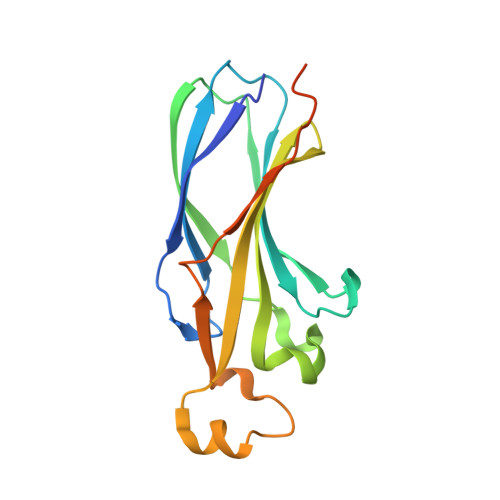
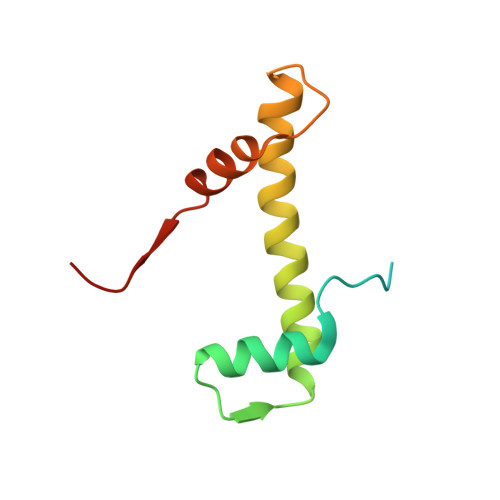
2IO5 | pdb_00002io5

Crystal structure of the CIA- histone H3-H4 complex


Experimental Data Snapshot

  • Method: X-RAY DIFFRACTION
  • Resolution: 2.70 Å
  • R-Value Free: 
    0.293 (Depositor), 0.291 (DCC) 
  • R-Value Work: 
    0.238 (Depositor), 0.236 (DCC) 
  • R-Value Observed: 
    0.240 (Depositor) 

Starting Models: experimental
View more details

wwPDB Validation 3D Report Full Report

Validation slider image for 2IO5

This is version 1.3 of the entry. See complete history

Literature

Structure and function of the histone chaperone CIA/ASF1 complexed with histones H3 and H4.

Natsume, R.Eitoku, M.Akai, Y.Sano, N.Horikoshi, M.Senda, T.

(2007) Nature 446: 338-341

  • DOI: https://doi.org/10.1038/nature05613
  • Primary Citation Related Structures: 
    2IO5

  • PubMed Abstract: 

    CIA (CCG1-interacting factor A)/ASF1, which is the most conserved histone chaperone among the eukaryotes, was genetically identified as a factor for an anti-silencing function (Asf1) by yeast genetic screening. Shortly after that, the CIA-histone-H3-H4 complex was isolated from Drosophila as a histone chaperone CAF-1 stimulator. Human CIA-I/II (ASF1a/b) was identified as a histone chaperone that interacts with the bromodomain-an acetylated-histone-recognizing domain-of CCG1, in the general transcription initiation factor TFIID. Intensive studies have revealed that CIA/ASF1 mediates nucleosome assembly by forming a complex with another histone chaperone in human cells and yeast, and is involved in DNA replication, transcription, DNA repair and silencing/anti-silencing in yeast. CIA/ASF1 was shown as a major storage chaperone for soluble histones in proliferating human cells. Despite all these biochemical and biological functional analyses, the structure-function relationship of the nucleosome assembly/disassembly activity of CIA/ASF1 has remained elusive. Here we report the crystal structure, at 2.7 A resolution, of CIA-I in complex with histones H3 and H4. The structure shows the histone H3-H4 dimer's mutually exclusive interactions with another histone H3-H4 dimer and CIA-I. The carboxy-terminal beta-strand of histone H4 changes its partner from the beta-strand in histone H2A to that of CIA-I through large conformational change. In vitro functional analysis demonstrated that CIA-I has a histone H3-H4 tetramer-disrupting activity. Mutants with weak histone H3-H4 dimer binding activity showed critical functional effects on cellular processes related to transcription. The histone H3-H4 tetramer-disrupting activity of CIA/ASF1 and the crystal structure of the CIA/ASF1-histone-H3-H4 dimer complex should give insights into mechanisms of both nucleosome assembly/disassembly and nucleosome semi-conservative replication.


  • Organizational Affiliation
    • Japan Biological Information Research Centre (JBIRC), Japan Biological Informatics Consortium (JBIC), 2-42 Aomi, Koto-ku, Tokyo 135-0064, Japan.

Macromolecule Content 

  • Total Structure Weight: 46.38 kDa 
  • Atom Count: 2,474 
  • Modeled Residue Count: 307 
  • Deposited Residue Count: 412 
  • Unique protein chains: 3

Macromolecules

Find similar proteins by:|  3D Structure
Entity ID: 1
MoleculeChains  Sequence LengthOrganismDetailsImage
ASF1A protein175Homo sapiensMutation(s): 0 
Gene Names: asf1a
UniProt & NIH Common Fund Data Resources
Find proteins for Q9Y294 (Homo sapiens)
Explore Q9Y294 
Go to UniProtKB:  Q9Y294
PHAROS:  Q9Y294
GTEx:  ENSG00000111875 
Entity Groups
Sequence Clusters30% Identity50% Identity70% Identity90% Identity95% Identity100% Identity
UniProt GroupQ9Y294
Sequence Annotations
Expand
Reference Sequence
Find similar proteins by:|  3D Structure
Entity ID: 2
MoleculeChains  Sequence LengthOrganismDetailsImage
Histone H3.1135Xenopus laevisMutation(s): 0 
Gene Names: Histone H3.1
UniProt
Find proteins for P84233 (Xenopus laevis)
Explore P84233 
Go to UniProtKB:  P84233
Entity Groups
Sequence Clusters30% Identity50% Identity70% Identity90% Identity95% Identity100% Identity
UniProt GroupP84233
Sequence Annotations
Expand
Reference Sequence
Find similar proteins by:|  3D Structure
Entity ID: 3
MoleculeChains  Sequence LengthOrganismDetailsImage
Histone H4102Xenopus laevisMutation(s): 0 
Gene Names: Histone H4
UniProt
Find proteins for P62799 (Xenopus laevis)
Explore P62799 
Go to UniProtKB:  P62799
Entity Groups
Sequence Clusters30% Identity50% Identity70% Identity90% Identity95% Identity100% Identity
UniProt GroupP62799
Sequence Annotations
Expand
Reference Sequence

Experimental Data & Validation

Experimental Data

  • Method: X-RAY DIFFRACTION
  • Resolution: 2.70 Å
  • R-Value Free:  0.293 (Depositor), 0.291 (DCC) 
  • R-Value Work:  0.238 (Depositor), 0.236 (DCC) 
  • R-Value Observed: 0.240 (Depositor) 
Space Group: C 2 2 21
Unit Cell:
Length ( Å )Angle ( ˚ )
a = 97.361α = 90
b = 104.78β = 90
c = 86.48γ = 90
Software Package:
Software NamePurpose
SCALAdata scaling
REFMACrefinement
PDB_EXTRACTdata extraction
ADSCdata collection
MOSFLMdata reduction
CCP4data scaling
MOLREPphasing

Structure Validation

View Full Validation Report


Entry History 

Deposition Data

Revision History  (Full details and data files)

  • Version 1.0: 2007-02-27
    Type: Initial release
  • Version 1.1: 2008-05-01
    Changes: Version format compliance
  • Version 1.2: 2011-07-13
    Changes: Advisory, Version format compliance
  • Version 1.3: 2023-10-25
    Changes: Data collection, Database references, Refinement description