2IHK | pdb_00002ihk

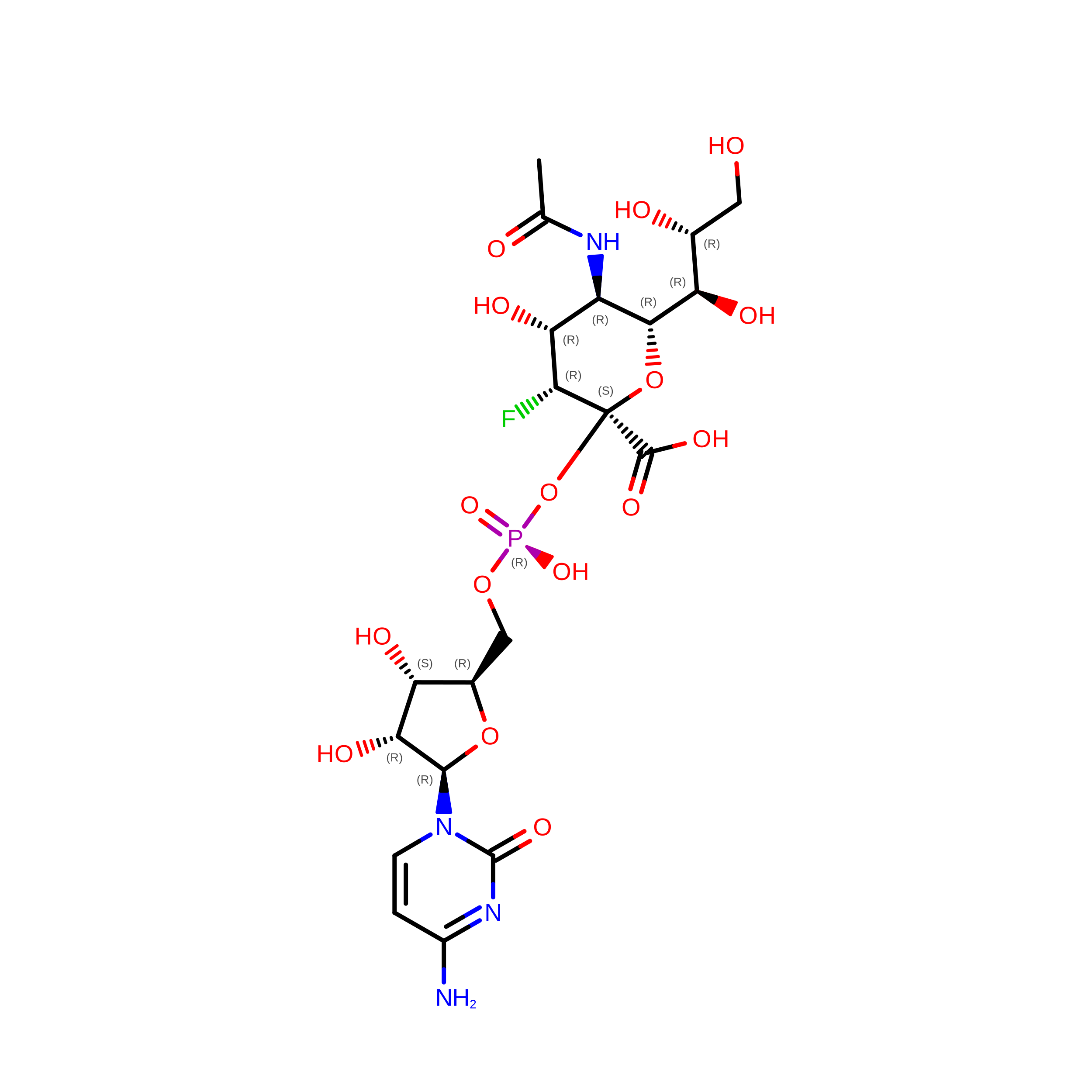
crystal structure of multifunctional sialyltransferase from pasteurella multocida with CMP-3F(equatorial)-Neu5Ac bound


Experimental Data Snapshot

  • Method: X-RAY DIFFRACTION
  • Resolution: 1.90 Å
  • R-Value Free: 
    0.205 (Depositor), 0.203 (DCC) 
  • R-Value Work: 
    0.177 (Depositor), 0.176 (DCC) 
  • R-Value Observed: 
    0.179 (Depositor) 

Starting Model: experimental
View more details

wwPDB Validation 3D Report Full Report

Validation slider image for 2IHK

Ligand Structure Quality Assessment 


This is version 1.3 of the entry. See complete history

Literature

Crystal Structures of Pasteurella multocida Sialyltransferase Complexes with Acceptor and Donor Analogues Reveal Substrate Binding Sites and Catalytic Mechanism.

Ni, L.Chokhawala, H.A.Cao, H.Henning, R.Ng, L.Huang, S.Yu, H.Chen, X.Fisher, A.J.

(2007) Biochemistry 46: 6288-6298

  • DOI: https://doi.org/10.1021/bi700346w
  • Primary Citation Related Structures: 
    2IHJ, 2IHK, 2IHZ, 2ILV

  • PubMed Abstract: 

    Sialyltransferases are key enzymes involved in the biosynthesis of biologically and pathologically important sialic acid-containing molecules in nature. Binary X-ray crystal structures of a multifunctional Pasteurella multocida sialyltransferase (Delta24PmST1) with a donor analogue CMP-3F(a)Neu5Ac or CMP-3F(e)Neu5Ac were determined at 2.0 and 1.9 A resolutions, respectively. Ternary X-ray structures of the protein in complex with CMP or a donor analogue CMP-3F(a)Neu5Ac and an acceptor lactose have been determined at 2.0 and 2.27 A resolutions, respectively. This represents the first sialyltransferase structure and the first GT-B-type glycosyltransferase structure that is bound to both a donor analogue and an acceptor simultaneously. The four structures presented here reveal that binding of the nucleotide-activated donor sugar causes a buried tryptophan to flip out of the protein core to interact with the donor sugar and helps define the acceptor sugar binding site. Additionally, key amino acid residues involved in the catalysis have been identified. Structural and kinetic data support a direct displacement mechanism involving an oxocarbenium ion-like transition state assisted with Asp141 serving as a general base to activate the acceptor hydroxyl group.


  • Organizational Affiliation
    • Department of Chemistry, University of California, One Shields Avenue, Davis, California 95616, USA.

Macromolecule Content 

  • Total Structure Weight: 47.1 kDa 
  • Atom Count: 3,454 
  • Modeled Residue Count: 376 
  • Deposited Residue Count: 399 
  • Unique protein chains: 1

Macromolecules

Find similar proteins by:|  3D Structure
Entity ID: 1
MoleculeChains  Sequence LengthOrganismDetailsImage
Alpha-2,3/2,6-sialyltransferase/sialidase399Pasteurella multocidaMutation(s): 0 
Gene Names: Pm0188
EC: 2.4.99.4
UniProt
Find proteins for Q15KI8 (Pasteurella multocida)
Explore Q15KI8 
Go to UniProtKB:  Q15KI8
Entity Groups
Sequence Clusters30% Identity50% Identity70% Identity90% Identity95% Identity100% Identity
UniProt GroupQ15KI8
Sequence Annotations
Expand
Reference Sequence

Small Molecules

Ligands 1 Unique
IDChains Name / Formula / InChI Key2D Diagram3D Interactions
CSF

Query on CSF


Download:Ideal Coordinates CCD File
B [auth A]CYTIDINE-5'-MONOPHOSPHATE-3-FLUORO-N-ACETYL-NEURAMINIC ACID
C20 H30 F N4 O16 P
HNJLGUNKGJTPBF-JTKQZVQZSA-N

Experimental Data & Validation

Experimental Data

  • Method: X-RAY DIFFRACTION
  • Resolution: 1.90 Å
  • R-Value Free:  0.205 (Depositor), 0.203 (DCC) 
  • R-Value Work:  0.177 (Depositor), 0.176 (DCC) 
  • R-Value Observed: 0.179 (Depositor) 
Space Group: P 1 21 1
Unit Cell:
Length ( Å )Angle ( ˚ )
a = 60.89α = 90
b = 65.022β = 98.56
c = 64.795γ = 90
Software Package:
Software NamePurpose
REFMACrefinement
HKL-2000data collection
MOSFLMdata reduction
SCALAdata scaling
AMoREphasing

Structure Validation

View Full Validation Report


Ligand Structure Quality Assessment 


Entry History 

Deposition Data

Revision History  (Full details and data files)

  • Version 1.0: 2007-05-22
    Type: Initial release
  • Version 1.1: 2008-05-01
    Changes: Version format compliance
  • Version 1.2: 2011-07-13
    Changes: Advisory, Version format compliance
  • Version 1.3: 2023-08-30
    Changes: Data collection, Database references, Derived calculations, Refinement description