2IEZ | pdb_00002iez

Crystal Structure of mouse Rab27b bound to GDP in monoclinic space group


Experimental Data Snapshot

  • Method: X-RAY DIFFRACTION
  • Resolution: 2.80 Å
  • R-Value Free: 
    0.363 (Depositor), 0.354 (DCC) 
  • R-Value Work: 
    0.262 (Depositor), 0.258 (DCC) 
  • R-Value Observed: 
    0.267 (Depositor) 

Starting Model: experimental
View more details

wwPDB Validation 3D Report Full Report

Validation slider image for 2IEZ

Ligand Structure Quality Assessment 


This is version 1.5 of the entry. See complete history

Literature

Structure of the small GTPase Rab27b shows an unexpected swapped dimer

Chavas, L.M.G.Torii, S.Kamikubo, H.Kawasaki, M.Ihara, K.Kato, R.Kataoka, M.Izumi, T.Wakatsuki, S.

(2007) Acta Crystallogr D Biol Crystallogr 63: 769-779

  • DOI: https://doi.org/10.1107/S0907444907019725
  • Primary Citation Related Structures: 
    2IEY, 2IEZ, 2IF0

  • PubMed Abstract: 

    Members of the Rab family of small GTPases regulate membrane traffic within the cell by recruiting their specific effectors in a nucleotide-dependent manner. The Rab27 subfamily consists of Rab27a and Rab27b, which share 70% sequence identity. By interacting with a large set of effector proteins such as melanophilin and granuphilin, both Rab27a and Rab27b regulate the exocytosis of secretory lysosomes. Here, the crystal structures of mouse Rab27b in complex with GDP have been determined in three distinct crystal lattices. Surprisingly, Rab27b-GDP exists in an open conformation with protruding switch and interswitch regions, which are stabilized through dimerization by means of domain-swapping in the crystals. In contrast, small-angle X-ray scattering measurements showed an extended monomer form of Rab27b in solution. The observed dimer formation of Rab27b-GDP in the crystals would restrain the highly flexible switch regions. Possible biological implications of this atypical structure of Rab27b and its plausible influence in effector interaction are discussed.


  • Organizational Affiliation
    • Structural Biology Research Center, Photon Factory, Institute of Materials Structure Science, High Energy Accelerator Research Organization (KEK), Tsukuba, Ibaraki 305-0801, Japan.

Macromolecule Content 

  • Total Structure Weight: 100.8 kDa 
  • Atom Count: 5,754 
  • Modeled Residue Count: 691 
  • Deposited Residue Count: 880 
  • Unique protein chains: 1

Macromolecules

Find similar proteins by:|  3D Structure
Entity ID: 1
MoleculeChains  Sequence LengthOrganismDetailsImage
Ras-related protein Rab-27BA,
B,
C [auth H],
D [auth I]
220Mus musculusMutation(s): 1 
EC: 3.6.5.2
UniProt & NIH Common Fund Data Resources
Find proteins for Q99P58 (Mus musculus)
Explore Q99P58 
Go to UniProtKB:  Q99P58
IMPC:  MGI:1931295
Entity Groups
Sequence Clusters30% Identity50% Identity70% Identity90% Identity95% Identity100% Identity
UniProt GroupQ99P58
Sequence Annotations
Expand
Reference Sequence

Small Molecules

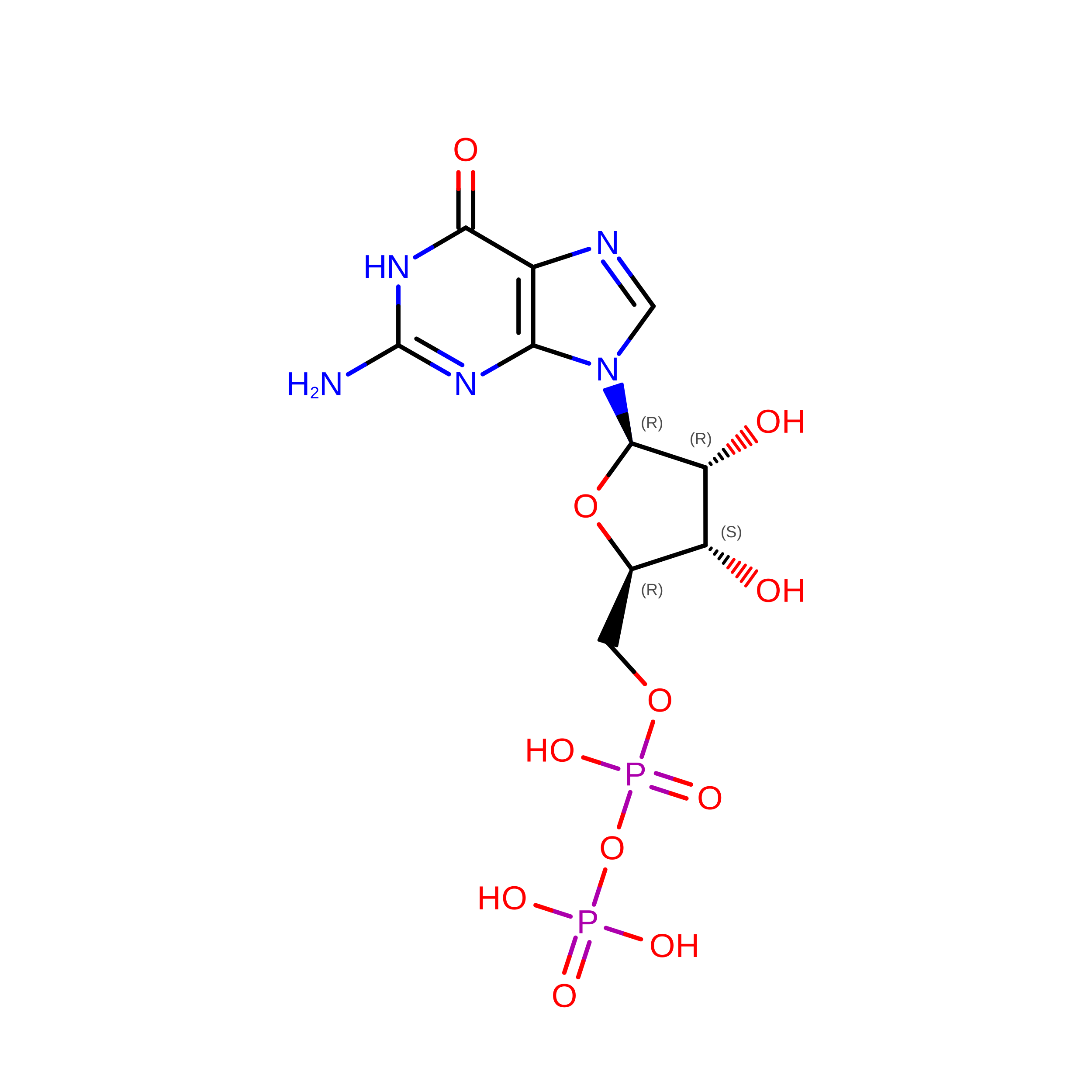
Ligands 2 Unique
IDChains Name / Formula / InChI Key2D Diagram3D Interactions
GDP

Query on GDP


Download:Ideal Coordinates CCD File
F [auth A],
H [auth B],
J [auth H],
L [auth I]
GUANOSINE-5'-DIPHOSPHATE
C10 H15 N5 O11 P2
QGWNDRXFNXRZMB-UUOKFMHZSA-N
CA

Query on CA


Download:Ideal Coordinates CCD File
E [auth A],
G [auth B],
I [auth H],
K [auth I]
CALCIUM ION
Ca
BHPQYMZQTOCNFJ-UHFFFAOYSA-N

Experimental Data & Validation

Experimental Data

  • Method: X-RAY DIFFRACTION
  • Resolution: 2.80 Å
  • R-Value Free:  0.363 (Depositor), 0.354 (DCC) 
  • R-Value Work:  0.262 (Depositor), 0.258 (DCC) 
  • R-Value Observed: 0.267 (Depositor) 
Space Group: C 1 2 1
Unit Cell:
Length ( Å )Angle ( ˚ )
a = 170.496α = 90
b = 63.348β = 98.45
c = 80.845γ = 90
Software Package:
Software NamePurpose
SCALAdata scaling
MOLREPphasing
REFMACrefinement
PDB_EXTRACTdata extraction
HKL-2000data reduction
CCP4data scaling

Structure Validation

View Full Validation Report


Ligand Structure Quality Assessment 


Entry History 

Deposition Data

Revision History  (Full details and data files)

  • Version 1.0: 2007-05-01
    Type: Initial release
  • Version 1.1: 2008-05-01
    Changes: Version format compliance
  • Version 1.2: 2011-07-13
    Changes: Derived calculations, Version format compliance
  • Version 1.3: 2012-04-11
    Changes: Database references
  • Version 1.4: 2023-10-25
    Changes: Data collection, Database references, Derived calculations, Refinement description
  • Version 1.5: 2024-10-30
    Changes: Structure summary