2I4W | pdb_00002i4w

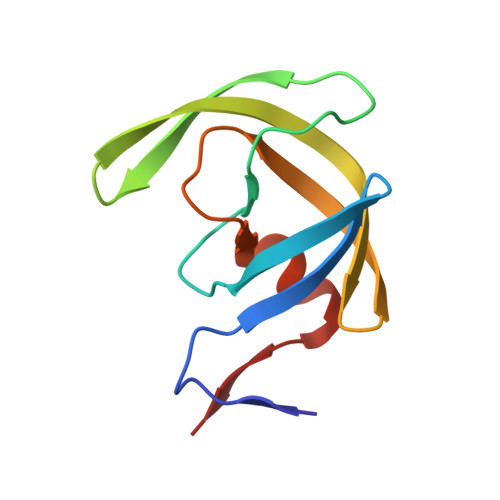
HIV-1 protease WT with GS-8374


Experimental Data Snapshot

  • Method: X-RAY DIFFRACTION
  • Resolution: 1.55 Å
  • R-Value Free: 
    0.252 (Depositor) 
  • R-Value Work: 
    0.224 (Depositor) 

wwPDB Validation 3D Report Full Report

Validation slider image for 2I4W

This is version 1.2 of the entry. See complete history

Literature

Suppression of HIV-1 Protease Inhibitor Resistance by Phosphonate-mediated Solvent Anchoring.

Cihlar, T.He, G.X.Liu, X.Chen, J.M.Hatada, M.Swaminathan, S.McDermott, M.J.Yang, Z.Y.Mulato, A.S.Chen, X.Leavitt, S.A.Stray, K.M.Lee, W.A.

(2006) J Mol Biology 363: 635-647

  • DOI: https://doi.org/10.1016/j.jmb.2006.07.073
  • Primary Citation Related Structures: 
    2I4D, 2I4U, 2I4V, 2I4W, 2I4X

  • PubMed Abstract: 

    The introduction of human immunodeficiency virus type 1 (HIV-1) protease inhibitors (PIs) markedly improved the clinical outcome and control of HIV-1 infection. However, cross-resistance among PIs due to a wide spectrum of mutations in viral protease is a major factor limiting their broader clinical use. Here we report on the suppression of PI resistance using a covalent attachment of a phosphonic acid motif to a peptidomimetic inhibitor scaffold. The resulting phosphonate analogs maintain high binding affinity to HIV-1 protease, potent antiretroviral activity, and unlike the parent molecules, display no loss of potency against a panel of clinically important PI-resistant HIV-1 strains. As shown by crystallographic analysis, the phosphonate moiety is highly exposed to solvent with no discernable interactions with any of the enzyme active site or surface residues. We term this effect "solvent anchoring" and demonstrate that it is driven by a favorable change in the inhibitor binding entropy upon the interaction with mutant enzymes. This type of thermodynamic behavior, which was not found with the parent scaffold fully buried in the enzyme active site, is a result of the increased degeneracy of inhibitor binding states, allowing effective molecular adaptation to the expanded cavity volume of mutant proteases. This strategy, which is applicable to various PI scaffolds, should facilitate the design of novel PIs and potentially other antiviral therapeutics.


  • Organizational Affiliation
    • Gilead Sciences, Inc., 333 Lakeside Drive, Foster City, CA 94404, USA.

Macromolecule Content 

  • Total Structure Weight: 22.39 kDa 
  • Atom Count: 1,749 
  • Modeled Residue Count: 198 
  • Deposited Residue Count: 198 
  • Unique protein chains: 1

Macromolecules

Find similar proteins by:|  3D Structure
Entity ID: 1
MoleculeChains  Sequence LengthOrganismDetailsImage
Protease
A, B
99Human immunodeficiency virus 1Mutation(s): 0 
Gene Names: gag
EC: 3.4.23.16
UniProt
Find proteins for P03366 (Human immunodeficiency virus type 1 group M subtype B (isolate BH10))
Explore P03366 
Go to UniProtKB:  P03366
Entity Groups
Sequence Clusters30% Identity50% Identity70% Identity90% Identity95% Identity100% Identity
UniProt GroupP03366
Sequence Annotations
Expand
Reference Sequence

Small Molecules

Ligands 1 Unique
IDChains Name / Formula / InChI Key2D Diagram3D Interactions
KGQ

Query on KGQ


Download:Ideal Coordinates CCD File
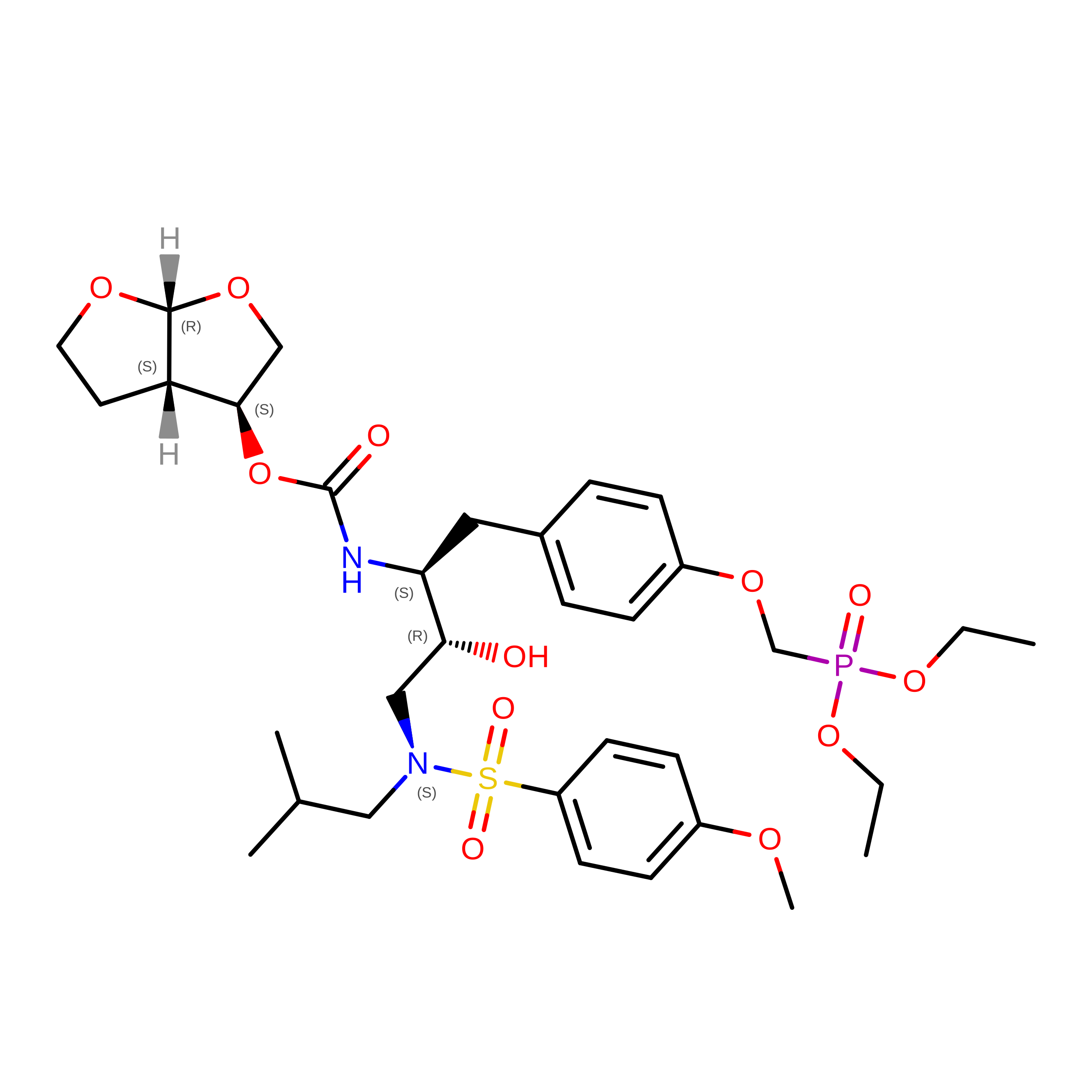
C [auth B]DIETHYL ({4-[(2S,3R)-2-({[(3R,3AS,6AR)-HEXAHYDROFURO[2,3-B]FURAN-3-YLOXY]CARBONYL}AMINO)-3-HYDROXY-4-{ISOBUTYL[(4-METHOXYPHENYL)SULFONYL]AMINO}BUTYL]PHENOXY}METHYL)PHOSPHONATE
C33 H49 N2 O12 P S
FCLYPCIMVVLLRN-FXSYQQGGSA-N

Experimental Data & Validation

Experimental Data

  • Method: X-RAY DIFFRACTION
  • Resolution: 1.55 Å
  • R-Value Free:  0.252 (Depositor) 
  • R-Value Work:  0.224 (Depositor) 
Space Group: P 21 21 2
Unit Cell:
Length ( Å )Angle ( ˚ )
a = 57.6α = 90
b = 85.911β = 90
c = 46.349γ = 90
Software Package:
Software NamePurpose
CrystalCleardata collection
AMoREphasing
X-PLORrefinement
d*TREKdata reduction
d*TREKdata scaling

Structure Validation

View Full Validation Report


Entry History 

Deposition Data

  • Released Date: 2007-08-28 
  • Deposition Author(s): Hatada, M.

Revision History  (Full details and data files)

  • Version 1.0: 2007-08-28
    Type: Initial release
  • Version 1.1: 2011-07-13
    Changes: Derived calculations, Version format compliance
  • Version 1.2: 2024-02-21
    Changes: Data collection, Database references, Derived calculations