2HWO | pdb_00002hwo

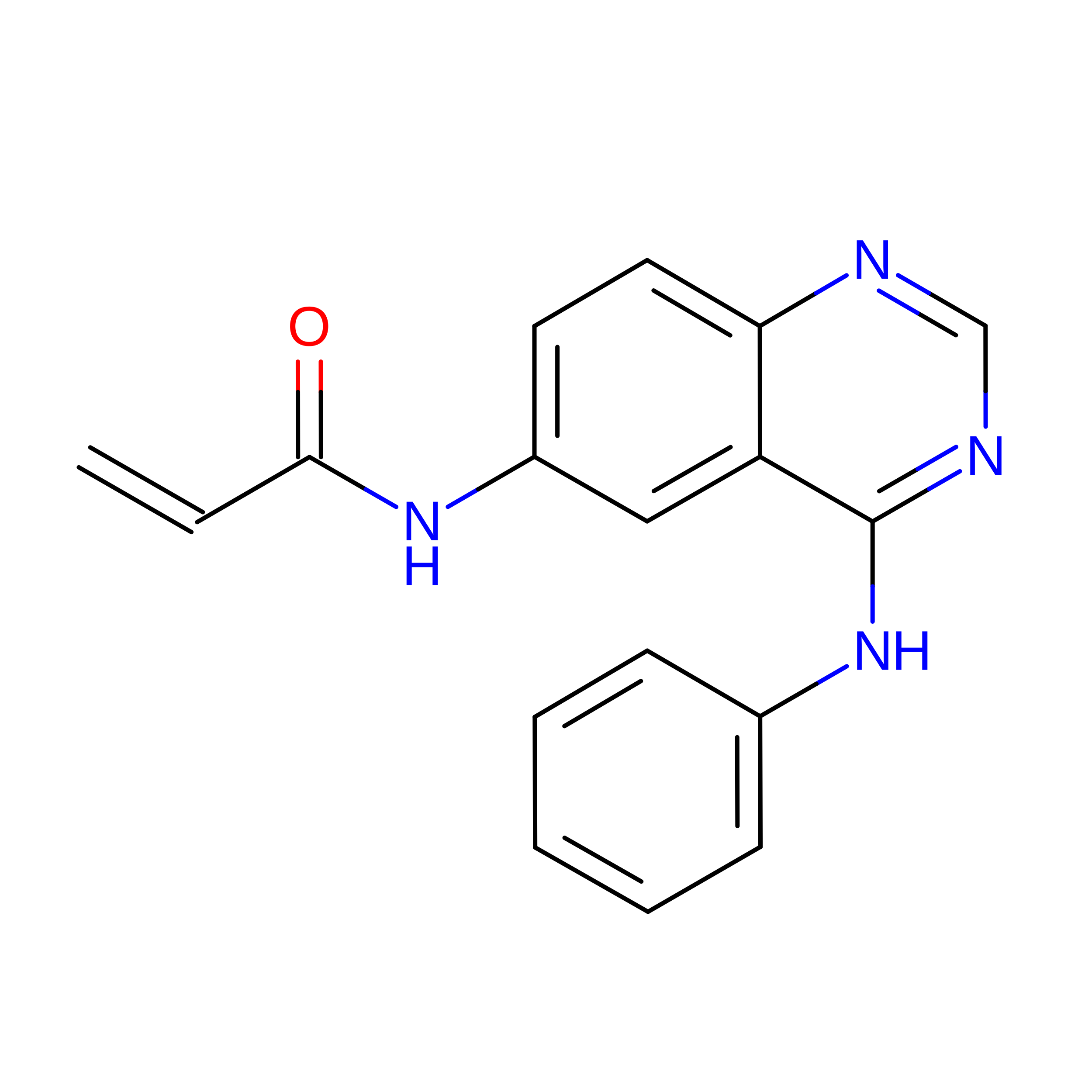
Crystal structure of Src kinase domain in complex with covalent inhibitor


Experimental Data Snapshot

  • Method: X-RAY DIFFRACTION
  • Resolution: 2.50 Å
  • R-Value Free: 
    0.292 (Depositor), 0.280 (DCC) 
  • R-Value Work: 
    0.235 (Depositor), 0.231 (DCC) 
  • R-Value Observed: 
    0.238 (Depositor) 

wwPDB Validation 3D Report Full Report

Validation slider image for 2HWO

Ligand Structure Quality Assessment 


This is version 1.6 of the entry. See complete history

Literature

Structure-guided development of affinity probes for tyrosine kinases using chemical genetics.

Blair, J.A.Rauh, D.Kung, C.Yun, C.H.Fan, Q.W.Rode, H.Zhang, C.Eck, M.J.Weiss, W.A.Shokat, K.M.

(2007) Nat Chem Biol 3: 229-238

  • DOI: https://doi.org/10.1038/nchembio866
  • Primary Citation Related Structures: 
    2HWO, 2HWP, 2J5E, 2J5F

  • PubMed Abstract: 

    As key components in nearly every signal transduction pathway, protein kinases are attractive targets for the regulation of cellular signaling by small-molecule inhibitors. We report the structure-guided development of 6-acrylamido-4-anilinoquinazoline irreversible kinase inhibitors that potently and selectively target rationally designed kinases bearing two selectivity elements that are not found together in any wild-type kinase: an electrophile-targeted cysteine residue and a glycine gatekeeper residue. Cocrystal structures of two irreversible quinazoline inhibitors bound to either epidermal growth factor receptor (EGFR) or engineered c-Src show covalent inhibitor binding to the targeted cysteine (Cys797 in EGFR and Cys345 in engineered c-Src). To accommodate the new covalent bond, the quinazoline core adopts positions that are different from those seen in kinase structures with reversible quinazoline inhibitors. Based on these structures, we developed a fluorescent 6-acrylamido-4-anilinoquinazoline affinity probe to report the fraction of kinase necessary for cellular signaling, and we used these reagents to quantitate the relationship between EGFR stimulation by EGF and its downstream outputs-Akt, Erk1 and Erk2.


  • Organizational Affiliation
    • Department of Chemistry, University of California, Berkeley, Berkeley, California 94720, USA.

Macromolecule Content 

  • Total Structure Weight: 66.16 kDa 
  • Atom Count: 3,879 
  • Modeled Residue Count: 493 
  • Deposited Residue Count: 572 
  • Unique protein chains: 1

Macromolecules

Find similar proteins by:|  3D Structure
Entity ID: 1
MoleculeChains  Sequence LengthOrganismDetailsImage
Proto-oncogene tyrosine-protein kinase Src
A, B
286Gallus gallusMutation(s): 1 
Gene Names: SRC
EC: 2.7.10.2
UniProt
Find proteins for P00523 (Gallus gallus)
Explore P00523 
Go to UniProtKB:  P00523
Entity Groups
Sequence Clusters30% Identity50% Identity70% Identity90% Identity95% Identity100% Identity
UniProt GroupP00523
Sequence Annotations
Expand
Reference Sequence

Small Molecules

Binding Affinity Annotations 
IDSourceBinding Affinity
RBS BindingDB:  2HWO IC50: 2.70e+4 (nM) from 1 assay(s)

Experimental Data & Validation

Experimental Data

  • Method: X-RAY DIFFRACTION
  • Resolution: 2.50 Å
  • R-Value Free:  0.292 (Depositor), 0.280 (DCC) 
  • R-Value Work:  0.235 (Depositor), 0.231 (DCC) 
  • R-Value Observed: 0.238 (Depositor) 
Space Group: P 1
Unit Cell:
Length ( Å )Angle ( ˚ )
a = 42.099α = 78.73
b = 63.255β = 88.04
c = 73.799γ = 89.95
Software Package:
Software NamePurpose
DENZOdata reduction
SCALEPACKdata scaling
REFMACrefinement
PDB_EXTRACTdata extraction
HKL-2000data collection
HKL-2000data reduction
AMoREphasing

Structure Validation

View Full Validation Report


Ligand Structure Quality Assessment 


Entry History 

Deposition Data

Revision History  (Full details and data files)

  • Version 1.0: 2007-02-27
    Type: Initial release
  • Version 1.1: 2008-05-01
    Changes: Version format compliance
  • Version 1.2: 2011-07-13
    Changes: Non-polymer description, Version format compliance
  • Version 1.3: 2017-10-18
    Changes: Advisory, Refinement description
  • Version 1.4: 2018-02-14
    Changes: Experimental preparation
  • Version 1.5: 2021-10-20
    Changes: Advisory, Database references, Derived calculations
  • Version 1.6: 2024-10-30
    Changes: Data collection, Structure summary