Download Mendeley
Structure of an Atypical Orphan Response Regulator Protein Supports a New Phosphorylation-independent Regulatory Mechanism
Hong, E., Lee, H.M., Ko, H., Kim, D.-U., Jeon, B.-Y., Jung, J., Shin, J., Lee, S.-A., Kim, Y., Jeon, Y.H., Cheong, C., Cho, H.-S., Lee, W.(2007) J Biol Chem 282: 20667-20675
- PubMed: 17491010 Search on PubMed
- DOI: https://doi.org/10.1074/jbc.M609104200
- Primary Citation Related Structures:
2HQN, 2HQO, 2HQR - PubMed Abstract:
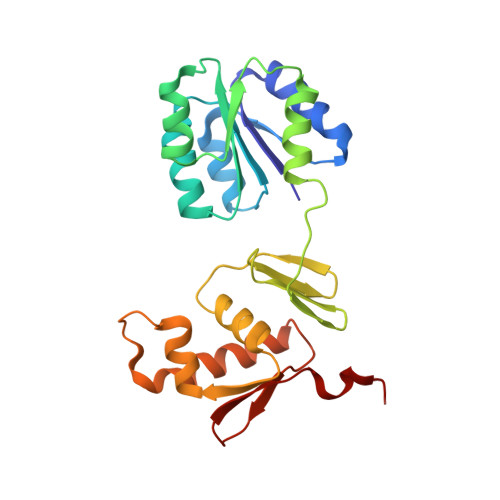
Two-component signal transduction systems, commonly found in prokaryotes, typically regulate cellular functions in response to environmental conditions through a phosphorylation-dependent process. A new type of response regulator, hp1043 (HP-RR) from Helicobacter pylori, has been recently identified. HP-RR is essential for cell growth and does not require the well known phosphorelay scheme. Unphosphorylated HP-RR binds specifically to its own promoter (P(1043)) and autoregulates the promoter of the tlpB gene (P(tlpB)). We have determined the structure of HP-RR by NMR and x-ray crystallography, revealing a symmetrical dimer with two functional domains. The molecular topology resembles that of the OmpR/PhoB subfamily, however, the symmetrical dimer is stable even in the unphosphorylated state. The dimer interface, formed by three secondary structure elements (alpha4-beta5-alpha5), resembles that of the active, phosphorylated forms of ArcA and PhoB. Several conserved residues of the HP-RR dimeric interface deviate from the OmpR/PhoB subfamily, although there are similar salt bridges and hydrophobic patches within the interface. Our findings reveal how a new type of response regulator protein could function as a cell growth-associated regulator in the absence of post-translational modification.
- Department of Biochemistry and HTSD-NMR & Application NRL, College of Science, Yonsei University, 134 Shinchon-Dong, Seodaemoon-Gu, Seoul 120-749, Korea.
Organizational Affiliation: