2HL8 | pdb_00002hl8

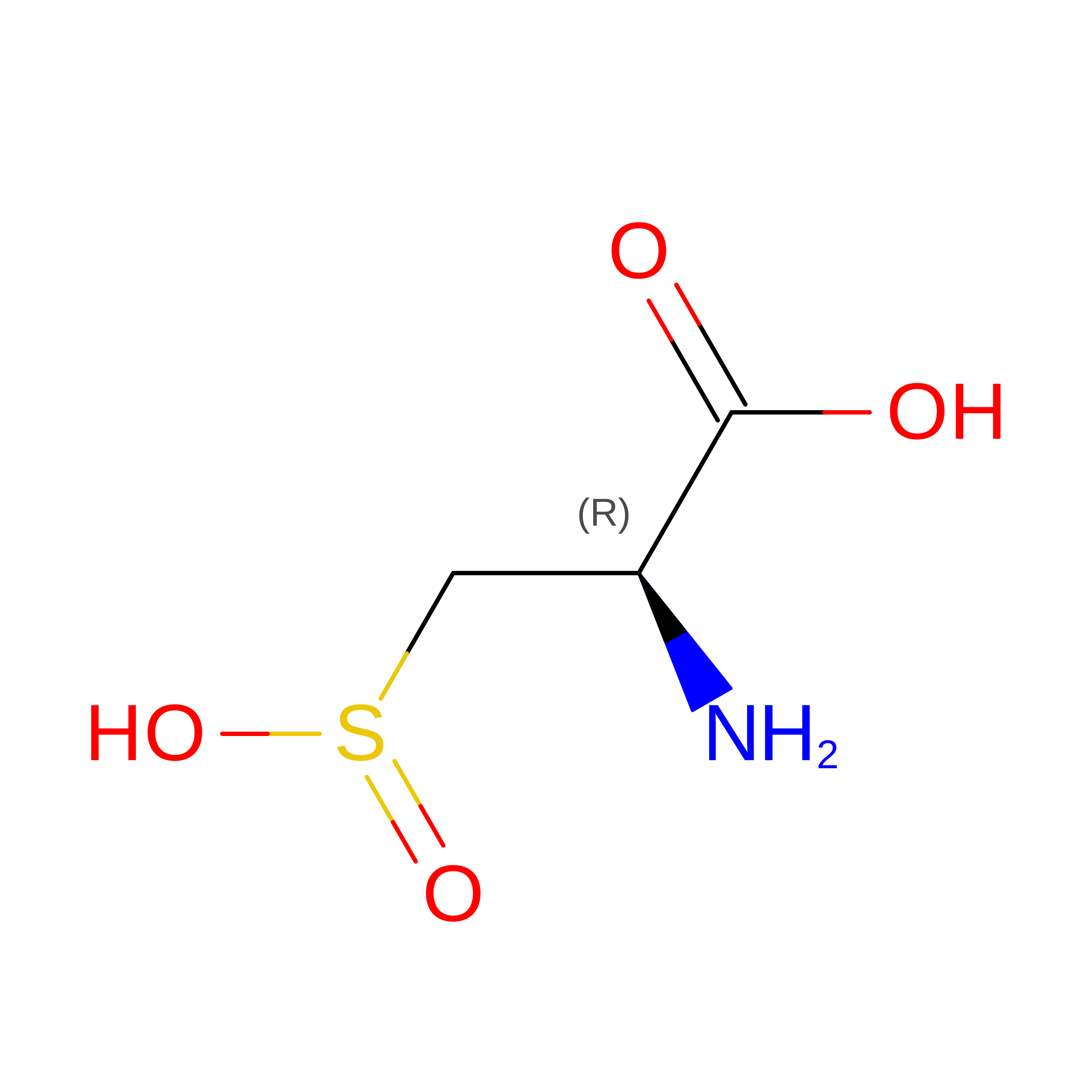
SUMO protease Ulp1 with the catalytic cysteine oxidized to a sulfinic acid


Experimental Data Snapshot

  • Method: X-RAY DIFFRACTION
  • Resolution: 2.00 Å
  • R-Value Free: 
    0.234 (Depositor), 0.237 (DCC) 
  • R-Value Work: 
    0.192 (Depositor), 0.197 (DCC) 

Starting Model: experimental
View more details

wwPDB Validation 3D Report Full Report

Validation slider image for 2HL8

This is version 1.4 of the entry. See complete history

Literature

Molecular basis of the redox regulation of SUMO proteases: a protective mechanism of intermolecular disulfide linkage against irreversible sulfhydryl oxidation

Xu, Z.Lam, L.S.M.Lam, L.H.Chau, S.F.Ng, T.B.Au, S.W.N.

(2008) FASEB J 22: 127-137

  • DOI: https://doi.org/10.1096/fj.06-7871com
  • Primary Citation Related Structures: 
    2HKP, 2HL8, 2HL9

  • PubMed Abstract: 

    Sumoylation has emerged as an indispensable post-translational modification that modulates the functions of a broad spectrum of proteins. Recent studies have demonstrated that reactive oxygen species influence the equilibrium of sumoylation-desumoylation. We show herein that H2O2 induces formation of an intermolecular disulfide linkage of human SUMO protease SENP1 via the active-site Cys 603 and a unique residue Cys 613. Such reversible modification confers a higher recovery of enzyme activity, which is also observed in yeast Ulp1, but not in human SENP2, suggesting its protective role against irreversible sulfhydryl oxidation. In vivo formation of a disulfide-linked dimer of SENP1 is also detected in cultured cells in response to oxidative stress. The modifications are further elucidated by the crystal structures of Ulp1 with the catalytic cysteine oxidized to sulfenic, sulfinic, and sulfonic acids. Our findings suggest that, in addition to SUMO conjugating enzymes, SUMO proteases may act as redox sensors and effectors modulating the desumoylation pathway and specific cellular responses to oxidative stress.


  • Organizational Affiliation
    • Centre of Protein Science and Crystallography, Department of Biochemistry, Faculty of Science, The Chinese University of Hong Kong, Hong Kong.

Macromolecule Content 

  • Total Structure Weight: 25.68 kDa 
  • Atom Count: 1,888 
  • Modeled Residue Count: 219 
  • Deposited Residue Count: 221 
  • Unique protein chains: 1

Macromolecules

Find similar proteins by:|  3D Structure
Entity ID: 1
MoleculeChains  Sequence LengthOrganismDetailsImage
Ubiquitin-like-specific protease 1221Saccharomyces cerevisiaeMutation(s): 0 
EC: 3.4.22 (PDB Primary Data), 3.4.22.68 (UniProt)
UniProt
Find proteins for Q02724 (Saccharomyces cerevisiae (strain ATCC 204508 / S288c))
Explore Q02724 
Go to UniProtKB:  Q02724
Entity Groups
Sequence Clusters30% Identity50% Identity70% Identity90% Identity95% Identity100% Identity
UniProt GroupQ02724
Sequence Annotations
Expand
Reference Sequence

Small Molecules

Modified Residues  1 Unique
IDChains TypeFormula2D DiagramParent
CSD
Query on CSD
A
L-PEPTIDE LINKINGC3 H7 N O4 SCYS

Experimental Data & Validation

Experimental Data

  • Method: X-RAY DIFFRACTION
  • Resolution: 2.00 Å
  • R-Value Free:  0.234 (Depositor), 0.237 (DCC) 
  • R-Value Work:  0.192 (Depositor), 0.197 (DCC) 
Space Group: C 1 2 1
Unit Cell:
Length ( Å )Angle ( ˚ )
a = 104.936α = 90
b = 40.189β = 112
c = 55.371γ = 90
Software Package:
Software NamePurpose
d*TREKdata scaling
REFMACrefinement
PDB_EXTRACTdata extraction
CrystalCleardata reduction
CrystalCleardata scaling
MOLREPphasing

Structure Validation

View Full Validation Report


Entry History 

Deposition Data

Revision History  (Full details and data files)

  • Version 1.0: 2007-07-31
    Type: Initial release
  • Version 1.1: 2011-07-13
    Changes: Version format compliance
  • Version 1.2: 2014-11-12
    Changes: Other
  • Version 1.3: 2023-10-25
    Changes: Data collection, Database references, Derived calculations, Refinement description
  • Version 1.4: 2024-10-16
    Changes: Structure summary