2HCD | pdb_00002hcd

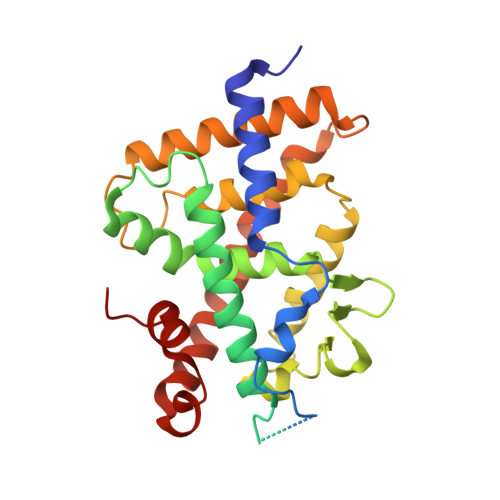
Crystal structure of the ligand binding domain of the Vitamin D nuclear receptor in complex with Gemini and a coactivator peptide


Experimental Data Snapshot

  • Method: X-RAY DIFFRACTION
  • Resolution: 2.60 Å
  • R-Value Free: 
    0.260 (Depositor), 0.262 (DCC) 
  • R-Value Work: 
    0.204 (Depositor), 0.214 (DCC) 
  • R-Value Observed: 
    0.227 (Depositor) 

Starting Model: experimental
View more details

wwPDB Validation 3D Report Full Report

Validation slider image for 2HCD

Ligand Structure Quality Assessment 


This is version 1.4 of the entry. See complete history

Literature

Adaptability of the Vitamin D nuclear receptor to the synthetic ligand Gemini: remodelling the LBP with one side chain rotation

Ciesielski, F.Rochel, N.Moras, D.

(2007) J Steroid Biochem Mol Biol 103: 235-242

  • DOI: https://doi.org/10.1016/j.jsbmb.2006.12.003
  • Primary Citation Related Structures: 
    2HC4, 2HCD

  • PubMed Abstract: 

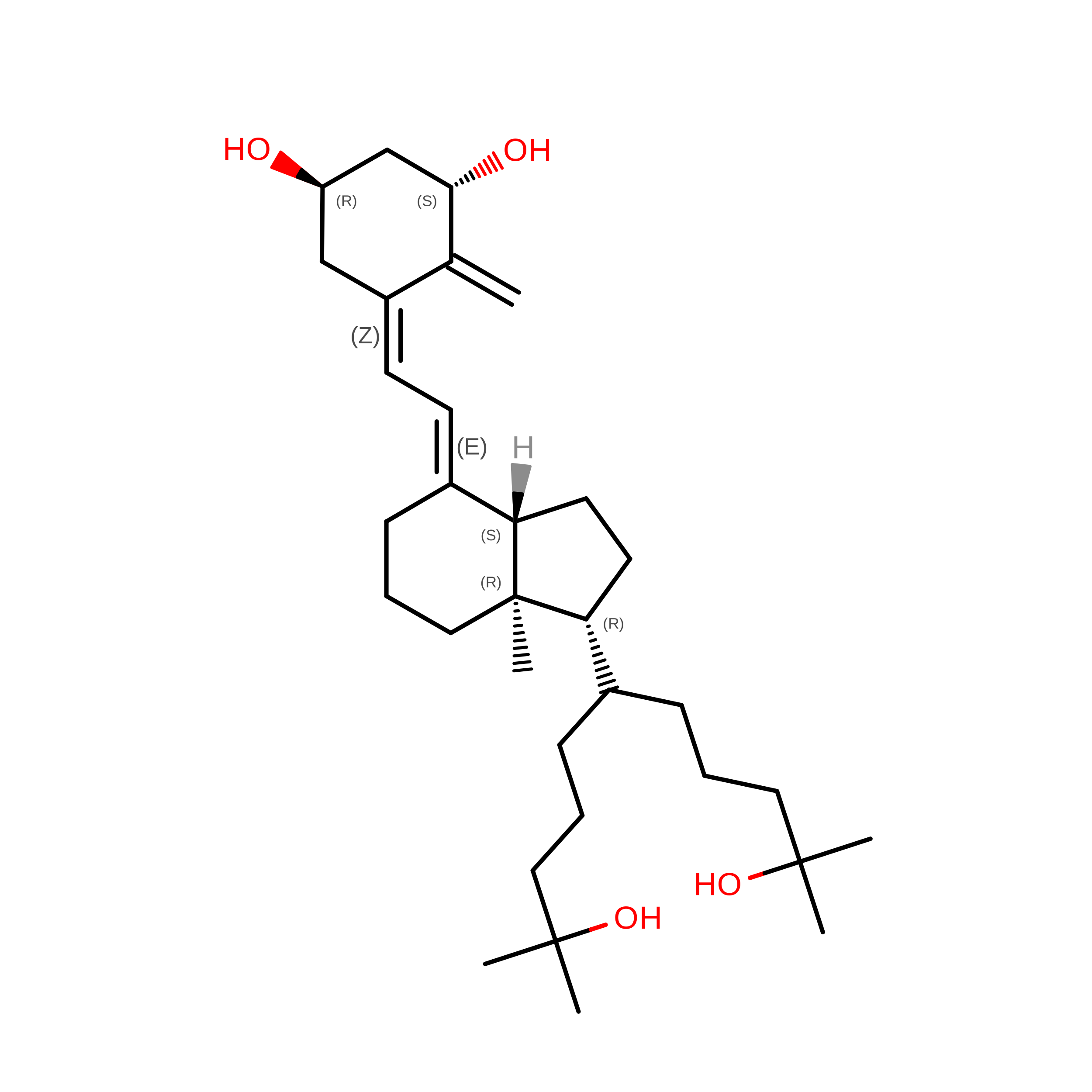
    The crystal structure of the ligand binding domain (LBD) of the wild-type Vitamin D receptor (VDR) of zebrafish bound to Gemini, a synthetic agonist ligand with two identical side chains branching at carbon 20 reveals a ligand-dependent structural rearrangement of the ligand binding pocket (LBP). The rotation of a Leu side chain opens the access to a channel that can accommodate the second side chain of the ligand. The 25% increase of the LBP's volume does not alter the essential agonist features of VDR. The possibility to adapt the LBP to novel ligands with different chemistry and/or structure opens new perspectives in the design of more specifically targeted ligands.


  • Organizational Affiliation
    • Département de Biologie et de Génomique Structurales, IGBMC, CNRS/INSERM Université Louis Pasteur, Parc d'innovation BP10142, 67404 Illkirch Cedex, France.

Macromolecule Content 

  • Total Structure Weight: 36.34 kDa 
  • Atom Count: 2,069 
  • Modeled Residue Count: 249 
  • Deposited Residue Count: 317 
  • Unique protein chains: 2

Macromolecules

Find similar proteins by:|  3D Structure
Entity ID: 1
MoleculeChains  Sequence LengthOrganismDetailsImage
Vitamin D receptor302Danio rerioMutation(s): 0 
UniProt
Find proteins for Q9PTN2 (Danio rerio)
Explore Q9PTN2 
Go to UniProtKB:  Q9PTN2
Entity Groups
Sequence Clusters30% Identity50% Identity70% Identity90% Identity95% Identity100% Identity
UniProt GroupQ9PTN2
Sequence Annotations
Expand
Reference Sequence
Find similar proteins by:  Sequence   |   3D Structure  
Entity ID: 2
MoleculeChains  Sequence LengthOrganismDetailsImage
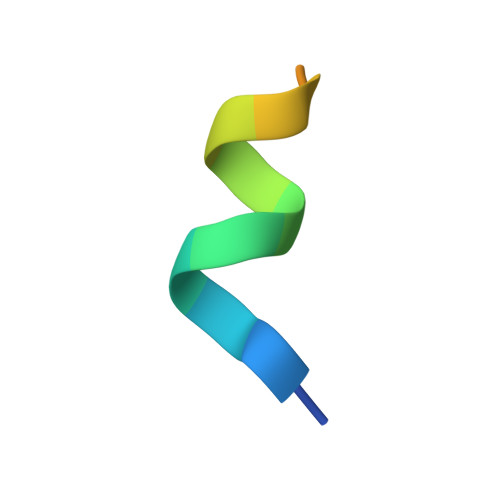
SRC-1 from Nuclear receptor coactivator 115Homo sapiensMutation(s): 0 
EC: 2.3.1.48
UniProt & NIH Common Fund Data Resources
Find proteins for Q15788 (Homo sapiens)
Explore Q15788 
Go to UniProtKB:  Q15788
PHAROS:  Q15788
GTEx:  ENSG00000084676 
Entity Groups
Sequence Clusters30% Identity50% Identity70% Identity90% Identity95% Identity100% Identity
UniProt GroupQ15788
Sequence Annotations
Expand
Reference Sequence

Small Molecules

Ligands 1 Unique
IDChains Name / Formula / InChI Key2D Diagram3D Interactions
BIV

Query on BIV


Download:Ideal Coordinates CCD File
C [auth A]21-NOR-9,10-SECOCHOLESTA-5,7,10(19)-TRIENE-1,3,25-TRIOL, 20-(4-HYDROXY-4-METHYLPENTYL)-, (1A,3B,5Z,7E)
C32 H54 O4
WTQXZYVWLNPNEX-LKUPKUSPSA-N

Experimental Data & Validation

Experimental Data

  • Method: X-RAY DIFFRACTION
  • Resolution: 2.60 Å
  • R-Value Free:  0.260 (Depositor), 0.262 (DCC) 
  • R-Value Work:  0.204 (Depositor), 0.214 (DCC) 
  • R-Value Observed: 0.227 (Depositor) 
Space Group: P 65 2 2
Unit Cell:
Length ( Å )Angle ( ˚ )
a = 65.859α = 90
b = 65.859β = 90
c = 265.018γ = 120
Software Package:
Software NamePurpose
CNSrefinement
ADSCdata collection
HKL-2000data scaling
CNSphasing

Structure Validation

View Full Validation Report


Ligand Structure Quality Assessment 


Entry History 

Deposition Data

Revision History  (Full details and data files)

  • Version 1.0: 2007-05-01
    Type: Initial release
  • Version 1.1: 2008-05-01
    Changes: Version format compliance
  • Version 1.2: 2011-07-13
    Changes: Version format compliance
  • Version 1.3: 2021-03-03
    Changes: Advisory, Database references, Derived calculations, Source and taxonomy
  • Version 1.4: 2023-10-25
    Changes: Advisory, Data collection, Database references, Refinement description