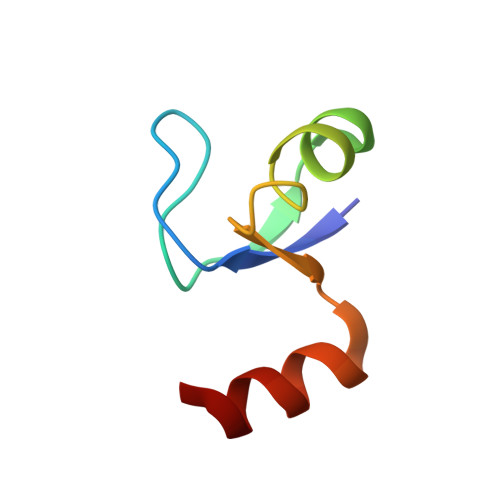
2HBB | pdb_00002hbb

Crystal Structure of the N-terminal Domain of Ribosomal Protein L9 (NTL9)


Experimental Data Snapshot

  • Method: X-RAY DIFFRACTION
  • Resolution: 1.90 Å
  • R-Value Free: 
    0.236 (Depositor), 0.237 (DCC) 
  • R-Value Work: 
    0.197 (Depositor), 0.197 (DCC) 
  • R-Value Observed: 
    0.199 (Depositor) 

wwPDB Validation 3D Report Full Report

Validation slider image for 2HBB

This is version 1.7 of the entry. See complete history

Literature

Energetically significant networks of coupled interactions within an unfolded protein.

Cho, J.H.Meng, W.Sato, S.Kim, E.Y.Schindelin, H.Raleigh, D.P.

(2014) Proc Natl Acad Sci U S A 111: 12079-12084

  • DOI: https://doi.org/10.1073/pnas.1402054111
  • Primary Citation Related Structures: 
    2HBA, 2HBB

  • PubMed Abstract: 

    Unfolded and partially unfolded proteins participate in a wide range of biological processes from pathological aggregation to the regulation of normal cellular activity. Unfolded states can be populated under strongly denaturing conditions, but the ensemble which is relevant for folding, stability, and aggregation is that populated under physiological conditions. Characterization of nonnative states is critical for the understanding of these processes, yet comparatively little is known about their energetics and their structural propensities under native conditions. The standard view is that energetically significant coupled interactions involving multiple residues are generally not present in the denatured state ensemble (DSE) or in intrinsically disordered proteins. Using the N-terminal domain of the ribosomal protein L9, a small α-β protein, as an experimental model system, we demonstrate that networks of energetically significant, coupled interactions can form in the DSE of globular proteins, and can involve residues that are distant in sequence and spatially well separated in the native structure. X-ray crystallography, NMR, dynamics studies, native state pKa measurements, and thermodynamic analysis of more than 25 mutants demonstrate that residues are energetically coupled in the DSE. Altering these interactions by mutation affects the stability of the domain. Mutations that alter the energetics of the DSE can impact the analysis of cooperativity and folding, and may play a role in determining the propensity to aggregate.


  • Organizational Affiliation
    • Department of Biochemistry and Biophysics, Texas A&M University, College Station, TX 77843-2128;

Macromolecule Content 

  • Total Structure Weight: 5.82 kDa 
  • Atom Count: 446 
  • Modeled Residue Count: 51 
  • Deposited Residue Count: 51 
  • Unique protein chains: 1

Macromolecules

Find similar proteins by:|  3D Structure
Entity ID: 1
MoleculeChains  Sequence LengthOrganismDetailsImage
50S ribosomal protein L951Geobacillus stearothermophilusMutation(s): 0 
Gene Names: rplI
UniProt
Find proteins for P02417 (Geobacillus stearothermophilus)
Explore P02417 
Go to UniProtKB:  P02417
Entity Groups
Sequence Clusters30% Identity50% Identity70% Identity90% Identity95% Identity100% Identity
UniProt GroupP02417
Sequence Annotations
Expand
Reference Sequence

Experimental Data & Validation

Experimental Data

  • Method: X-RAY DIFFRACTION
  • Resolution: 1.90 Å
  • R-Value Free:  0.236 (Depositor), 0.237 (DCC) 
  • R-Value Work:  0.197 (Depositor), 0.197 (DCC) 
  • R-Value Observed: 0.199 (Depositor) 
Space Group: P 41 21 2
Unit Cell:
Length ( Å )Angle ( ˚ )
a = 53.918α = 90
b = 53.918β = 90
c = 36.339γ = 90
Software Package:
Software NamePurpose
DENZOdata reduction
SCALEPACKdata scaling
MOLREPphasing
REFMACrefinement
PDB_EXTRACTdata extraction
ADSCdata collection

Structure Validation

View Full Validation Report


Entry History 

Deposition Data

Revision History  (Full details and data files)

  • Version 1.0: 2007-05-29
    Type: Initial release
  • Version 1.1: 2008-05-01
    Changes: Version format compliance
  • Version 1.2: 2011-07-13
    Changes: Derived calculations, Version format compliance
  • Version 1.3: 2013-10-23
    Changes: Database references
  • Version 1.4: 2014-08-13
    Changes: Database references
  • Version 1.5: 2014-09-24
    Changes: Database references
  • Version 1.6: 2017-10-18
    Changes: Refinement description
  • Version 1.7: 2024-02-14
    Changes: Data collection, Database references, Derived calculations