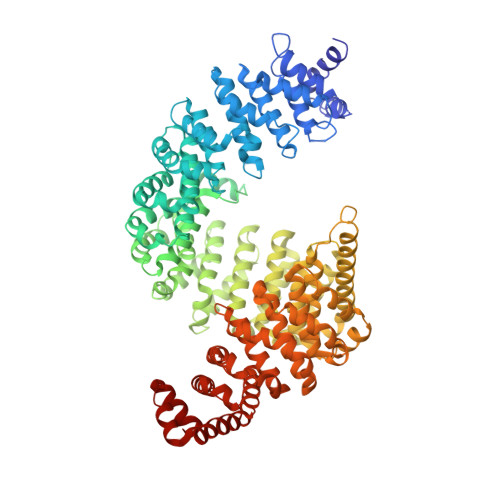
2H4M | pdb_00002h4m

Karyopherin Beta2/Transportin-M9NLS


Experimental Data Snapshot

  • Method: X-RAY DIFFRACTION
  • Resolution: 3.05 Å
  • R-Value Free: 
    0.250 (Depositor) 
  • R-Value Work: 
    0.238 (Depositor) 

Starting Model: experimental
View more details

wwPDB Validation 3D Report Full Report

Validation slider image for 2H4M

This is version 1.5 of the entry. See complete history

Literature

Rules for nuclear localization sequence recognition by karyopherin beta 2.

Lee, B.J.Cansizoglu, A.E.Louis, T.H.Zhang, Z.Chook, Y.M.

(2006) Cell 126: 543-558

  • DOI: https://doi.org/10.1016/j.cell.2006.05.049
  • Primary Citation Related Structures: 
    2H4M

  • PubMed Abstract: 

    Karyopherinbeta (Kapbeta) proteins bind nuclear localization and export signals (NLSs and NESs) to mediate nucleocytoplasmic trafficking, a process regulated by Ran GTPase through its nucleotide cycle. Diversity and complexity of signals recognized by Kap betas have prevented prediction of new Kap beta substrates. The structure of Kap beta 2 (also known as Transportin) bound to one of its substrates, the NLS of hnRNP A1, that we report here explains the mechanism of substrate displacement by Ran GTPase. Further analyses reveal three rules for NLS recognition by Kap beta 2: NLSs are structurally disordered in free substrates, have overall basic character, and possess a central hydrophobic or basic motif followed by a C-terminal R/H/KX(2-5)PY consensus sequence. We demonstrate the predictive nature of these rules by identifying NLSs in seven previously known Kap beta 2 substrates and uncovering 81 new candidate substrates, confirming five experimentally. These studies define and validate a new NLS that could not be predicted by primary sequence analysis alone.


  • Organizational Affiliation
    • Department of Pharmacology, University of Texas Southwestern Medical Center at Dallas, 6001 Forest Park, Dallas, TX 75390, USA.

Macromolecule Content 

  • Total Structure Weight: 206.2 kDa 
  • Atom Count: 12,740 
  • Modeled Residue Count: 1,687 
  • Deposited Residue Count: 1,828 
  • Unique protein chains: 2

Macromolecules

Find similar proteins by:|  3D Structure
Entity ID: 1
MoleculeChains  Sequence LengthOrganismDetailsImage
Transportin-1
A, B
865Homo sapiensMutation(s): 0 
Gene Names: TNPO1KPNB2MIP1TRN
UniProt & NIH Common Fund Data Resources
Find proteins for Q92973 (Homo sapiens)
Explore Q92973 
Go to UniProtKB:  Q92973
PHAROS:  Q92973
GTEx:  ENSG00000083312 
Entity Groups
Sequence Clusters30% Identity50% Identity70% Identity90% Identity95% Identity100% Identity
UniProt GroupQ92973
Sequence Annotations
Expand
Reference Sequence
Find similar proteins by:|  3D Structure
Entity ID: 2
MoleculeChains  Sequence LengthOrganismDetailsImage
Heterogeneous nuclear ribonucleoprotein A1
C, D
49Homo sapiensMutation(s): 0 
Gene Names: HNRNPA1HNRPA1
UniProt & NIH Common Fund Data Resources
Find proteins for P09651 (Homo sapiens)
Explore P09651 
Go to UniProtKB:  P09651
PHAROS:  P09651
GTEx:  ENSG00000135486 
Entity Groups
Sequence Clusters30% Identity50% Identity70% Identity90% Identity95% Identity100% Identity
UniProt GroupP09651
Sequence Annotations
Expand
Reference Sequence

Experimental Data & Validation

Experimental Data

  • Method: X-RAY DIFFRACTION
  • Resolution: 3.05 Å
  • R-Value Free:  0.250 (Depositor) 
  • R-Value Work:  0.238 (Depositor) 
Space Group: C 1 2 1
Unit Cell:
Length ( Å )Angle ( ˚ )
a = 152.013α = 90
b = 154.093β = 91.75
c = 141.667γ = 90
Software Package:
Software NamePurpose
SBC-Collectdata collection
HKL-2000data reduction
PHASERphasing
CNSrefinement
HKL-2000data scaling

Structure Validation

View Full Validation Report


Entry History 

Deposition Data

Revision History  (Full details and data files)

  • Version 1.0: 2006-10-24
    Type: Initial release
  • Version 1.1: 2008-05-01
    Changes: Version format compliance
  • Version 1.2: 2011-07-13
    Changes: Version format compliance
  • Version 1.3: 2017-06-14
    Changes: Advisory, Database references, Source and taxonomy, Structure summary
  • Version 1.4: 2023-08-30
    Changes: Advisory, Data collection, Database references, Refinement description
  • Version 1.5: 2024-10-09
    Changes: Structure summary