Download Mendeley
Solution structure of a purine rich hexaloop hairpin belonging to PGY/MDR1 mRNA and targeted by antisense oligonucleotides.
Joli, F., Bouchemal, N., Laigle, A., Hartmann, B., Hantz, E.(2006) Nucleic Acids Res 34: 5740-5751
- PubMed: 17041234 Search on PubMedSearch on PubMed Central
- DOI: https://doi.org/10.1093/nar/gkl617
- Primary Citation Related Structures:
2GVO - PubMed Abstract:
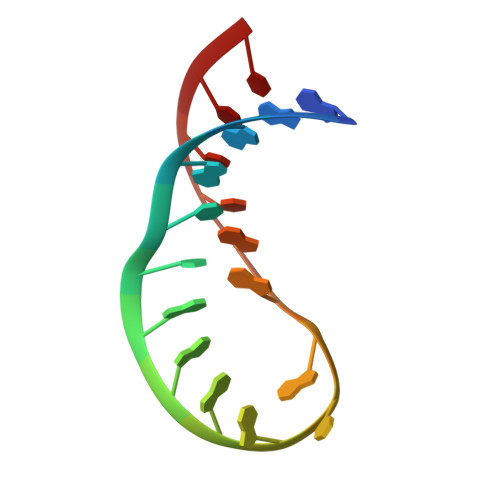
A preferential target of antisense oligonucleotides directed against human PGY/MDR1 mRNA is a hairpin containing a stem with a G*U wobble pair, capped by the purine-rich 5'r(GGGAUG)3' hexaloop. This hairpin is studied by multidimensional NMR and restrained molecular dynamics, with special emphasis on the conformation of south sugars and non-standard phosphate linkages evidenced in both the stem and the loop. The hairpin is found to be highly structured. The G*U wobble pair, a strong counterion binding site, displays structural particularities that are characteristic of this type of mismatch. The upper part of the stem undergoes distortions that optimize its interactions with the beginning of the loop. The loop adopts a new fold in which the single-stranded GGGA purine tract is structured in A-like conformation stacked in continuity of the stem and displays an extensive hydrogen bonding surface for recognition. The remarkable hairpin stability results from classical inter- and intra-strand interactions reinforced by numerous hydrogen bonds involving unusual backbone conformations and ribose 2'-hydroxyl groups. Overall, this work emphasizes numerous features that account for the well-ordered structure of the whole hairpin and highlights the loop properties that facilitate interaction with antisense oligonucleotides.
- Laboratoire BioMoCeTi, CNRS UMR 7033 UFR SMBH, Université Paris 13, 74 rue Marcel Cachin, 93017 Bobigny cedex, France. fjoli@smbh.univ-paris13.fr
Organizational Affiliation: