2G8I | pdb_00002g8i

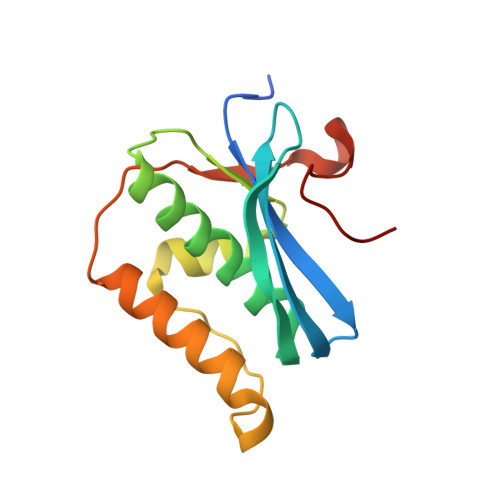
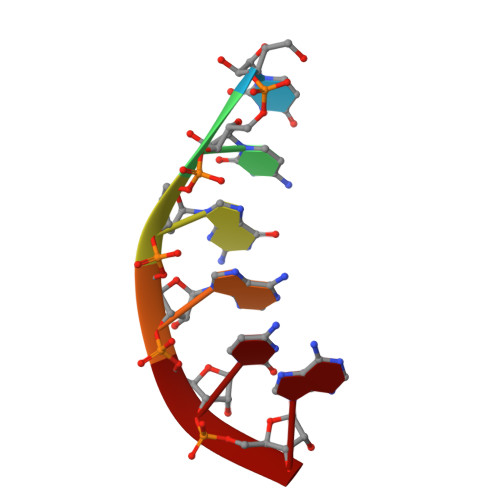
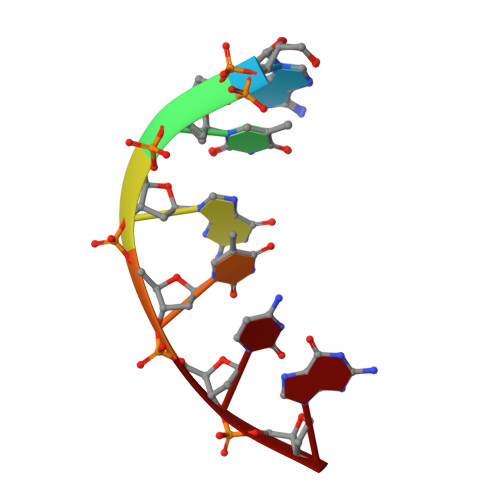
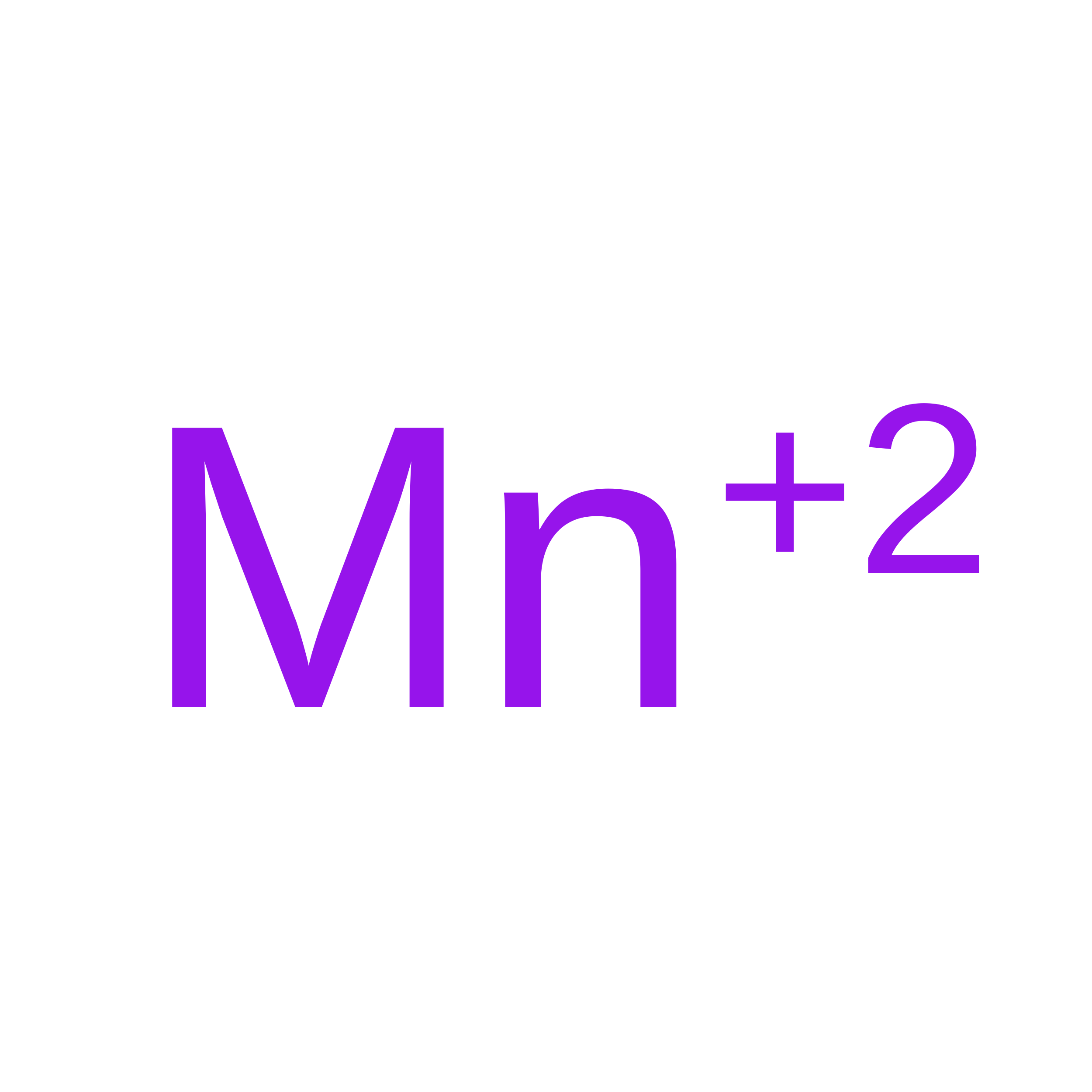
B. halodurans RNase H catalytic domain D192N mutant in complex with Mn2+ and RNA/DNA hybrid (non-P nick at the active site)


Experimental Data Snapshot

  • Method: X-RAY DIFFRACTION
  • Resolution: 1.65 Å
  • R-Value Free: 
    0.202 (Depositor), 0.207 (DCC) 
  • R-Value Work: 
    0.173 (Depositor), 0.177 (DCC) 

Starting Model: experimental
View more details

wwPDB Validation 3D Report Full Report

Validation slider image for 2G8I

This is version 1.4 of the entry. See complete history

Literature

Stepwise analyses of metal ions in RNase H catalysis from substrate destabilization to product release.

Nowotny, M.Yang, W.

(2006) EMBO J 25: 1924-1933

  • DOI: https://doi.org/10.1038/sj.emboj.7601076
  • Primary Citation Related Structures: 
    2G8F, 2G8H, 2G8I, 2G8K, 2G8U, 2G8V, 2G8W

  • PubMed Abstract: 

    In two-metal catalysis, metal ion A has been proposed to activate the nucleophile and metal ion B to stabilize the transition state. We recently reported crystal structures of RNase H-RNA/DNA substrate complexes obtained at 1.5-2.2 Angstroms. We have now determined and report here structures of reaction intermediate and product complexes of RNase H at 1.65-1.85 Angstroms. The movement of the two metal ions suggests how they may facilitate RNA hydrolysis during the catalytic process. Firstly, metal ion A may assist nucleophilic attack by moving towards metal ion B and bringing the nucleophile close to the scissile phosphate. Secondly, metal ion B transforms from an irregular coordination in the substrate complex to a more regular geometry in the product complex. The exquisite sensitivity of Mg(2+) to the coordination environment likely destabilizes the enzyme-substrate complex and reduces the energy barrier to form product. Lastly, product release probably requires dissociation of metal ion A, which is inhibited by either high concentrations of divalent cations or mutation of an assisting protein residue.


  • Organizational Affiliation
    • Laboratory of Molecular Biology, National Institute of Diabetes and Digestive and Kidney Diseases, National Institutes of Health, Bethesda, MD 20892, USA.

Macromolecule Content 

  • Total Structure Weight: 20.4 kDa 
  • Atom Count: 1,727 
  • Modeled Residue Count: 146 
  • Deposited Residue Count: 154 
  • Unique protein chains: 1
  • Unique nucleic acid chains: 2

Macromolecules


Find similar proteins by:|  3D Structure
Entity ID: 3
MoleculeChains  Sequence LengthOrganismDetailsImage
Ribonuclease HC [auth A]142Halalkalibacterium haloduransMutation(s): 1 
Gene Names: rnhA
EC: 3.1.26.4
UniProt
Find proteins for Q9KEI9 (Halalkalibacterium halodurans (strain ATCC BAA-125 / DSM 18197 / FERM 7344 / JCM 9153 / C-125))
Explore Q9KEI9 
Go to UniProtKB:  Q9KEI9
Entity Groups
Sequence Clusters30% Identity50% Identity70% Identity90% Identity95% Identity100% Identity
UniProt GroupQ9KEI9
Sequence Annotations
Expand
Reference Sequence
Find similar nucleic acids by:  Sequence
Entity ID: 1
MoleculeChains LengthOrganismImage
5'-R(*UP*CP*GP*AP*CP*A)-3'A [auth B]6N/A
Sequence Annotations
Expand
Reference Sequence
Find similar nucleic acids by:  Sequence
Entity ID: 2
MoleculeChains LengthOrganismImage
5'-D(*AP*TP*GP*TP*CP*G)-3'B [auth C]6N/A
Sequence Annotations
Expand
Reference Sequence

Experimental Data & Validation

Experimental Data

  • Method: X-RAY DIFFRACTION
  • Resolution: 1.65 Å
  • R-Value Free:  0.202 (Depositor), 0.207 (DCC) 
  • R-Value Work:  0.173 (Depositor), 0.177 (DCC) 
Space Group: C 1 2 1
Unit Cell:
Length ( Å )Angle ( ˚ )
a = 82.118α = 90
b = 37.084β = 96.53
c = 61.772γ = 90
Software Package:
Software NamePurpose
HKL-2000data collection
SCALEPACKdata scaling
EPMRphasing
CNSrefinement
HKL-2000data reduction

Structure Validation

View Full Validation Report


Entry History 

Deposition Data

Revision History  (Full details and data files)

  • Version 1.0: 2006-04-25
    Type: Initial release
  • Version 1.1: 2008-05-01
    Changes: Version format compliance
  • Version 1.2: 2011-07-13
    Changes: Version format compliance
  • Version 1.3: 2021-10-20
    Changes: Database references, Derived calculations
  • Version 1.4: 2023-08-30
    Changes: Data collection, Refinement description