2G37 | pdb_00002g37

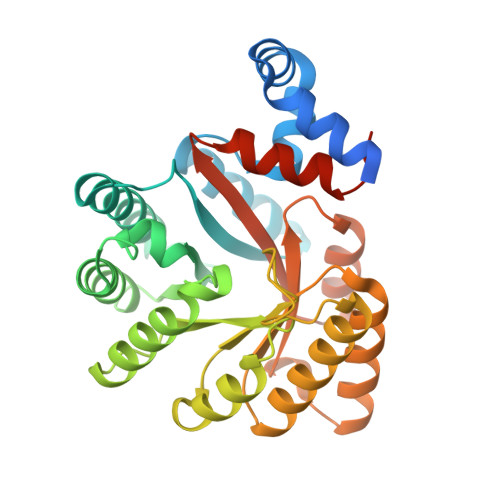
Structure of Thermus thermophilus L-proline dehydrogenase


Experimental Data Snapshot

  • Method: X-RAY DIFFRACTION
  • Resolution: 2.00 Å
  • R-Value Free: 
    0.231 (Depositor), 0.230 (DCC) 
  • R-Value Work: 
    0.190 (Depositor), 0.190 (DCC) 
  • R-Value Observed: 
    0.192 (Depositor) 

wwPDB Validation 3D Report Full Report

Validation slider image for 2G37

Ligand Structure Quality Assessment 


This is version 1.3 of the entry. See complete history

Literature

Structure and Kinetics of Monofunctional Proline Dehydrogenase from Thermus thermophilus.

White, T.A.Krishnan, N.Becker, D.F.Tanner, J.J.

(2007) J Biological Chem 282: 14316-14327

  • DOI: https://doi.org/10.1074/jbc.M700912200
  • Primary Citation Related Structures: 
    2G37

  • PubMed Abstract: 

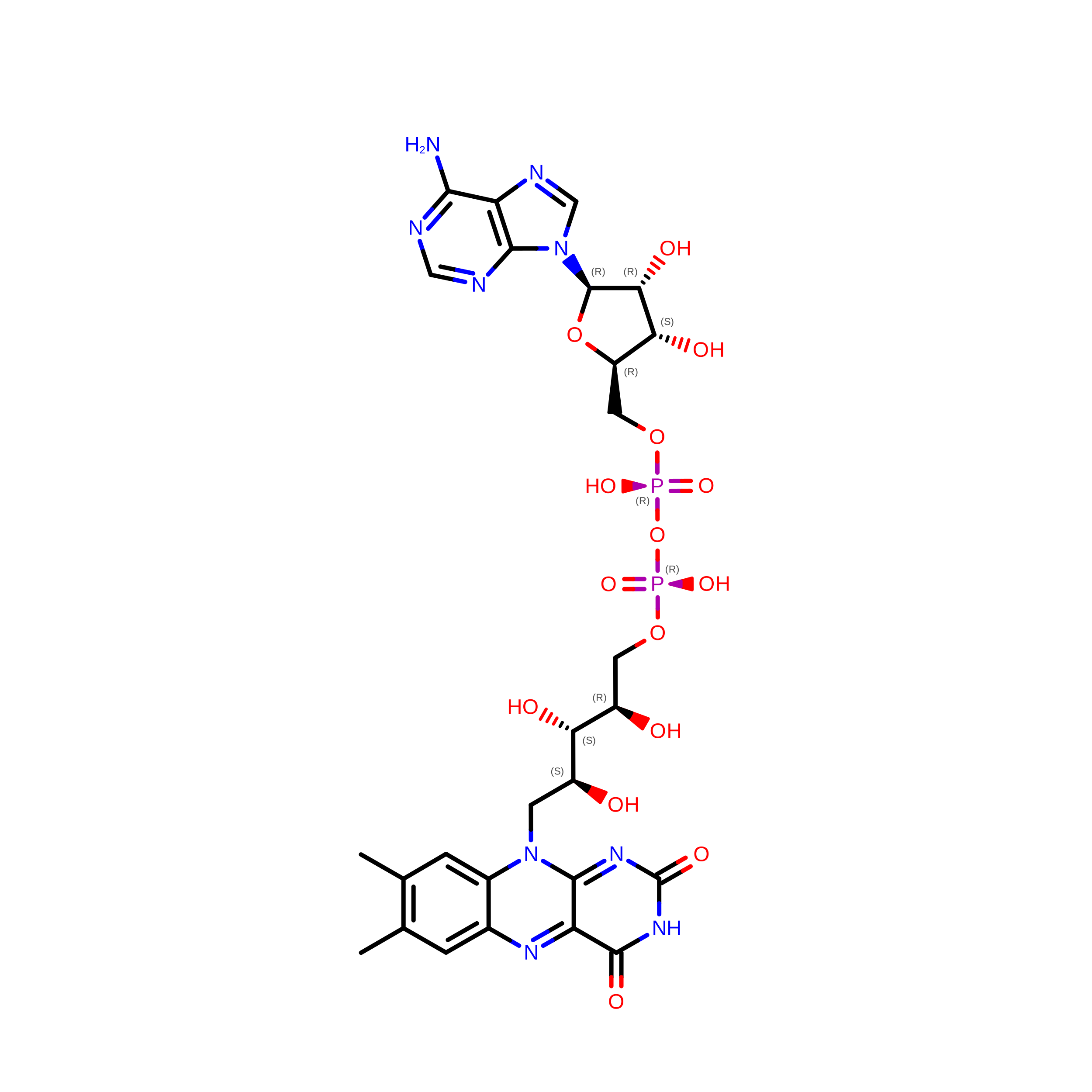
    Proline dehydrogenase (PRODH) and Delta(1)-pyrroline-5-carboxylate dehydrogenase (P5CDH) catalyze the two-step oxidation of proline to glutamate. They are distinct monofunctional enzymes in all eukaryotes and some bacteria but are fused into bifunctional enzymes known as proline utilization A (PutA) in other bacteria. Here we report the first structure and biochemical data for a monofunctional PRODH. The 2.0-A resolution structure of Thermus thermophilus PRODH reveals a distorted (betaalpha)(8) barrel catalytic core domain and a hydrophobic alpha-helical domain located above the carboxyl-terminal ends of the strands of the barrel. Although the catalytic core is similar to that of the PutA PRODH domain, the FAD conformation of T. thermophilus PRODH is remarkably different and likely reflects unique requirements for membrane association and communication with P5CDH. Also, the FAD of T. thermophilus PRODH is highly solvent-exposed compared with PutA due to a 4-A shift of helix 8. Structure-based sequence analysis of the PutA/PRODH family led us to identify nine conserved motifs involved in cofactor and substrate recognition. Biochemical studies show that the midpoint potential of the FAD is -75 mV and the kinetic parameters for proline are K(m) = 27 mm and k(cat) = 13 s(-1). 3,4-Dehydro-l-proline was found to be an efficient substrate, and l-tetrahydro-2-furoic acid is a competitive inhibitor (K(I) = 1.0 mm). Finally, we demonstrate that T. thermophilus PRODH reacts with O(2) producing superoxide. This is significant because superoxide production underlies the role of human PRODH in p53-mediated apoptosis, implying commonalities between eukaryotic and bacterial monofunctional PRODHs.


  • Organizational Affiliation
    • Department of Biochemistry, University of Missouri-Columbia, Columbia, MO 65211, USA.

Macromolecule Content 

  • Total Structure Weight: 78.14 kDa 
  • Atom Count: 5,184 
  • Modeled Residue Count: 592 
  • Deposited Residue Count: 654 
  • Unique protein chains: 1

Macromolecules

Find similar proteins by:|  3D Structure
Entity ID: 1
MoleculeChains  Sequence LengthOrganismDetailsImage
proline dehydrogenase/delta-1-pyrroline-5-carboxylate dehydrogenase
A, B
327Thermus thermophilus HB27Mutation(s): 0 
Gene Names: proline dehydrogenase/delta-1-pyrroline-5-carboxylate dehydrogenase
EC: 1.5.99.8 (PDB Primary Data), 1.5.5.2 (UniProt)
UniProt
Find proteins for Q72IB8 (Thermus thermophilus (strain ATCC BAA-163 / DSM 7039 / HB27))
Explore Q72IB8 
Go to UniProtKB:  Q72IB8
Entity Groups
Sequence Clusters30% Identity50% Identity70% Identity90% Identity95% Identity100% Identity
UniProt GroupQ72IB8
Sequence Annotations
Expand
Reference Sequence

Experimental Data & Validation

Experimental Data

  • Method: X-RAY DIFFRACTION
  • Resolution: 2.00 Å
  • R-Value Free:  0.231 (Depositor), 0.230 (DCC) 
  • R-Value Work:  0.190 (Depositor), 0.190 (DCC) 
  • R-Value Observed: 0.192 (Depositor) 
Space Group: P 21 21 21
Unit Cell:
Length ( Å )Angle ( ˚ )
a = 82.067α = 90
b = 89.59β = 90
c = 94.316γ = 90
Software Package:
Software NamePurpose
d*TREKdata scaling
REFMACrefinement
PDB_EXTRACTdata extraction
Blu-Icedata collection
SOLVEphasing

Structure Validation

View Full Validation Report


Ligand Structure Quality Assessment 


Entry History 

Deposition Data

Revision History  (Full details and data files)

  • Version 1.0: 2007-02-27
    Type: Initial release
  • Version 1.1: 2008-05-01
    Changes: Version format compliance
  • Version 1.2: 2011-07-13
    Changes: Advisory, Source and taxonomy, Version format compliance
  • Version 1.3: 2024-02-14
    Changes: Data collection, Database references, Derived calculations