2FZM | pdb_00002fzm

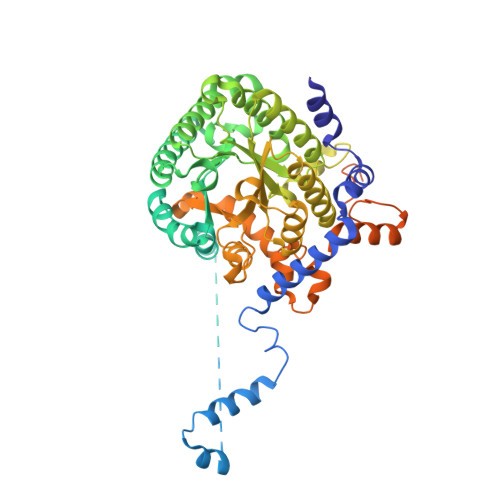
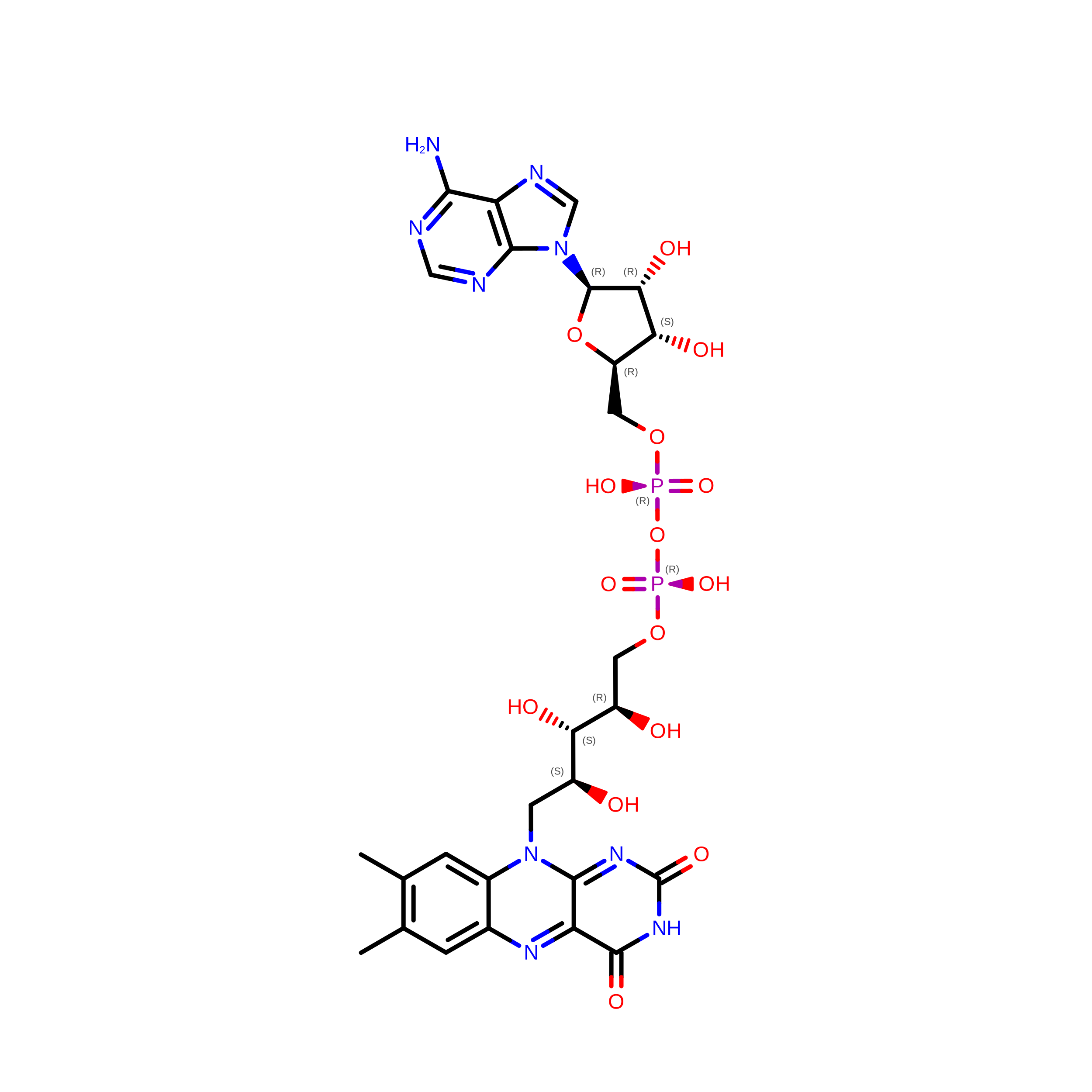
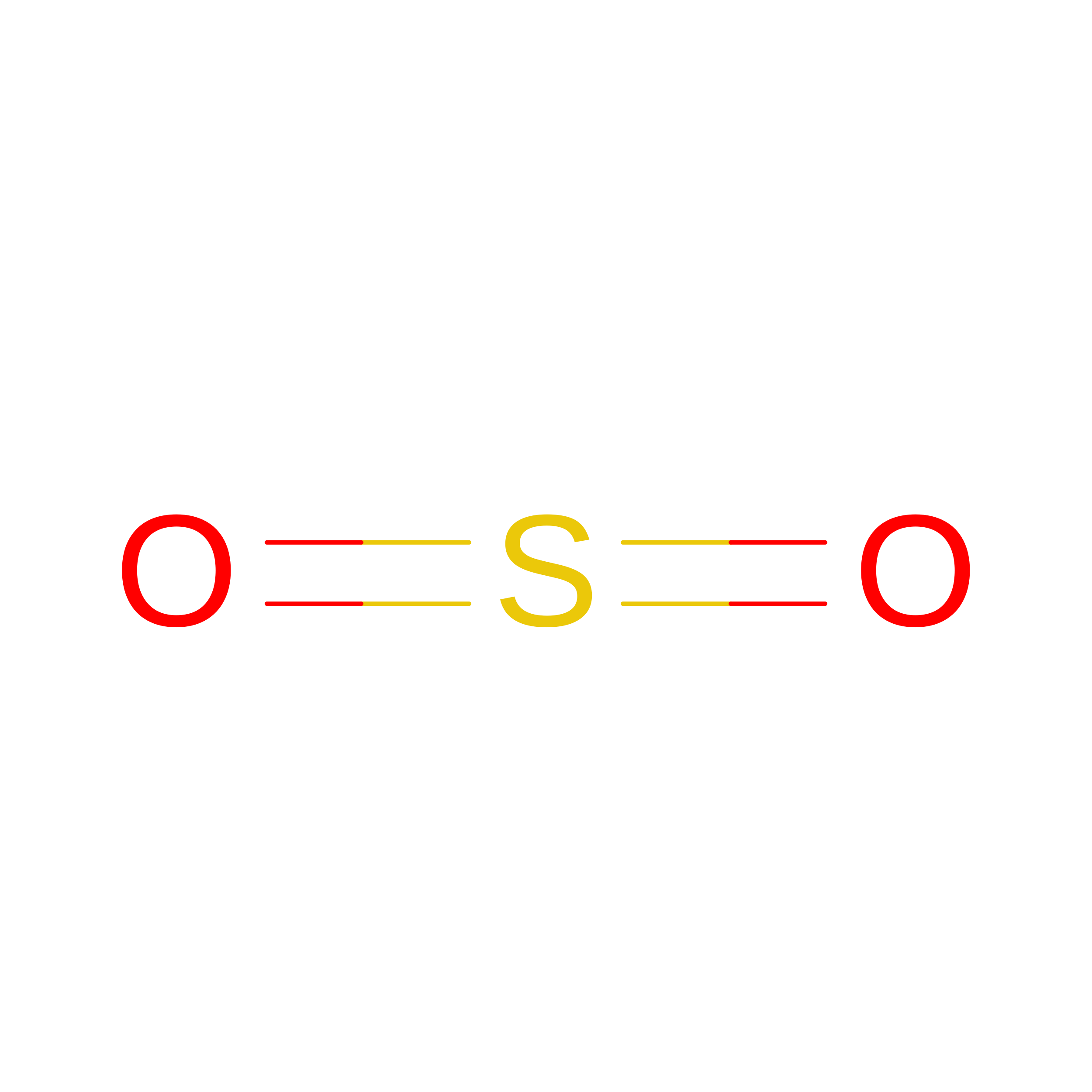
Structure of the E. coli PutA proline dehydrogenase domain reduced by dithionite and complexed with SO2


Experimental Data Snapshot

  • Method: X-RAY DIFFRACTION
  • Resolution: 2.30 Å
  • R-Value Free: 
    0.257 (Depositor), 0.261 (DCC) 
  • R-Value Work: 
    0.209 (Depositor), 0.214 (DCC) 
  • R-Value Observed: 
    0.212 (Depositor) 

Starting Model: experimental
View more details

wwPDB Validation 3D Report Full Report

Validation slider image for 2FZM

Ligand Structure Quality Assessment 


This is version 1.4 of the entry. See complete history

Literature

Redox-induced changes in flavin structure and roles of flavin N(5) and the ribityl 2'-OH group in regulating PutA--membrane binding.

Zhang, W.Zhang, M.Zhu, W.Zhou, Y.Wanduragala, S.Rewinkel, D.Tanner, J.J.Becker, D.F.

(2007) Biochemistry 46: 483-491

  • DOI: https://doi.org/10.1021/bi061935g
  • Primary Citation Related Structures: 
    2FZM

  • PubMed Abstract: 

    PutA is a novel flavoprotein in Escherichia coli that switches from a transcriptional repressor to a membrane-bound proline catabolic enzyme. Previous crystallographic studies of the PutA proline dehydrogenase (PRODH) domain under oxidizing conditions revealed that FAD N(5) and the ribityl 2'-OH group form hydrogen bonds with Arg431 and Arg556, respectively. Here we identify molecular interactions in the PutA PRODH active site that underlie redox-dependent functional switching of PutA. We report that reduction of the PRODH domain induces major structural changes in the FAD cofactor, including a 22 degrees bend of the isoalloxazine ring along the N(5)-N(10) axis, crankshaft rotation of the upper part of the ribityl chain, and formation of a new hydrogen bond network involving the ribityl 2'-OH group, FAD N(1), and Gly435. The roles of the FAD 2'-OH group and the FAD N(5)-Arg431 hydrogen bond pair in regulating redox-dependent PutA-membrane associations were tested using FAD analogues and site-directed mutagenesis. Kinetic membrane binding measurements and cell-based reporter gene assays of modified PutA proteins show that disrupting the FAD N(5)-Arg431 interaction impairs the reductive activation of PutA-membrane binding. We also show that the FAD 2'-OH group acts as a redox-sensitive toggle switch that controls PutA-membrane binding. These results illustrate a new versatility of the ribityl chain in flavoprotein mechanisms.


  • Organizational Affiliation
    • Department of Biochemistry, University of Nebraska, Lincoln, Nebraska 68588, USA.

Macromolecule Content 

  • Total Structure Weight: 67.52 kDa 
  • Atom Count: 3,633 
  • Modeled Residue Count: 450 
  • Deposited Residue Count: 602 
  • Unique protein chains: 1

Macromolecules

Find similar proteins by:|  3D Structure
Entity ID: 1
MoleculeChains  Sequence LengthOrganismDetailsImage
Bifunctional protein putA, Proline dehydrogenase (EC 1.5.99.8) (Proline oxidase)602Escherichia coliMutation(s): 0 
Gene Names: putA
EC: 1.5.99.8 (PDB Primary Data), 1.2.1.88 (UniProt), 1.5.5.2 (UniProt)
UniProt
Find proteins for P09546 (Escherichia coli (strain K12))
Explore P09546 
Go to UniProtKB:  P09546
Entity Groups
Sequence Clusters30% Identity50% Identity70% Identity90% Identity95% Identity100% Identity
UniProt GroupP09546
Sequence Annotations
Expand
Reference Sequence

Small Molecules

Experimental Data & Validation

Experimental Data

  • Method: X-RAY DIFFRACTION
  • Resolution: 2.30 Å
  • R-Value Free:  0.257 (Depositor), 0.261 (DCC) 
  • R-Value Work:  0.209 (Depositor), 0.214 (DCC) 
  • R-Value Observed: 0.212 (Depositor) 
Space Group: I 2 2 2
Unit Cell:
Length ( Å )Angle ( ˚ )
a = 73.11α = 90
b = 141.424β = 90
c = 145.7γ = 90
Software Package:
Software NamePurpose
DENZOdata reduction
SCALEPACKdata scaling
REFMACrefinement
PDB_EXTRACTdata extraction

Structure Validation

View Full Validation Report


Ligand Structure Quality Assessment 


Entry History 

Deposition Data

  • Released Date: 2007-04-03 
  • Deposition Author(s): Tanner, J.J.

Revision History  (Full details and data files)

  • Version 1.0: 2007-04-03
    Type: Initial release
  • Version 1.1: 2008-05-01
    Changes: Version format compliance
  • Version 1.2: 2011-07-13
    Changes: Advisory, Derived calculations, Version format compliance
  • Version 1.3: 2017-10-18
    Changes: Refinement description
  • Version 1.4: 2023-08-30
    Changes: Data collection, Database references, Derived calculations, Refinement description