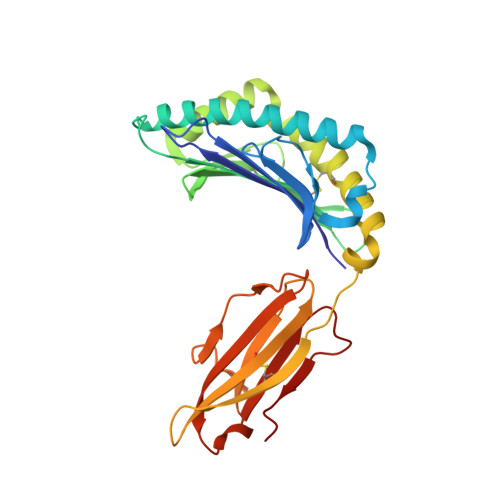
2FYY | pdb_00002fyy

The role of T cell receptor alpha genes in directing human MHC restriction


Experimental Data Snapshot

  • Method: X-RAY DIFFRACTION
  • Resolution: 1.50 Å
  • R-Value Free: 
    0.236 (Depositor), 0.295 (DCC) 
  • R-Value Work: 
    0.225 (Depositor), 0.279 (DCC) 
  • R-Value Observed: 
    0.225 (Depositor) 

Starting Model: experimental
View more details

wwPDB Validation 3D Report Full Report

Validation slider image for 2FYY

This is version 1.5 of the entry. See complete history

Literature

TCR alpha genes direct MHC restriction in the potent human T cell response to a class I-bound viral epitope.

Miles, J.J.Borg, N.A.Brennan, R.M.Tynan, F.E.Kjer-Nielsen, L.Silins, S.L.Bell, M.J.Burrows, J.M.McCluskey, J.Rossjohn, J.Burrows, S.R.

(2006) J Immunol 177: 6804-6814

  • DOI: https://doi.org/10.4049/jimmunol.177.10.6804
  • Primary Citation Related Structures: 
    2FYY, 2FZ3

  • PubMed Abstract: 

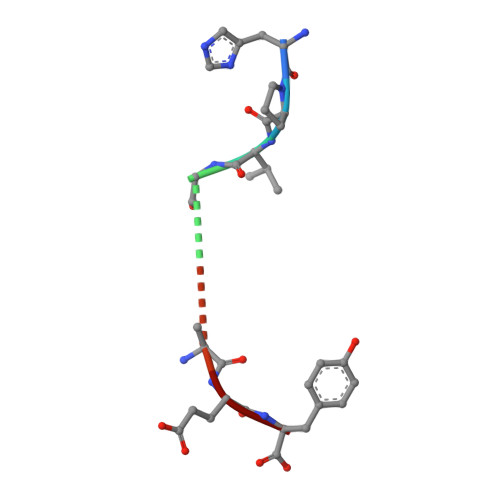
    The underlying generic properties of alphabeta TCRs that control MHC restriction remain largely unresolved. To investigate MHC restriction, we have examined the CTL response to a viral epitope that binds promiscuously to two human leukocyte Ags (HLAs) that differ by a single amino acid at position 156. Individuals expressing either HLA-B*3501 (156Leucine) or HLA-B*3508 (156Arginine) showed a potent CTL response to the 407HPVGEADYFEY417 epitope from EBV. Interestingly, the response was characterized by highly restricted TCR beta-chain usage in both HLA-B*3501+ and HLA-B*3508+ individuals; however, this conserved TRBV9+ beta-chain was associated with distinct TCR alpha-chains depending upon the HLA-B*35 allele expressed by the virus-exposed host. Functional assays confirmed that TCR alpha-chain usage determined the HLA restriction of the CTLs. Structural studies revealed significant differences in the mobility of the peptide when bound to HLA-B*3501 or HLA-B*3508. In HLA-B*3501, the bulged section of the peptide was disordered, whereas in HLA-B*3508 the bulged epitope adopted an ordered conformation. Collectively, these data demonstrate not only that mobile MHC-bound peptides can be highly immunogenic but can also stimulate an extremely biased TCR repertoire. In addition, TCR alpha-chain usage is shown to play a critical role in controlling MHC restriction between closely related allomorphs.


  • Organizational Affiliation
    • Cellular Immunology Laboratory, Queensland Institute of Medical Research, Brisbane, Australia.

Macromolecule Content 

  • Total Structure Weight: 45.02 kDa 
  • Atom Count: 3,433 
  • Modeled Residue Count: 382 
  • Deposited Residue Count: 386 
  • Unique protein chains: 3

Macromolecules

Find similar proteins by:|  3D Structure
Entity ID: 1
MoleculeChains  Sequence LengthOrganismDetailsImage
HLA class I histocompatibility antigen, B-35 alpha chain276Homo sapiensMutation(s): 0 
UniProt
Find proteins for O19626 (Homo sapiens)
Explore O19626 
Go to UniProtKB:  O19626
Entity Groups
Sequence Clusters30% Identity50% Identity70% Identity90% Identity95% Identity100% Identity
UniProt GroupO19626
Sequence Annotations
Expand
Reference Sequence
Find similar proteins by:|  3D Structure
Entity ID: 2
MoleculeChains  Sequence LengthOrganismDetailsImage
Beta-2-microglobulin99Homo sapiensMutation(s): 0 
UniProt & NIH Common Fund Data Resources
Find proteins for P61769 (Homo sapiens)
Explore P61769 
Go to UniProtKB:  P61769
PHAROS:  P61769
GTEx:  ENSG00000166710 
Entity Groups
Sequence Clusters30% Identity50% Identity70% Identity90% Identity95% Identity100% Identity
UniProt GroupP61769
Sequence Annotations
Expand
Reference Sequence
Find similar proteins by:  Sequence   |   3D Structure  
Entity ID: 3
MoleculeChains  Sequence LengthOrganismDetailsImage
11-mer peptide from Epstein-Barr nuclear antigen 111N/AMutation(s): 0 
EC: 3.1.21
UniProt
Find proteins for P03211 (Epstein-Barr virus (strain B95-8))
Explore P03211 
Go to UniProtKB:  P03211
Entity Groups
Sequence Clusters30% Identity50% Identity70% Identity90% Identity95% Identity100% Identity
UniProt GroupP03211
Sequence Annotations
Expand
Reference Sequence

Experimental Data & Validation

Experimental Data

  • Method: X-RAY DIFFRACTION
  • Resolution: 1.50 Å
  • R-Value Free:  0.236 (Depositor), 0.295 (DCC) 
  • R-Value Work:  0.225 (Depositor), 0.279 (DCC) 
  • R-Value Observed: 0.225 (Depositor) 
Space Group: P 21 21 21
Unit Cell:
Length ( Å )Angle ( ˚ )
a = 51.045α = 90
b = 81.783β = 90
c = 110.308γ = 90
Software Package:
Software NamePurpose
REFMACrefinement
HKL-2000data reduction
SCALEPACKdata scaling
MOLREPphasing

Structure Validation

View Full Validation Report


Entry History 

Deposition Data

Revision History  (Full details and data files)

  • Version 1.0: 2006-12-26
    Type: Initial release
  • Version 1.1: 2008-05-01
    Changes: Version format compliance
  • Version 1.2: 2011-07-13
    Changes: Version format compliance
  • Version 1.3: 2019-11-06
    Changes: Data collection, Database references
  • Version 1.4: 2023-10-25
    Changes: Data collection, Database references, Refinement description
  • Version 1.5: 2024-10-09
    Changes: Structure summary