2FF0 | pdb_00002ff0

Solution Structure of Steroidogenic Factor 1 DNA Binding Domain Bound to its Target Sequence in the Inhibin alpha-subunit Promoter


Experimental Data Snapshot

  • Method: SOLUTION NMR
  • Conformers Calculated: 200 
  • Conformers Submitted: 16 
  • Selection Criteria: lowest restraint energies, restraint violations, and RMS deviations from ideal covalent geometry 

wwPDB Validation 3D Report Full Report

Validation slider image for 2FF0

This is version 1.4 of the entry. See complete history

Literature

Sequence-specific deoxyribonucleic Acid (DNA) recognition by steroidogenic factor 1: a helix at the carboxy terminus of the DNA binding domain is necessary for complex stability.

Little, T.H.Zhang, Y.Matulis, C.K.Weck, J.Zhang, Z.Ramachandran, A.Mayo, K.E.Radhakrishnan, I.

(2006) Mol Endocrinol 20: 831-843

  • DOI: https://doi.org/10.1210/me.2005-0384
  • Primary Citation Related Structures: 
    2FF0

  • PubMed Abstract: 

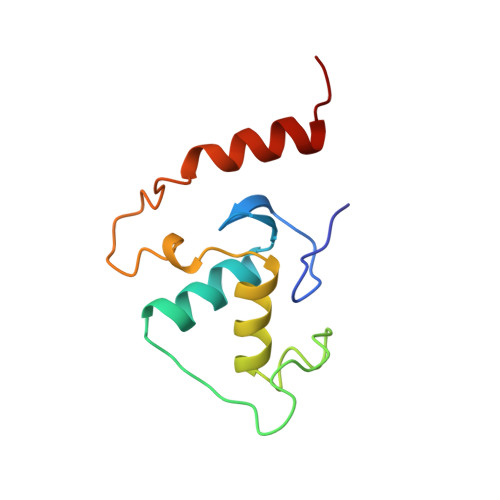
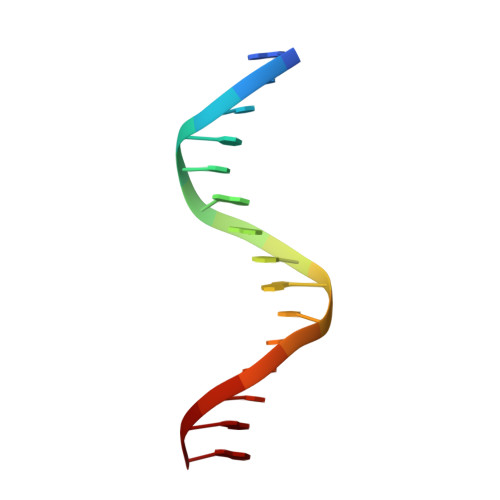
    Steroidogenic factor 1 (SF1) is a member of the NR5A subfamily of nuclear hormone receptors and is considered a master regulator of reproduction because it regulates a number of genes encoding reproductive hormones and enzymes involved in steroid hormone biosynthesis. Like other NR5A members, SF1 harbors a highly conserved approximately 30-residue segment called the FTZ-F1 box C-terminal to the core DNA binding domain (DBD) common to all nuclear receptors and binds to 9-bp DNA sequences as a monomer. Here we describe the solution structure of the SF1 DBD in complex with an atypical sequence in the proximal promoter region of the inhibin-alpha gene that encodes a subunit of a reproductive hormone. SF1 forms a specific complex with the DNA through a bipartite motif binding to the major and minor grooves through the core DBD and the N-terminal segment of the FTZ-F1 box, respectively, in a manner previously described for two other monomeric receptors, nerve growth factor-induced-B and estrogen-related receptor 2. However, unlike these receptors, SF1 harbors a helix in the C-terminal segment of the FTZ-F1 box that interacts with both the core DBD and DNA and serves as an important determinant of stability of the complex. We propose that the FTZ-F1 helix along with the core DBD serves as a platform for interactions with coactivators and other DNA-bound factors in the vicinity.


  • Organizational Affiliation
    • Department of Biochemistry, Molecular Biology, and Cell Biology, Northwestern University, Evanston, Illinois 60208-3500, USA.

Macromolecule Content 

  • Total Structure Weight: 21.2 kDa 
  • Atom Count: 1,435 
  • Modeled Residue Count: 132 
  • Deposited Residue Count: 132 
  • Unique protein chains: 1
  • Unique nucleic acid chains: 2

Macromolecules


Find similar proteins by:|  3D Structure
Entity ID: 3
MoleculeChains  Sequence LengthOrganismDetailsImage
Steroidogenic factor 1C [auth A]102Mus musculusMutation(s): 0 
Gene Names: Nr5a1Ftzf1
UniProt
Find proteins for P33242 (Mus musculus)
Explore P33242 
Go to UniProtKB:  P33242
Entity Groups
Sequence Clusters30% Identity50% Identity70% Identity90% Identity95% Identity100% Identity
UniProt GroupP33242
Sequence Annotations
Expand
Reference Sequence
Find similar nucleic acids by:  Sequence
Entity ID: 1
MoleculeChains LengthOrganismImage
GGCTCAGGGCCACAGA [auth B]15N/A
Sequence Annotations
Expand
Reference Sequence
Find similar nucleic acids by:  Sequence
Entity ID: 2
MoleculeChains LengthOrganismImage
CTGTGGCCCTGAGCCB [auth C]15N/A
Sequence Annotations
Expand
Reference Sequence

Small Molecules

Experimental Data & Validation

Experimental Data

  • Method: SOLUTION NMR
  • Conformers Calculated: 200 
  • Conformers Submitted: 16 
  • Selection Criteria: lowest restraint energies, restraint violations, and RMS deviations from ideal covalent geometry 

Structure Validation

View Full Validation Report


Entry History 

Deposition Data

Revision History  (Full details and data files)

  • Version 1.0: 2006-04-11
    Type: Initial release
  • Version 1.1: 2008-05-01
    Changes: Version format compliance
  • Version 1.2: 2011-07-13
    Changes: Version format compliance
  • Version 1.3: 2022-03-09
    Changes: Data collection, Database references, Derived calculations
  • Version 1.4: 2024-05-29
    Changes: Data collection