2F9S | pdb_00002f9s

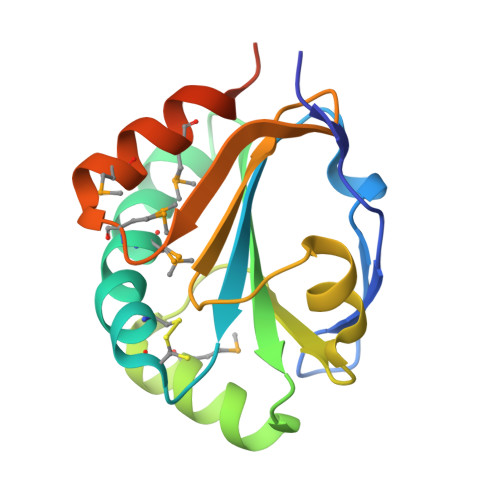
2nd Crystal Structure Of A Soluble Domain Of ResA In The Oxidised Form


Experimental Data Snapshot

  • Method: X-RAY DIFFRACTION
  • Resolution: 1.40 Å
  • R-Value Free: 
    0.175 (Depositor), 0.187 (DCC) 
  • R-Value Work: 
    0.162 (Depositor), 0.187 (DCC) 
  • R-Value Observed: 
    0.163 (Depositor) 

wwPDB Validation 3D Report Full Report

Validation slider image for 2F9S

This is version 1.3 of the entry. See complete history

Literature

Mechanism of substrate specificity in Bacillus subtilis ResA, a thioredoxin-like protein involved in cytochrome c maturation

Colbert, C.L.Wu, Q.Erbel, P.J.A.Gardner, K.H.Deisenhofer, J.

(2006) Proc Natl Acad Sci U S A 103: 4410-4415

  • DOI: https://doi.org/10.1073/pnas.0600552103
  • Primary Citation Related Structures: 
    2F9S

  • PubMed Abstract: 

    The covalent attachment of heme cofactors to the apo-polypeptides via thioether bonds is unique to the maturation of c-type cytochromes. A number of thiol-disulfide oxidoreductases prepare the apocytochrome for heme insertion in system I and II cytochrome c maturation. Although most thiol-disulfide oxidoreductases are nonspecific, the less common, specific thiol-disulfide oxidoreductases may be key to directing the usage of electrons. Here we demonstrate that unlike other thiol-disulfide oxidoreductases, the protein responsible for reducing oxidized apocytochrome c in Bacillus subtilis, ResA, is specific for cytochrome c550 and utilizes alternate conformations to recognize redox partners. We report solution NMR evidence that ResA undergoes a redox-dependent conformational change between oxidation states, as well as data showing that ResA utilizes a surface cavity present only in the reduced state to recognize a peptide derived from cytochrome c550. Finally, we confirm that ResA is a specific thiol-disulfide oxidoreductase by comparing its reactivity to our mimetic peptide with its reactivity to oxidized glutathione, a nonspecific substrate. This study biochemically demonstrates the specificity of this thiol-disulfide oxidoreductase and enables us to outline a structural mechanism of regulating the usage of electrons in a thiol-disulfide oxidoreductase system.


  • Organizational Affiliation
    • Howard Hughes Medical Institute, and Department of Biochemistry, University of Texas Southwestern Medical Center, 6001 Forest Park Road, Dallas, TX 75390, USA.

Macromolecule Content 

  • Total Structure Weight: 34.5 kDa 
  • Atom Count: 2,522 
  • Modeled Residue Count: 274 
  • Deposited Residue Count: 302 
  • Unique protein chains: 1

Macromolecules

Find similar proteins by:|  3D Structure
Entity ID: 1
MoleculeChains  Sequence LengthOrganismDetailsImage
Thiol-disulfide oxidoreductase resA
A, B
151Bacillus subtilisMutation(s): 5 
Gene Names: resa
UniProt
Find proteins for P35160 (Bacillus subtilis (strain 168))
Explore P35160 
Go to UniProtKB:  P35160
Entity Groups
Sequence Clusters30% Identity50% Identity70% Identity90% Identity95% Identity100% Identity
UniProt GroupP35160
Sequence Annotations
Expand
Reference Sequence

Small Molecules

Modified Residues  1 Unique
IDChains TypeFormula2D DiagramParent
MSE
Query on MSE
A, B
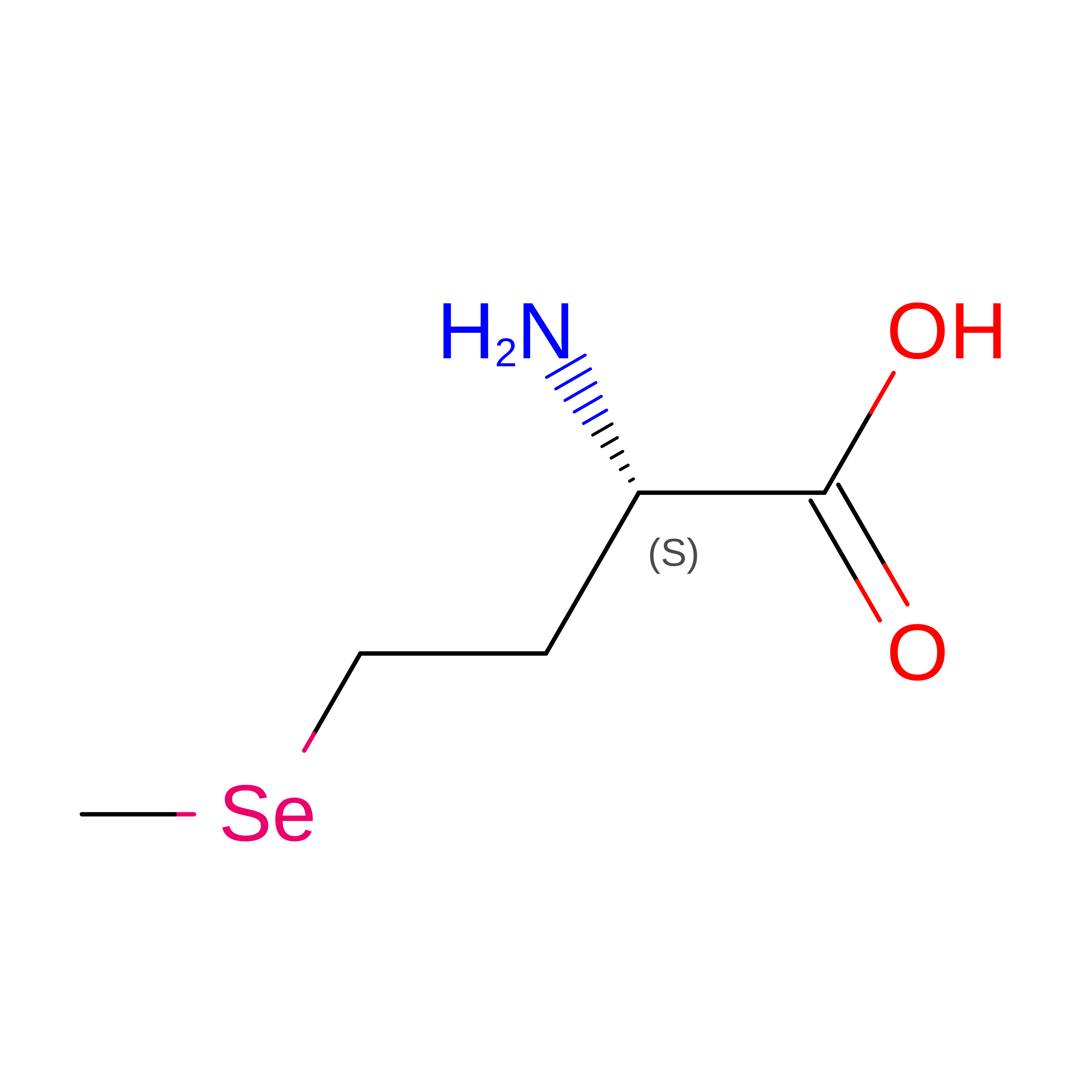
L-PEPTIDE LINKINGC5 H11 N O2 SeMET

Experimental Data & Validation

Experimental Data

  • Method: X-RAY DIFFRACTION
  • Resolution: 1.40 Å
  • R-Value Free:  0.175 (Depositor), 0.187 (DCC) 
  • R-Value Work:  0.162 (Depositor), 0.187 (DCC) 
  • R-Value Observed: 0.163 (Depositor) 
Space Group: P 65
Unit Cell:
Length ( Å )Angle ( ˚ )
a = 61.186α = 90
b = 61.186β = 90
c = 166.999γ = 120
Software Package:
Software NamePurpose
HKL-2000data collection
SCALEPACKdata scaling
SOLVEphasing
REFMACrefinement
HKL-2000data reduction

Structure Validation

View Full Validation Report


Entry History 

Deposition Data

Revision History  (Full details and data files)

  • Version 1.0: 2006-04-18
    Type: Initial release
  • Version 1.1: 2008-05-01
    Changes: Version format compliance
  • Version 1.2: 2011-07-13
    Changes: Version format compliance
  • Version 1.3: 2024-10-09
    Changes: Data collection, Database references, Derived calculations, Structure summary