2EB5 | pdb_00002eb5

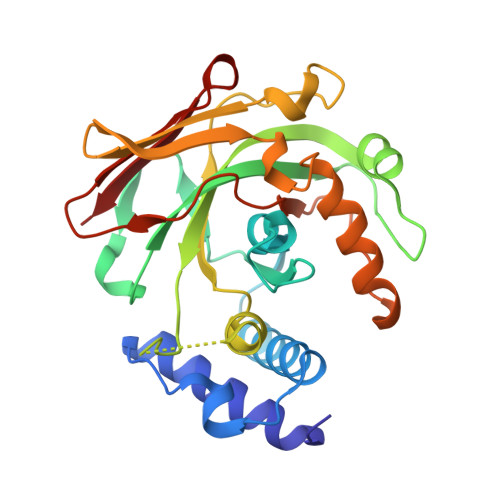
Crystal structure of HpcG complexed with oxalate


Experimental Data Snapshot

  • Method: X-RAY DIFFRACTION
  • Resolution: 1.70 Å
  • R-Value Free: 
    0.226 (Depositor) 
  • R-Value Work: 
    0.192 (Depositor) 
  • R-Value Observed: 
    0.194 (Depositor) 

wwPDB Validation 3D Report Full Report

Validation slider image for 2EB5

This is version 1.3 of the entry. See complete history

Literature

Structure and Mechanism of HpcG, a Hydratase in the Homoprotocatechuate Degradation Pathway of Escherichia coli

Izumi, A.Rea, D.Adachi, T.Unzai, S.Park, S.Y.Roper, D.I.Tame, J.R.H.

(2007) J Mol Biology 370: 899-911

  • DOI: https://doi.org/10.1016/j.jmb.2007.05.006
  • Primary Citation Related Structures: 
    2EB4, 2EB5, 2EB6

  • PubMed Abstract: 

    HpcG catalyses the hydration of a carbon-carbon double bond without the aid of any cofactor other than a simple divalent metal ion such as Mg(2+). Since the substrate has a nearby carbonyl group, it is believed that it first isomerises to form a pair of conjugated double bonds in the enol tautomer before Michael addition of water. Previous chemical studies of the reaction, and that of the related enzyme MhpD, have failed to provide a clear picture of the mechanism. The substrate itself is unstable, preventing co-crystallisation or soaking of crystals, but oxalate is a strong competitive inhibitor. We have solved the crystal structure of the protein in the apo form, and with magnesium and oxalate bound. Modelling substrate into the active site suggests the attacking water molecule is not part of the metal coordination shell, in contrast to a previous proposal. Our model suggests that geometrically strained cis isomer intermediates do not lie on the reaction pathway, and that separate groups are involved in the isomerisation and hydration steps.


  • Organizational Affiliation
    • Protein Design Laboratory, Yokohama City University, Suehiro 1-7-29, Tsurumi, Yokohama 230-0045, Japan.

Macromolecule Content 

  • Total Structure Weight: 149.72 kDa 
  • Atom Count: 10,981 
  • Modeled Residue Count: 1,300 
  • Deposited Residue Count: 1,335 
  • Unique protein chains: 1

Macromolecules

Find similar proteins by:|  3D Structure
Entity ID: 1
MoleculeChains  Sequence LengthOrganismDetailsImage
2-oxo-hept-3-ene-1,7-dioate hydratase
A, B, C, D, E
267Escherichia coliMutation(s): 0 
Gene Names: HPCG
EC: 4.2.1 (PDB Primary Data), 4.2.1.163 (UniProt)
UniProt
Find proteins for Q46982 (Escherichia coli)
Explore Q46982 
Go to UniProtKB:  Q46982
Entity Groups
Sequence Clusters30% Identity50% Identity70% Identity90% Identity95% Identity100% Identity
UniProt GroupQ46982
Sequence Annotations
Expand
Reference Sequence

Small Molecules

Ligands 3 Unique
IDChains Name / Formula / InChI Key2D Diagram3D Interactions
OXL

Query on OXL


Download:Ideal Coordinates CCD File
G [auth A],
K [auth B],
N [auth C],
R [auth D],
U [auth E]
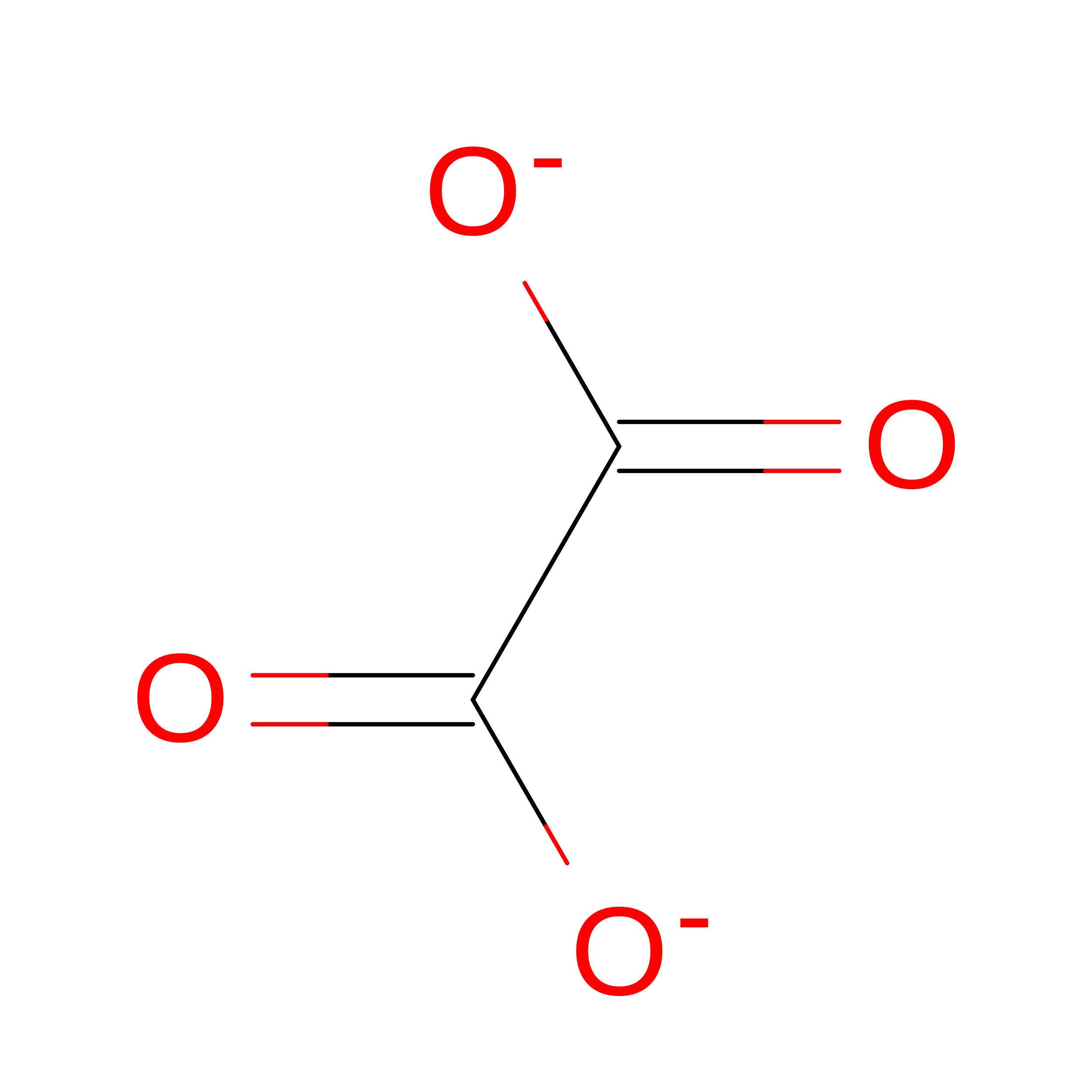
OXALATE ION
C2 O4
MUBZPKHOEPUJKR-UHFFFAOYSA-L
SCN

Query on SCN


Download:Ideal Coordinates CCD File
H [auth A]
I [auth A]
L [auth B]
O [auth C]
P [auth C]
H [auth A],
I [auth A],
L [auth B],
O [auth C],
P [auth C],
S [auth D],
V [auth E]
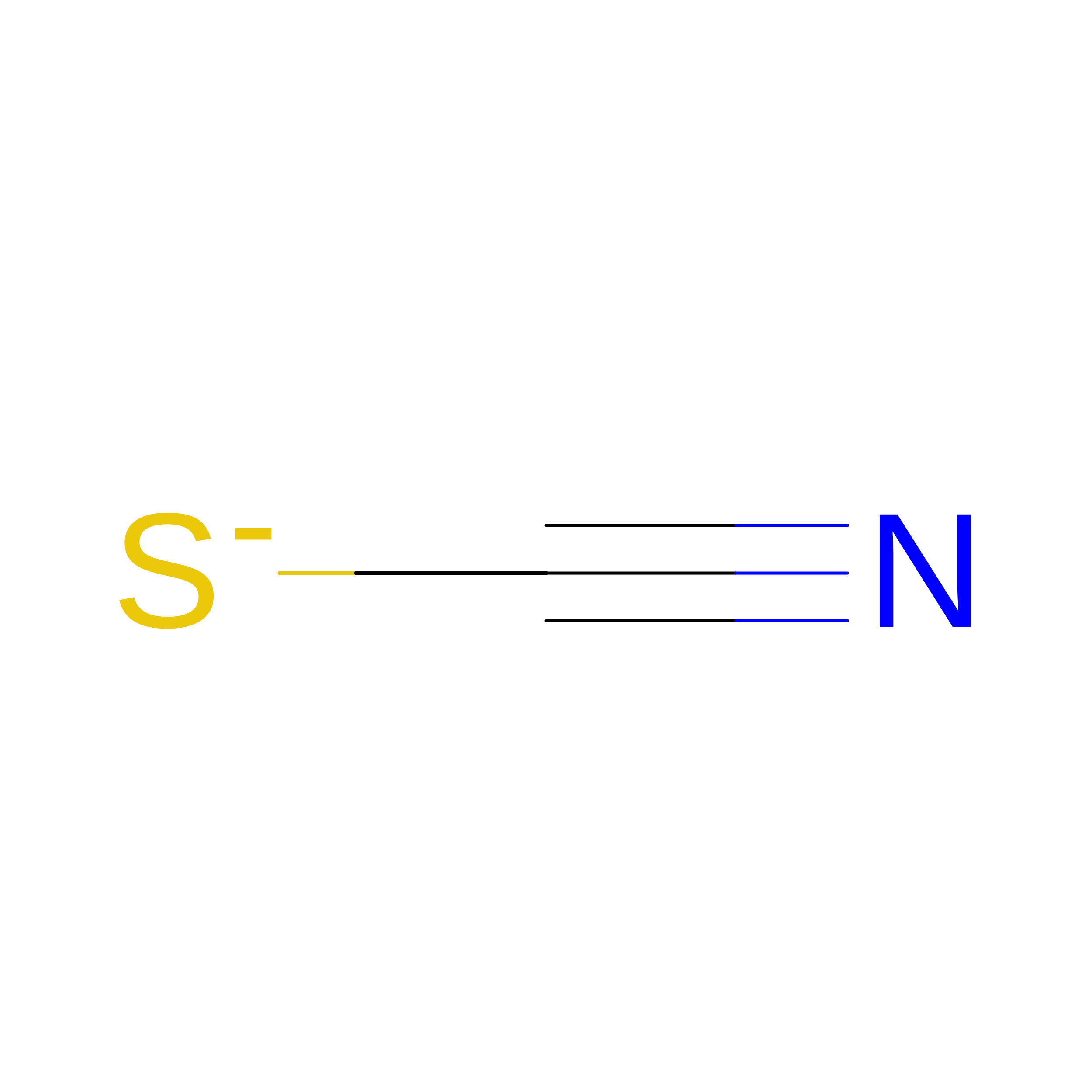
THIOCYANATE ION
C N S
ZMZDMBWJUHKJPS-UHFFFAOYSA-M
MG

Query on MG


Download:Ideal Coordinates CCD File
F [auth A],
J [auth B],
M [auth C],
Q [auth D],
T [auth E]
MAGNESIUM ION
Mg
JLVVSXFLKOJNIY-UHFFFAOYSA-N

Experimental Data & Validation

Experimental Data

  • Method: X-RAY DIFFRACTION
  • Resolution: 1.70 Å
  • R-Value Free:  0.226 (Depositor) 
  • R-Value Work:  0.192 (Depositor) 
  • R-Value Observed: 0.194 (Depositor) 
Space Group: P 43 21 2
Unit Cell:
Length ( Å )Angle ( ˚ )
a = 136.541α = 90
b = 136.541β = 90
c = 192.397γ = 90
Software Package:
Software NamePurpose
REFMACrefinement
HKL-2000data collection
DENZOdata reduction
SCALEPACKdata scaling
MOLREPphasing

Structure Validation

View Full Validation Report


Entry History 

Deposition Data

Revision History  (Full details and data files)

  • Version 1.0: 2007-07-17
    Type: Initial release
  • Version 1.1: 2008-04-30
    Changes: Version format compliance
  • Version 1.2: 2011-07-13
    Changes: Derived calculations, Version format compliance
  • Version 1.3: 2024-03-13
    Changes: Data collection, Database references, Derived calculations