2EAL | pdb_00002eal

Crystal structure of human galectin-9 N-terminal CRD in complex with Forssman pentasaccharide


Experimental Data Snapshot

  • Method: X-RAY DIFFRACTION
  • Resolution: 1.85 Å
  • R-Value Free: 
    0.245 (Depositor), 0.246 (DCC) 
  • R-Value Work: 
    0.207 (Depositor), 0.208 (DCC) 
  • R-Value Observed: 
    0.209 (Depositor) 

wwPDB Validation 3D Report Full Report

Validation slider image for 2EAL

This is version 2.1 of the entry. See complete history

Literature

Structural analysis of the human galectin-9 N-terminal carbohydrate recognition domain reveals unexpected properties that differ from the mouse orthologue.

Nagae, M.Nishi, N.Nakamura-Tsuruta, S.Hirabayashi, J.Wakatsuki, S.Kato, R.

(2008) J Mol Biology 375: 119-135

  • DOI: https://doi.org/10.1016/j.jmb.2007.09.060
  • Primary Citation Related Structures: 
    2EAK, 2EAL

  • PubMed Abstract: 

    Galectins are a family of beta-galactoside-binding lectins that contain a conserved carbohydrate recognition domain (CRD). They exhibit high affinities for small beta-galactosides as well as variable binding specificities for complex glycoconjugates. Structural and biochemical analyses of the mechanism governing specific carbohydrate recognition provide a useful template to elucidate the function of these proteins. Here we report the crystal structures of the human galectin-9 N-terminal CRD (NCRD) in the presence of lactose and Forssman pentasaccharide. Mouse galectin-9 NCRD, the structure of which was previously solved by our group, forms a non-canonical dimer in both the crystal state and in solution. Human galectin-9 NCRD, however, exists as a monomer in crystals, despite a high sequence identity to the mouse homologue. Comparative frontal affinity chromatography analysis of the mouse and human galectin-9 NCRDs revealed different carbohydrate binding specificities, with disparate affinities for complex glycoconjugates. Human galectin-9 NCRD exhibited a high affinity for Forssman pentasaccharide; the association constant for mouse galectin-9 NCRD was 100-fold less than that observed for the human protein. The combination of structural data with mutational studies demonstrated that non-conserved amino acid residues on the concave surface were important for determination of target specificities. The human galectin-9 NCRD exhibited greater inhibition of cell proliferation than the mouse NCRD. We discuss the biochemical and structural differences between highly homologous proteins from different species.


  • Organizational Affiliation
    • Structural Biology Research Center, Photon Factory, Institute of Materials Structure Science, High Energy Accelerator Research Organization (KEK), 1-1 Oho, Tsukuba, Ibaraki 305-0801, Japan.

Macromolecule Content 

  • Total Structure Weight: 33.89 kDa 
  • Atom Count: 2,503 
  • Modeled Residue Count: 283 
  • Deposited Residue Count: 296 
  • Unique protein chains: 1

Macromolecules

Find similar proteins by:|  3D Structure
Entity ID: 1
MoleculeChains  Sequence LengthOrganismDetailsImage
Galectin-9
A, B
148Homo sapiensMutation(s): 0 
UniProt & NIH Common Fund Data Resources
Find proteins for O00182 (Homo sapiens)
Explore O00182 
Go to UniProtKB:  O00182
PHAROS:  O00182
GTEx:  ENSG00000168961 
Entity Groups
Sequence Clusters30% Identity50% Identity70% Identity90% Identity95% Identity100% Identity
UniProt GroupO00182
Sequence Annotations
Expand
Reference Sequence

Oligosaccharides

Help  
Entity ID: 2
MoleculeChains Length2D Diagram GlycosylationD Interactions
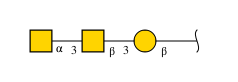
2-acetamido-2-deoxy-alpha-D-galactopyranose-(1-3)-2-acetamido-2-deoxy-beta-D-galactopyranose-(1-3)-beta-D-galactopyranose
C, D
3N/A
Glycosylation Resources
GlyTouCan: G81206JQ
GlyCosmos: G81206JQ
GlyGen: G81206JQ

Experimental Data & Validation

Experimental Data

  • Method: X-RAY DIFFRACTION
  • Resolution: 1.85 Å
  • R-Value Free:  0.245 (Depositor), 0.246 (DCC) 
  • R-Value Work:  0.207 (Depositor), 0.208 (DCC) 
  • R-Value Observed: 0.209 (Depositor) 
Space Group: P 21 21 21
Unit Cell:
Length ( Å )Angle ( ˚ )
a = 38.486α = 90
b = 68.836β = 90
c = 106.106γ = 90
Software Package:
Software NamePurpose
REFMACrefinement
HKL-2000data collection
HKL-2000data reduction
HKL-2000data scaling
MOLREPphasing

Structure Validation

View Full Validation Report


Entry History 

Deposition Data

Revision History  (Full details and data files)

  • Version 1.0: 2007-09-25
    Type: Initial release
  • Version 1.1: 2011-07-13
    Changes: Version format compliance
  • Version 1.2: 2012-02-22
    Changes: Advisory, Database references
  • Version 1.3: 2020-06-24
    Changes: Advisory, Data collection, Derived calculations
  • Version 2.0: 2020-07-29
    Type: Remediation
    Reason: Carbohydrate remediation
    Changes: Advisory, Atomic model, Data collection, Derived calculations, Structure summary
  • Version 2.1: 2024-03-13
    Changes: Data collection, Database references, Structure summary