Download Mendeley
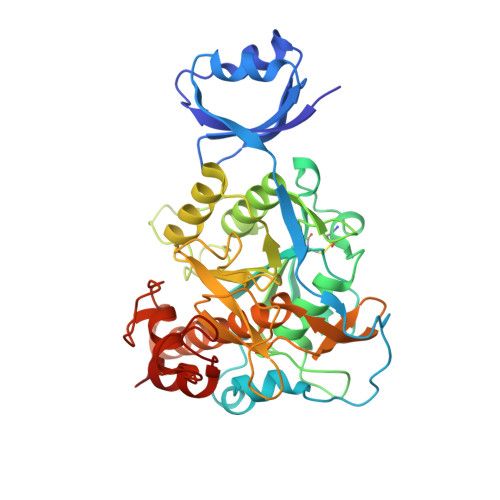
Crystal structure of unautoprocessed precursor of subtilisin from a hyperthermophilic archaeon: evidence for Ca2+-induced folding
Tanaka, S., Saito, K., Chon, H., Matsumura, H., Koga, Y., Takano, K., Kanaya, S.(2007) J Biol Chem 282: 8246-8255
- PubMed: 17237225 Search on PubMed
- DOI: https://doi.org/10.1074/jbc.M610137200
- Primary Citation Related Structures:
2E1P - PubMed Abstract:
The crystal structure of an active site mutant of pro-Tk-subtilisin (pro-S324A) from the hyperthermophilic archaeon Thermococcus kodakaraensis was determined at 2.3 A resolution. The overall structure of this protein is similar to those of bacterial subtilisin-propeptide complexes, except that the peptide bond linking the propeptide and mature domain contacts with the active site, and the mature domain contains six Ca2+ binding sites. The Ca-1 site is conserved in bacterial subtilisins but is formed prior to autoprocessing, unlike the corresponding sites of bacterial subtilisins. All other Ca2+-binding sites are unique in the pro-S324A structure and are located at the surface loops. Four of them apparently contribute to the stability of the central alphabetaalpha substructure of the mature domain. The CD spectra, 1-anilino-8-naphthalenesulfonic acid fluorescence spectra, and sensitivities to chymotryptic digestion of this protein indicate that the conformation of pro-S324A is changed from an unstable molten globule-like structure to a stable native one upon Ca2+ binding. Another active site mutant, pro-S324C, was shown to be autoprocessed to form a propeptide-mature domain complex in the presence of Ca2+. The CD spectra of this protein indicate that the structure of pro-S324C is changed upon Ca2+ binding like pro-S324A but is not seriously changed upon subsequent autoprocessing. These results suggest that the maturation process of Tk-subtilisin is different from that of bacterial subtilisins in terms of the requirement of Ca2+ for folding of the mature domain and completion of the folding process prior to autoprocessing.
- Department of Material and Life Science, Graduate School of Engineering, Osaka University, 2-1 Yamadaoka, Suita, Osaka 565-0871, Japan.
Organizational Affiliation: