2DY4 | pdb_00002dy4

Crystal structure of RB69 GP43 in complex with DNA containing Thymine Glycol


Experimental Data Snapshot

  • Method: X-RAY DIFFRACTION
  • Resolution: 2.65 Å
  • R-Value Free: 
    0.281 (Depositor), 0.278 (DCC) 
  • R-Value Work: 
    0.229 (Depositor), 0.226 (DCC) 

Starting Model: experimental
View more details

wwPDB Validation 3D Report Full Report

Validation slider image for 2DY4

This is version 1.7 of the entry. See complete history

Literature

A structural rationale for stalling of a replicative DNA polymerase at the most common oxidative thymine lesion, thymine glycol.

Aller, P.Rould, M.A.Hogg, M.Wallace, S.S.Doublie, S.

(2007) Proc Natl Acad Sci U S A 104: 814-818

  • DOI: https://doi.org/10.1073/pnas.0606648104
  • Primary Citation Related Structures: 
    2DY4

  • PubMed Abstract: 

    Thymine glycol (Tg) is a common product of oxidation and ionizing radiation, including that used for cancer treatment. Although Tg is a poor mutagenic lesion, it has been shown to present a strong block to both repair and replicative DNA polymerases. The 2.65-A crystal structure of a binary complex of the replicative RB69 DNA polymerase with DNA shows that the templating Tg is intrahelical and forms a regular Watson-Crick base pair with the incorporated A. The C5 methyl group protrudes axially from the ring of the damaged pyrimidine and hinders stacking of the adjacent 5' template guanine. The position of the displaced 5' template guanine is such that the next incoming nucleotide cannot be incorporated into the growing primer strand, and it explains why primer extension past the lesion is prohibited even though DNA polymerases can readily incorporate an A across from the Tg lesion.


  • Organizational Affiliation
    • Department of Microbiology and Molecular Genetics, Markey Center for Molecular Genetics, University of Vermont, 95 Carrigan Drive, Burlington, VT 05405, USA.

Macromolecule Content 

  • Total Structure Weight: 463.96 kDa 
  • Atom Count: 31,943 
  • Modeled Residue Count: 3,710 
  • Deposited Residue Count: 3,744 
  • Unique protein chains: 1
  • Unique nucleic acid chains: 2

Macromolecules


Find similar proteins by:|  3D Structure
Entity ID: 3
MoleculeChains  Sequence LengthOrganismDetailsImage
DNA polymeraseI [auth A],
J [auth B],
K [auth C],
L [auth D]
903Escherichia phage RB69Mutation(s): 2 
Gene Names: gp43
EC: 2.7.7.7 (PDB Primary Data), 3.1.11 (UniProt)
UniProt
Find proteins for Q38087 (Escherichia phage RB69)
Explore Q38087 
Go to UniProtKB:  Q38087
Entity Groups
Sequence Clusters30% Identity50% Identity70% Identity90% Identity95% Identity100% Identity
UniProt GroupQ38087
Sequence Annotations
Expand
Reference Sequence
Find similar nucleic acids by:  Sequence
Entity ID: 1
MoleculeChains LengthOrganismImage
5'-D(*CP*GP*(CTG)P*GP*GP*AP*AP*TP*GP*A*CP*AP*GP*CP*CP*GP*CP*G)-3'A [auth E],
C [auth G],
E [auth I],
G [auth K]
18N/A
Sequence Annotations
Expand
Reference Sequence
Find similar nucleic acids by:  Sequence
Entity ID: 2
MoleculeChains LengthOrganismImage
5'-D(*GP*CP*GP*GP*CP*TP*GP*T*CP*AP*TP*TP*CP*CP*A)-3'B [auth F],
D [auth H],
F [auth J],
H [auth L]
15N/A
Sequence Annotations
Expand
Reference Sequence

Small Molecules

Modified Residues  1 Unique
IDChains TypeFormula2D DiagramParent
MSE
Query on MSE
I [auth A],
J [auth B],
K [auth C],
L [auth D]
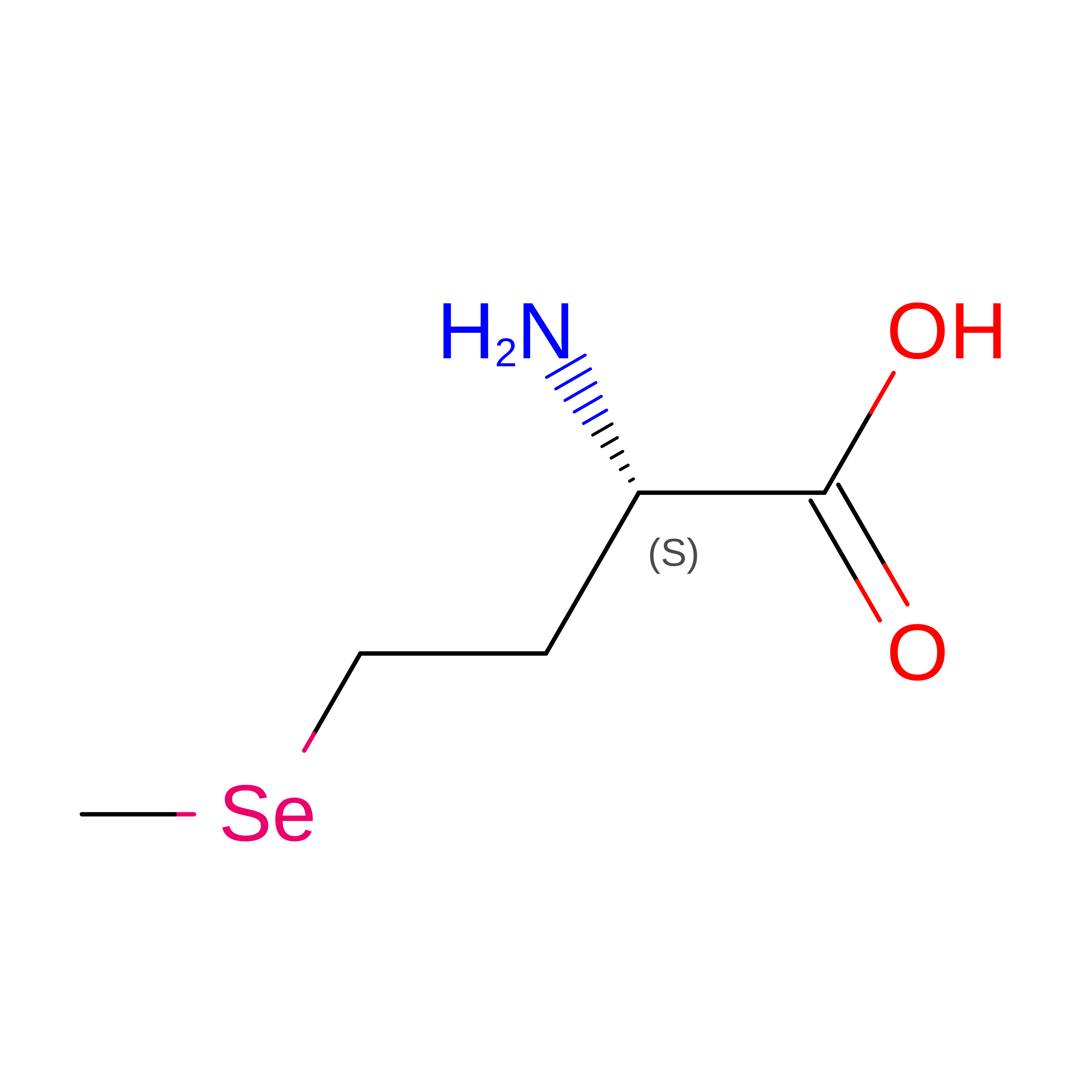
L-PEPTIDE LINKINGC5 H11 N O2 SeMET

Experimental Data & Validation

Experimental Data

  • Method: X-RAY DIFFRACTION
  • Resolution: 2.65 Å
  • R-Value Free:  0.281 (Depositor), 0.278 (DCC) 
  • R-Value Work:  0.229 (Depositor), 0.226 (DCC) 
Space Group: P 1 21 1
Unit Cell:
Length ( Å )Angle ( ˚ )
a = 132.612α = 90
b = 122.632β = 96.31
c = 168.695γ = 90
Software Package:
Software NamePurpose
DENZOdata reduction
SCALEPACKdata scaling
CNSrefinement
PDB_EXTRACTdata extraction
Blu-Icedata collection
HKL-2000data reduction
HKL-2000data scaling
CNSphasing

Structure Validation

View Full Validation Report


Entry History 

Deposition Data

Revision History  (Full details and data files)

  • Version 1.0: 2007-01-09
    Type: Initial release
  • Version 1.1: 2008-04-30
    Changes: Version format compliance
  • Version 1.2: 2011-07-13
    Changes: Version format compliance
  • Version 1.3: 2017-10-11
    Changes: Refinement description
  • Version 1.4: 2021-11-10
    Changes: Database references, Derived calculations
  • Version 1.5: 2023-10-25
    Changes: Data collection, Refinement description
  • Version 1.6: 2023-11-15
    Changes: Data collection
  • Version 1.7: 2024-10-23
    Changes: Structure summary