2DXI | pdb_00002dxi

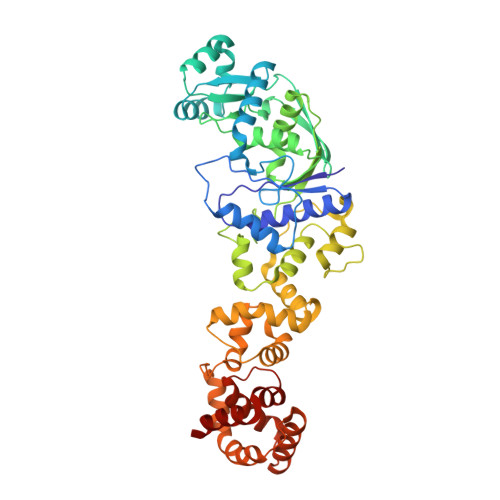
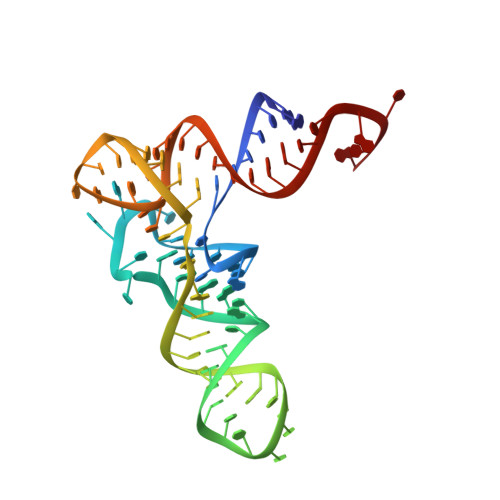
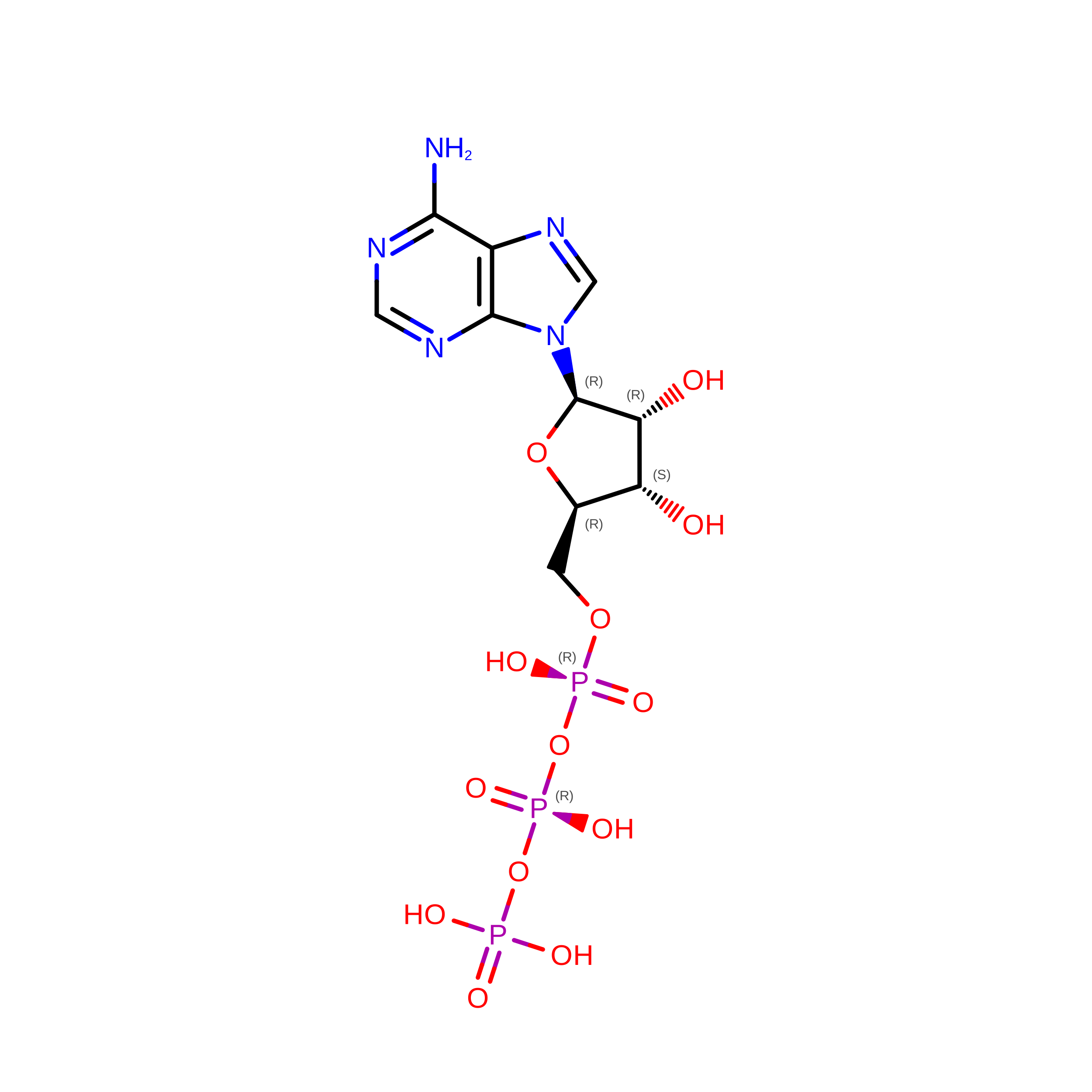
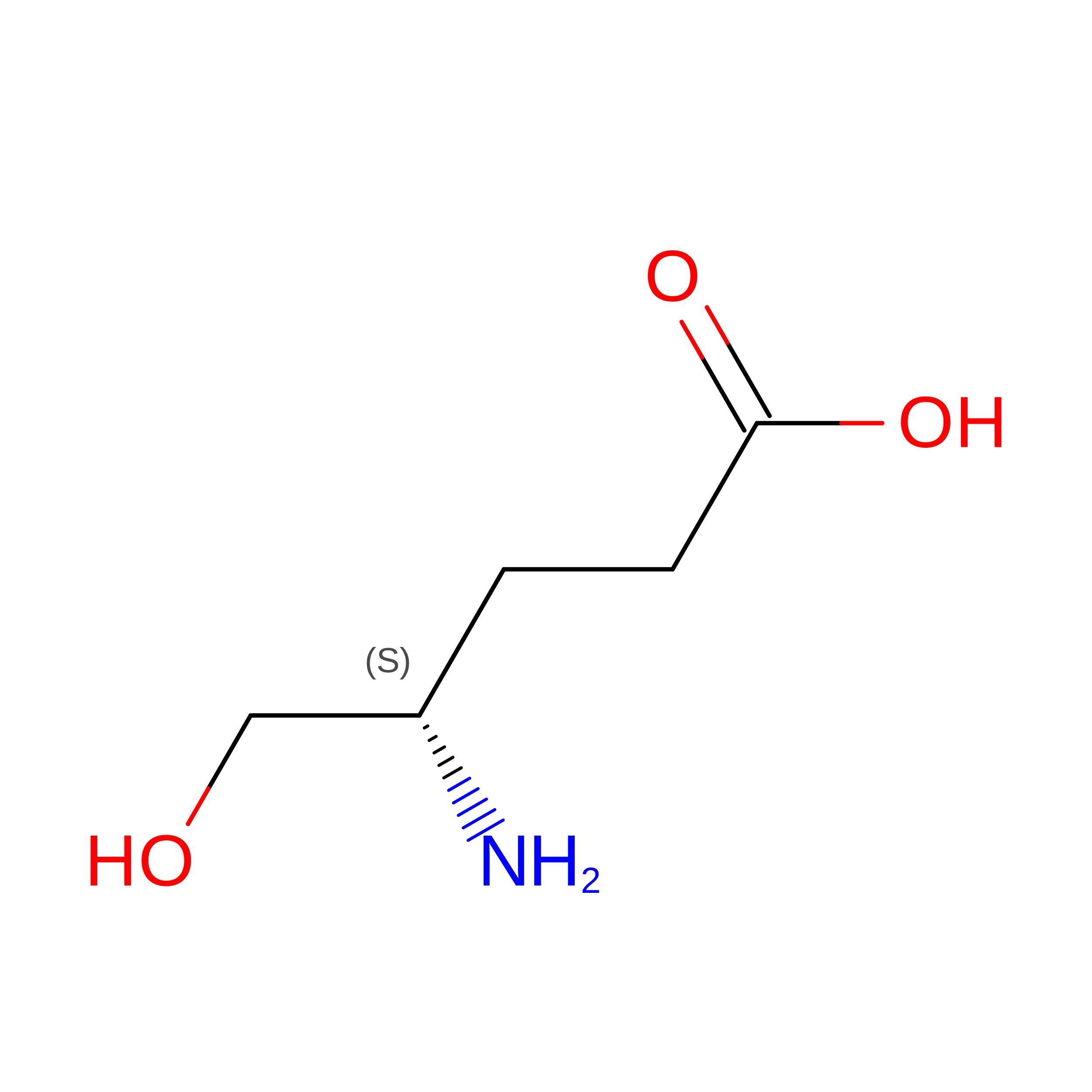
2.2 A crystal structure of glutamyl-tRNA synthetase from Thermus thermophilus complexed with tRNA(Glu), ATP, and L-glutamol


Experimental Data Snapshot

  • Method: X-RAY DIFFRACTION
  • Resolution: 2.20 Å
  • R-Value Free: 
    0.257 (Depositor), 0.259 (DCC) 
  • R-Value Work: 
    0.214 (Depositor), 0.215 (DCC) 
  • R-Value Observed: 
    0.214 (Depositor) 

Starting Model: experimental
View more details

wwPDB Validation 3D Report Full Report

Validation slider image for 2DXI

Ligand Structure Quality Assessment 


This is version 2.0 of the entry. See complete history

Literature

Structural bases of transfer RNA-dependent amino acid recognition and activation by glutamyl-tRNA synthetase

Sekine, S.Shichiri, M.Bernier, S.Chenevert, R.Lapointe, J.Yokoyama, S.

(2006) Structure 14: 1791-1799

  • DOI: https://doi.org/10.1016/j.str.2006.10.005
  • Primary Citation Related Structures: 
    2CUZ, 2CV0, 2CV2, 2DXI

  • PubMed Abstract: 

    Glutamyl-tRNA synthetase (GluRS) is one of the aminoacyl-tRNA synthetases that require the cognate tRNA for specific amino acid recognition and activation. We analyzed the role of tRNA in amino acid recognition by crystallography. In the GluRS*tRNA(Glu)*Glu structure, GluRS and tRNA(Glu) collaborate to form a highly complementary L-glutamate-binding site. This collaborative site is functional, as it is formed in the same manner in pretransition-state mimic, GluRS*tRNA(Glu)*ATP*Eol (a glutamate analog), and posttransition-state mimic, GluRS*tRNA(Glu)*ESA (a glutamyl-adenylate analog) structures. In contrast, in the GluRS*Glu structure, only GluRS forms the amino acid-binding site, which is defective and accounts for the binding of incorrect amino acids, such as D-glutamate and L-glutamine. Therefore, tRNA(Glu) is essential for formation of the completely functional binding site for L-glutamate. These structures, together with our previously described structures, reveal that tRNA plays a crucial role in accurate positioning of both L-glutamate and ATP, thus driving the amino acid activation.


  • Organizational Affiliation
    • Department of Biophysics and Biochemistry, Graduate School of Science, University of Tokyo, 7-3-1 Hongo, Bunkyo-ku, Tokyo 113-0033, Japan.

Macromolecule Content 

  • Total Structure Weight: 157.52 kDa 
  • Atom Count: 11,272 
  • Modeled Residue Count: 1,086 
  • Deposited Residue Count: 1,086 
  • Unique protein chains: 1
  • Unique nucleic acid chains: 1

Macromolecules


Find similar proteins by:|  3D Structure
Entity ID: 2
MoleculeChains  Sequence LengthOrganismDetailsImage
glutamyl-tRNA synthetaseC [auth A],
D [auth B]
468Thermus thermophilusMutation(s): 0 
EC: 6.1.1.17
UniProt
Find proteins for P27000 (Thermus thermophilus (strain ATCC 27634 / DSM 579 / HB8))
Explore P27000 
Go to UniProtKB:  P27000
Entity Groups
Sequence Clusters30% Identity50% Identity70% Identity90% Identity95% Identity100% Identity
UniProt GroupP27000
Sequence Annotations
Expand
Reference Sequence
Find similar nucleic acids by:  (by identity cutoff) 
Entity ID: 1
MoleculeChains LengthOrganismImage
tRNAA [auth C],
B [auth D]
75N/A
Sequence Annotations
Expand
Reference Sequence

Experimental Data & Validation

Experimental Data

  • Method: X-RAY DIFFRACTION
  • Resolution: 2.20 Å
  • R-Value Free:  0.257 (Depositor), 0.259 (DCC) 
  • R-Value Work:  0.214 (Depositor), 0.215 (DCC) 
  • R-Value Observed: 0.214 (Depositor) 
Space Group: C 2 2 21
Unit Cell:
Length ( Å )Angle ( ˚ )
a = 110.615α = 90
b = 219.119β = 90
c = 135.816γ = 90
Software Package:
Software NamePurpose
CNSrefinement
HKL-2000data collection
HKL-2000data reduction
SCALEPACKdata scaling
CNSphasing

Structure Validation

View Full Validation Report


Ligand Structure Quality Assessment 


Entry History 

Deposition Data

Revision History  (Full details and data files)

  • Version 1.0: 2006-10-31
    Type: Initial release
  • Version 1.1: 2008-04-30
    Changes: Version format compliance
  • Version 1.2: 2011-07-13
    Changes: Version format compliance
  • Version 1.3: 2023-10-25
    Changes: Data collection, Database references, Derived calculations, Refinement description
  • Version 2.0: 2023-11-15
    Changes: Atomic model, Data collection